

simply amazing, always for you.
Love, Lies, and Letdowns
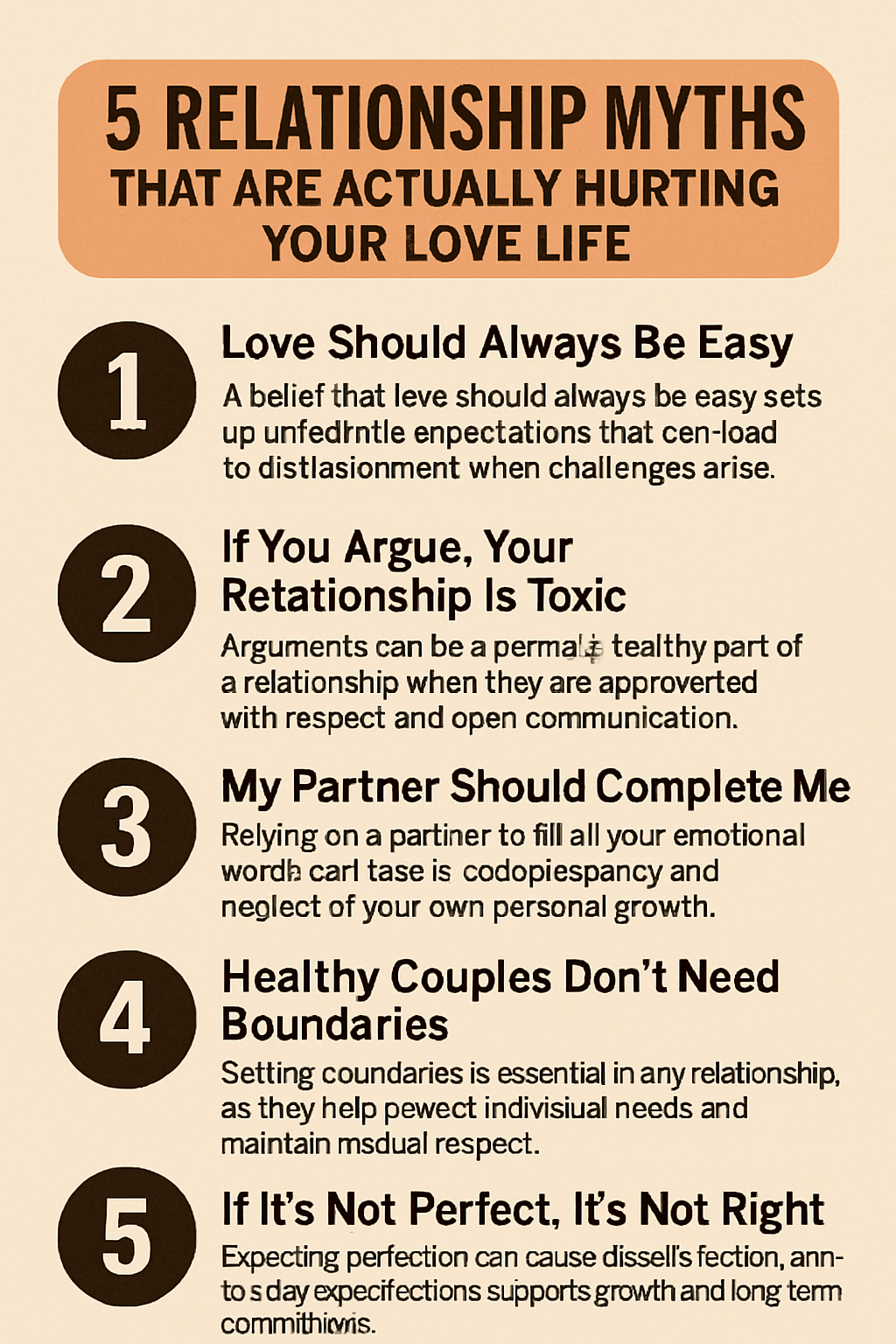
Love is one of the most discussed and desired experiences in human life. Yet despite all the conversation around relationships—through books, songs, movies, social media, and self-help seminars—many people are still being misled by persistent myths that quietly damage their love lives. These myths, while often wrapped in good intentions or romantic ideals, create unrealistic expectations that sabotage relationships from within.
In this in-depth guide, we break down five of the most common and harmful relationship myths. Each myth will be dissected and examined with psychological insight, real-life examples, and actionable advice, helping you uncover how these beliefs may be sabotaging your relationship—and what to do instead.
If you’ve ever wondered why relationships that look “perfect” on the outside eventually fall apart—or why your love life always feels harder than it should—this article is for you.
Myth 1: “Love Should Always Be Easy”
Where This Myth Comes From
We’ve all seen the Hollywood version: boy meets girl, instant chemistry, no friction, everything falls perfectly into place. It’s tempting to believe that real love should be smooth and magical 100% of the time. If it’s hard, we’re taught, maybe it just isn’t “meant to be.”
Why It’s Harmful
This myth sets people up for disillusionment. When challenges arise—as they inevitably will—one or both partners may interpret that as a sign of failure or incompatibility. Instead of learning and adapting together, they may walk away prematurely.
The Reality
Even the healthiest relationships go through hard seasons. Stress from work, family responsibilities, health concerns, emotional baggage, or even differences in communication styles can create friction. These moments are not indicators that love has vanished, but opportunities to deepen the bond.
Real-Life Example
Rachel and James had been together for three years when James lost his job. Financial pressure and self-esteem issues caused tension between them. Rachel started to wonder if they were no longer compatible. But after open conversations and couples counseling, they not only overcame the issue—they came out stronger, more connected, and more in tune with each other.
The Shift
Instead of seeing effort as a sign of failure, see it as a sign of commitment. Real love requires conscious investment, mutual understanding, and patience.
Takeaway Belief: “Love isn’t perfect—it’s practiced.”
Myth 2: “If You Argue, Your Relationship Is Toxic”
Where This Myth Comes From
The myth that conflict equals toxicity is perpetuated by romanticized ideals of harmony. We admire the couples who “never fight” and assume that conflict means something is wrong.
Why It’s Harmful
Couples who avoid conflict at all costs often end up sweeping issues under the rug. Unaddressed grievances build up over time, eroding trust, intimacy, and connection. Worse still, many people remain in passive-aggressive patterns or emotionally distant states because they’re afraid of “rocking the boat.”
The Reality
All couples argue. What differentiates healthy relationships from unhealthy ones is how they argue. Productive arguments can actually bring couples closer by fostering understanding and negotiation skills.
Psychological Insight
According to Dr. John Gottman, a renowned relationship researcher, it’s not the presence of conflict that predicts divorce—it’s the presence of contempt. Disagreements, when handled with mutual respect and empathy, can actually be beneficial.
Real-Life Example
Maria and Daniel disagreed constantly about parenting styles. Instead of shutting down or labeling their relationship toxic, they sought out a family therapist who helped them establish boundaries and find middle ground. They now co-parent with more unity and less resentment.
The Shift
Learn to argue constructively. Use “I” statements instead of “you” accusations. Focus on the issue, not the person. Create a safe space where both voices are heard.
Takeaway Belief: “Conflict handled well is a sign of a mature relationship.”
Myth 3: “My Partner Should Complete Me”
Where This Myth Comes From
Made famous by the line “You complete me” from Jerry Maguire, this myth romanticizes the idea that a partner should fill all your emotional voids, rescue you from unhappiness, and serve as your all-in-one emotional savior.
Why It’s Harmful
This belief leads to emotional dependency and unrealistic expectations. You may begin to place the responsibility of your personal happiness and identity on your partner, leading to imbalance and frustration.
The Reality
Healthy relationships are built between two whole people—not two halves trying to become one. Each person should have a sense of identity, purpose, and fulfillment outside the relationship.
Real-Life Example
Sam always felt incomplete when single and expected his partners to fill the emotional void. As a result, his relationships were intense but short-lived. When he finally focused on his own self-development—career, hobbies, therapy—he was able to enter a relationship from a place of wholeness rather than need.
The Shift
Seek partnership, not rescue. A healthy relationship is a bonus to your life, not the sole source of your joy.
Takeaway Belief: “A strong ‘me’ creates a stronger ‘we.’”
Myth 4: “Healthy Couples Don’t Need Boundaries”
Where This Myth Comes From
There’s a common misconception that true love means total openness, constant availability, and complete fusion of lives. Some even believe that setting boundaries is selfish or signals distrust.
Why It’s Harmful
Without boundaries, personal identity and autonomy erode. This often leads to emotional exhaustion, resentment, or even controlling behavior. Boundaries are not barriers—they are guidelines for sustainable connection.
The Reality
Healthy relationships are interdependent, not dependent. Each person has the right to personal space, privacy, emotional needs, and time apart. Boundaries actually create a safer and more respectful dynamic.
Psychological Insight
According to Dr. Brené Brown, boundaries are key to compassion. When people understand each other’s limits, trust deepens, and communication improves.
Real-Life Example
Ava needed quiet time after work to decompress, but her partner Max felt hurt when she didn’t immediately engage in conversation. After communicating her need for a 30-minute wind-down period, Max no longer took it personally, and they enjoyed more meaningful connection later in the evening.
The Shift
Normalize setting and respecting boundaries. These include emotional, physical, time-related, and digital boundaries.
Takeaway Belief: “Boundaries are the framework of mutual respect.”
Myth 5: “If It’s Not Perfect, It’s Not Right”
Where This Myth Comes From
Social media, rom-coms, and romantic novels often paint a picture of flawless love—sunsets, exotic vacations, passionate reunions, and effortless happiness. This feeds into the “perfectionist” myth of love.
Why It’s Harmful
When perfection becomes the goal, even small flaws feel like red flags. You may begin to question your partner’s worth, overanalyze every disagreement, or chase an illusion of a better relationship elsewhere.
The Reality
Real love is messy, evolving, and imperfect. People change. Circumstances shift. Long-term love isn’t about finding someone perfect—it’s about choosing someone, again and again, through each season of life.
Real-Life Example
Julie almost broke up with her partner because they didn’t share the same interests. But after reflecting and discussing openly, she realized that their emotional alignment, values, and respect were what truly mattered. Today, they thrive in their differences.
Psychological Insight
The concept of “ideal love” often conflicts with “real love.” Ideal love is based on fantasy and expectations; real love is built through consistency, forgiveness, and growth.
The Shift
Let go of the chase for perfection. Embrace progress over perfection, and gratitude over entitlement.
Takeaway Belief: “Real love grows in the soil of acceptance.”
Rewriting the Narrative of Love
Relationship myths are not just harmless beliefs—they’re often invisible saboteurs, quietly dictating how we show up in love. They color how we interpret conflict, how we respond to imperfection, and how we define success in our partnerships.
Letting go of these myths doesn’t mean lowering your standards or settling for less. It means building your love life on truth, empathy, and mutual effort—where both partners feel seen, respected, and free to grow.
No relationship is without struggle. But with realistic expectations, open communication, and a willingness to learn, you can cultivate a relationship that’s not just lasting—but fulfilling.
So here’s the question: Which of these myths have you unknowingly carried into your relationships—and how are you going to start rewriting your love story today?

Support Our Website!
We appreciate your visit and hope you find our content valuable. If you’d like to support us further, please consider contributing through the TILL NUMBER: 9549825. Your support helps us keep delivering great content!
If you’d like to support Nabado from outside Kenya, we invite you to send your contributions through trusted third-party services such as Remitly, SendWave, or WorldRemit. These platforms are reliable and convenient for international money transfers.
Please use the following details when sending your support:
Phone Number: +254701838999
Recipient Name: Peterson Getuma Okemwa
We sincerely appreciate your generosity and support. Thank you for being part of this journey!