

We aint done yet.. Expect another one.
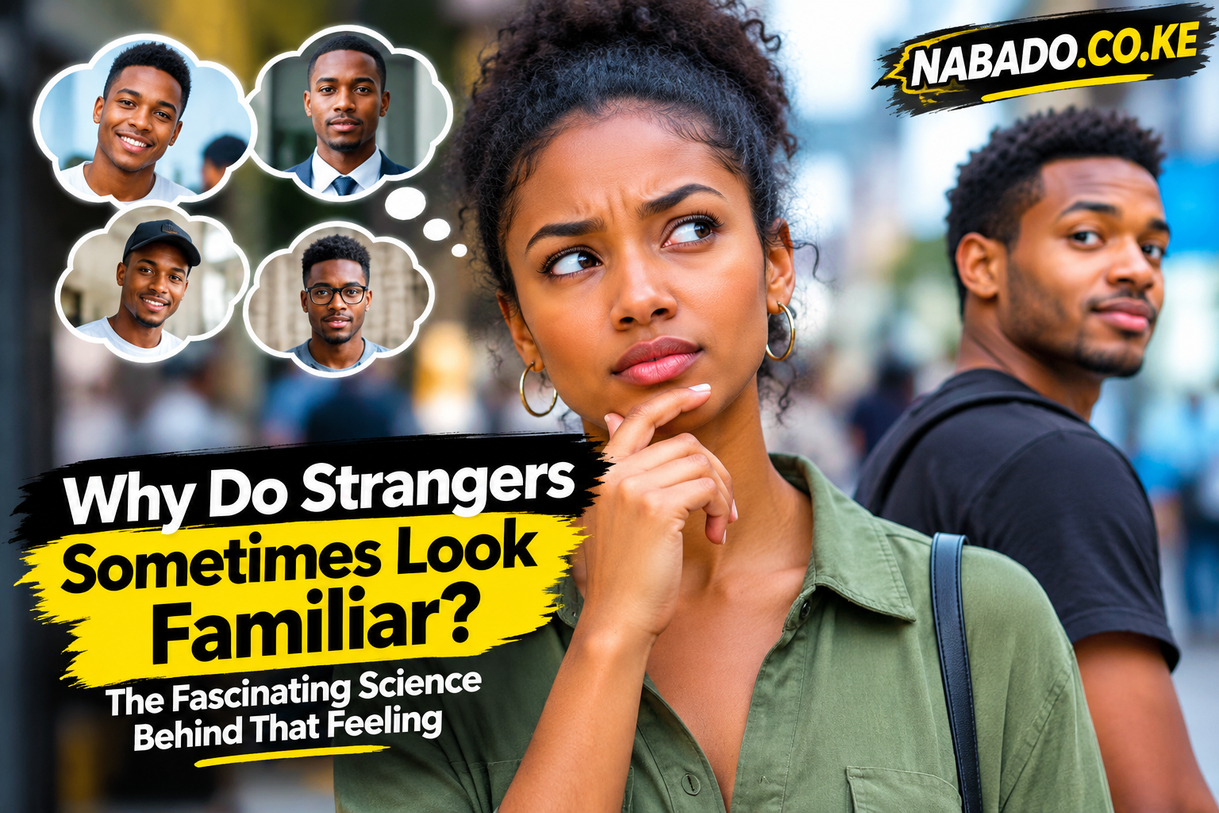
Have you ever looked at someone you’ve never met and immediately felt like you knew them?
Perhaps you were walking through a shopping centre, sitting in a bus, standing in a queue or scrolling through social media when a stranger suddenly caught your attention. Something about their face seemed incredibly familiar.
You might even have thought, “I know this person. But where from?”
Then you searched your memory and came up with nothing.
The strange thing is that the feeling can be extremely convincing. You may stare at the person’s face for a few seconds, trying to remember whether they were a former classmate, an old neighbour, a colleague or someone you once met years ago.
Eventually, you realize you probably have never met them.
So why does this happen?
The answer lies in the remarkable way the human brain processes faces, memories and familiarity. Our brains are constantly comparing what we see with information stored from previous experiences. Sometimes that system produces a feeling of recognition even when there is no clear memory attached to it.
The brain is constantly searching for familiar patterns
Humans are naturally good at recognizing patterns.
Every day, we encounter hundreds or even thousands of faces. Most of them disappear from our conscious memory almost immediately. However, our brains still process characteristics such as facial shape, eyes, nose, hairstyle, expressions, voice and body language.
When you meet someone new, your brain doesn’t simply ask, “Who is this person?”
It is also asking, often unconsciously:
“Does this person resemble anyone I’ve seen before?”
That comparison can happen incredibly quickly.
A stranger may have the same smile as an old friend, similar eyes to a former colleague or facial expressions that remind you of someone from your childhood.
You may not consciously identify the connection, but your brain can still detect it.
The result is that powerful feeling of familiarity.
Familiarity is not the same as recognition
One of the most important things to understand is that feeling familiar with someone is not the same as actually recognizing them.
Recognition usually involves being able to identify the person and retrieve information about them.
For example:
“That’s John. We went to university together.”
Familiarity is different.
It may simply feel like:
“I’ve seen this person somewhere before.”
You may have no idea where, when or even whether you actually encountered them.
The brain can therefore generate a sense of familiarity without producing a specific memory.
This is one reason people sometimes become convinced that a stranger is someone they know.
You may have actually seen the stranger before
There is another possibility: you really have encountered the person before, but you don’t remember doing so.
Think about how many people you pass during a normal week.
You might see the same person:
- On your daily commute
- At a supermarket
- In an office building
- At a restaurant
- At a gym
- At school
- In your neighbourhood
- At a shopping centre
- At a public event
You may never have spoken to them.
Your brain could nevertheless have registered their face.
Later, when you see them again, the stored information may trigger a vague sense of familiarity.
The problem is that the original memory may be too weak to consciously retrieve.
This can create a peculiar experience: your brain recognizes something that your conscious mind cannot explain.
The mysterious power of unconscious memory
Not every experience we have becomes a conscious memory.
You can walk past hundreds of people without remembering their faces. Nevertheless, your brain is continuously processing visual information.
Some of that information can influence future reactions without you consciously remembering the original experience.
This is sometimes described as implicit memory.
Implicit memory refers broadly to situations where previous experiences influence behaviour or perception without requiring conscious recollection.
This helps explain why something can feel familiar even when you cannot say exactly why.
You might not remember seeing a stranger last month, but your brain could still retain enough information to produce that strange sense of recognition.
Why facial features can fool the brain
Human faces contain many individual features.
The brain evaluates combinations of these features rather than treating every face as completely unique.
For example, two unrelated people might share:
- Similar eye shape
- Similar eyebrows
- Similar cheekbones
- Similar jawlines
- Similar noses
- Similar smiles
- Similar hairstyles
- Similar facial expressions
Neither person needs to be an exact look-alike.
A handful of similarities can be enough to activate memories of someone else.
You may therefore look at a stranger and think, “He looks like my old teacher,” even though the resemblance is only noticeable in certain circumstances.
Sometimes the voice makes a stranger seem familiar
It isn’t always about the face.
A stranger’s voice can produce exactly the same reaction.
You may hear someone speak and suddenly think their voice sounds like an old friend, relative, colleague or celebrity.
The same thing can happen with accents, laughter, speech patterns or particular phrases.
Your brain combines information from different senses. A person’s face, voice, movements and mannerisms can collectively create a strong impression of familiarity.
A stranger might look unfamiliar when silent but seem strangely familiar the moment they begin talking.
Body language can trigger memories too
Humans don’t just recognize faces.
We recognize ways of moving.
Someone might walk in a particular way, tilt their head while speaking, gesture with their hands or laugh in a distinctive manner.
These behaviours can remind you of another person.
You may therefore experience familiarity even when the stranger’s facial features aren’t particularly similar to anyone you know.
The brain is looking at the entire person, not just their face.
This is where déjà vu enters the picture
The experience can sometimes resemble déjà vu.
Déjà vu is the strange sensation that you have experienced a current situation before, even though you know—or strongly suspect—that you haven’t.
A similar feeling can occur with people.
You may meet someone for the first time and suddenly feel as though you have encountered them previously.
However, it is important not to automatically interpret this as proof of a supernatural event, a past-life connection or some hidden memory.
There are ordinary psychological mechanisms that can create powerful feelings of familiarity.
The human brain is capable of producing convincing experiences without the conscious mind knowing exactly where they originated.
Why the feeling can be so strong
You might wonder why a simple resemblance can create such a powerful reaction.
One reason is that familiarity is an important survival mechanism.
For much of human history, recognizing people quickly mattered.
Knowing whether someone was a family member, friend, stranger or potential threat could have had serious consequences.
The brain therefore became extremely efficient at detecting familiar patterns.
Modern humans still have this system.
The difference is that we now encounter vastly more people than our ancestors did.
Instead of living among a relatively small community, we can interact with thousands of strangers throughout our lives.
Our brains are consequently exposed to an enormous variety of faces.
Occasionally, the matching system produces a false alarm.
False familiarity is surprisingly normal
Feeling that someone looks familiar does not necessarily mean there is something unusual happening.
It is a normal feature of human perception.
The brain works with incomplete information. It makes rapid judgments and predictions rather than carefully examining every detail.
Imagine seeing someone from a distance.
You might recognize their hairstyle, clothing and posture before you can clearly see their face.
Your brain starts forming a prediction about who they might be.
Then you get closer and realize:
“Wait, that’s not the person I thought it was.”
The same process can happen with unfamiliar faces.
Why childhood memories can play a role
Sometimes a stranger reminds you of someone from many years ago.
This can be particularly confusing because the original memory may be buried deep in your personal history.
Perhaps the stranger resembles a childhood friend you haven’t seen since primary school.
Maybe they have the same smile as a relative or the same facial expression as a teacher you once knew.
You may not consciously remember the original person’s face in detail.
But when a new face contains similar characteristics, your brain can activate that old association.
The conscious reaction may simply be:
“There’s something about this person.”
Familiarity can come from photographs and media
You don’t necessarily have to have met someone in real life for their appearance to feel familiar.
People see enormous numbers of faces through:
- Television
- Films
- News reports
- Social media
- Advertisements
- School materials
- Websites
- Photographs
A stranger may resemble a person you have seen repeatedly on a screen.
You may not remember the original face consciously, but repeated exposure can make certain facial patterns feel familiar.
This is especially relevant in today’s digital world, where people are constantly exposed to faces from around the globe.
Why we sometimes think strangers are celebrities
Have you ever looked at someone and thought they looked like a famous actor, musician or athlete?
This happens because the brain is constantly comparing faces with stored representations.
The stranger doesn’t necessarily look exactly like the celebrity.
Perhaps they share a hairstyle, facial structure, beard, smile or expression.
The brain notices the similarities and generates an association.
For a moment, the stranger becomes mentally connected with a familiar face.
The brain doesn’t always explain its decisions
One of the fascinating things about perception is that we often experience the result without knowing the process that produced it.
You don’t consciously calculate the distance between someone’s eyes or analyze the exact shape of their jaw.
The brain does much of this automatically.
You simply experience the final impression:
“This person looks familiar.”
Trying to explain that feeling afterward can therefore be difficult.
The information that produced the impression may have been processed outside conscious awareness.
Why the feeling disappears after a conversation
Sometimes the familiarity disappears once you actually interact with the stranger.
You may initially think:
“I definitely know this person.”
Then they speak.
Their voice doesn’t match your memory. Their personality is different. Their story doesn’t fit. You realize you have probably never met them.
What happened?
Your brain initially made a prediction based on limited visual information.
More information arrived and corrected the prediction.
This is a normal part of perception.
The brain constantly updates its interpretation as new evidence becomes available.
Could the stranger actually be related to you?
Occasionally, a striking resemblance may have a biological explanation.
Relatives can share facial characteristics because of inherited genes.
You might therefore encounter someone who resembles a distant relative without immediately knowing the connection.
However, a similar appearance alone isn’t enough to establish a family relationship.
Humans naturally share many facial characteristics, so resemblance can occur by chance.
If a stranger looks remarkably like someone in your family, the resemblance may be interesting—but it isn’t automatically evidence of shared ancestry.
Why some faces are easier to remember
Not all faces are equally memorable.
Distinctive faces tend to stand out.
Someone with an unusual hairstyle, distinctive facial structure or particularly expressive face may be easier to remember than someone whose features blend into the crowd.
This can influence feelings of familiarity.
If a stranger happens to share several characteristics with a memorable person from your past, the association may become especially strong.
Stress, fatigue and attention can affect perception
Your mental state can also influence how you perceive familiarity.
When you’re tired, distracted or overwhelmed, you may pay less conscious attention to faces.
Later, you might experience a vague familiarity without being able to remember where you saw someone.
Likewise, when you’re walking through a crowded environment, your brain has to process enormous amounts of information quickly.
It cannot consciously record every face.
Instead, it relies on shortcuts and pattern recognition.
Those shortcuts are usually useful—but occasionally misleading.
Is it possible to confuse familiarity with intuition?
Absolutely.
People sometimes describe the experience as intuition.
They might say:
“Something told me I knew that person.”
The feeling itself is genuine.
But the explanation may be psychological rather than mysterious.
Intuition often comes from the brain recognizing patterns before conscious reasoning catches up.
In this case, the brain might detect similarities in someone’s appearance, voice or behaviour without you consciously identifying them.
That can feel like intuition because you experience the conclusion before you understand the evidence.
When should you be concerned?
Occasionally feeling that strangers look familiar is generally nothing to worry about.
It is a normal feature of memory and perception.
However, if someone experiences persistent or severe problems recognizing familiar people, becomes frequently confused about identities, or develops sudden changes in memory or perception, that is different from occasionally thinking a stranger looks familiar.
Significant changes in recognition or memory can have many possible causes and may warrant discussion with a healthcare professional.
For most people, however, the occasional “Have I met you before?” feeling is simply part of being human.
The fascinating truth about familiar strangers
The next time a stranger catches your attention because they look oddly familiar, don’t immediately assume you’ve forgotten meeting them.
Your brain may simply be doing what it does best: finding patterns.
Perhaps they resemble an old friend.
Perhaps you saw them months ago without realizing it.
Perhaps their eyes remind you of a family member.
Perhaps their voice sounds like someone from your past.
Or perhaps your brain has simply found enough similarities between this stranger and people stored in your memory to produce a convincing feeling of recognition.
And that is what makes the experience so fascinating.
We often think of memory as a collection of photographs stored inside the brain.
In reality, memory and perception are much more complicated.
The brain is constantly comparing the present with the past, filling gaps, making predictions and deciding what feels familiar.
Sometimes it gets the answer exactly right.
Sometimes it doesn’t.
But that mysterious moment when you look at a complete stranger and think, “I swear I’ve seen you before,” is a small glimpse into just how sophisticated—and occasionally imperfect—the human mind really is.
A familiar-looking stranger doesn’t necessarily represent a forgotten encounter or some unexplained connection. More often, it is the result of the brain matching facial features, voices, movements and memories at extraordinary speed
. The feeling of familiarity is real.
The person may still be a stranger.
And perhaps the most fascinating part is that your brain can know something feels familiar without being able to tell you exactly why.
SUGGESTED READS
- Africa’s Social Media Obsession: The Countries Spending More of Their Lives Online
- The World’s Most Expensive Trees: Why Agarwood Is Worth More Than Gold
- Lost Your KCSE Certificate? Here’s How to Download It Online in Minutes
- How to Register and Run for President in Kenya
- You’re Probably Spiritually Drained — Here Are the Signs Most People Ignore
- Meet the 10 Wealthiest Banks in the World Dominating Global Finance
- The Great Shift: Why the World Is Choosing Experiences Over Possessions

Support Our Website!
We appreciate your visit and hope you find our content valuable. If you’d like to support us further, please consider contributing through the TILL NUMBER: 9549825. Your support helps us keep delivering great content!
If you’d like to support Nabado from outside Kenya, we invite you to send your contributions through trusted third-party services such as Remitly, western union, SendWave, or WorldRemit. These platforms are reliable and convenient for international money transfers.
Please use the following details when sending your support:
Phone Number: +254701838999
Recipient Name: Peterson Getuma Okemwa
We sincerely appreciate your generosity and support. Thank you for being part of this journey!