

We aint done yet… Expect another one.
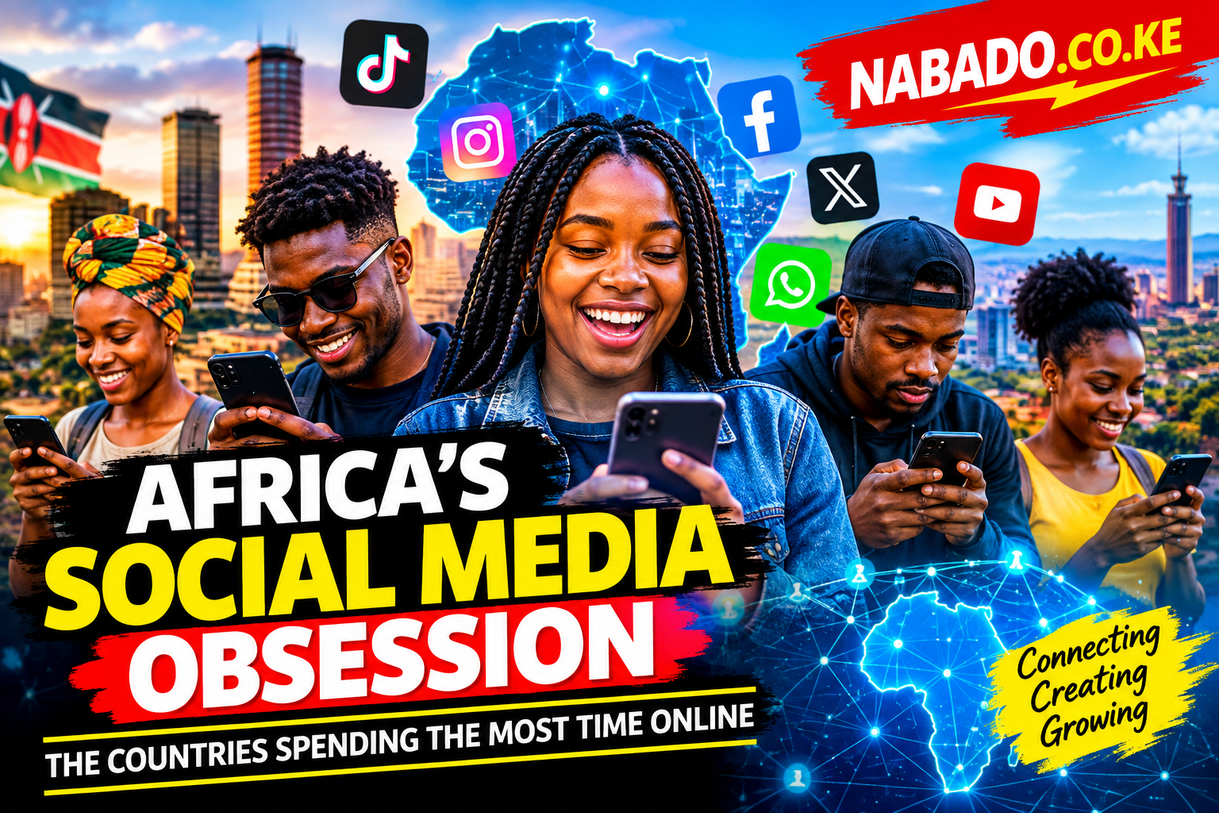
Social media is no longer something Africans simply use for entertainment. Across the continent, it has become part of everyday life.
People wake up and check WhatsApp messages before getting out of bed. They scroll through TikTok while commuting, follow breaking news on X, watch YouTube during lunch and spend their evenings moving between Facebook, Instagram and other platforms.
For millions of Africans, the smartphone has become a newspaper, television, radio, marketplace and social meeting place rolled into one.
But which African countries are most immersed in social media?
There is no scientifically accepted ranking of African countries by “social-media addiction.” Having millions of users does not automatically mean those people are addicted. However, digital-use statistics reveal which countries have some of the continent’s largest and most deeply connected social-media audiences.
Recent digital data puts countries such as Egypt, Nigeria, South Africa, Kenya and Ghana firmly among Africa’s major social-media markets.
And behind those numbers is a much bigger story about how the internet is changing African society.
Egypt Has One of Africa’s Biggest Social-Media Audiences
Egypt stands out because of the enormous size of its digital population.
Recent figures from DataReportal put Egypt at approximately 51.6 million social-media user identities in October 2025.
That makes the North African country one of the continent’s biggest social-media markets.
Egypt also has a huge internet population, meaning social platforms can reach tens of millions of people almost instantly.
Facebook remains important, while YouTube, Instagram and TikTok have become major destinations for entertainment, news and online personalities.
Social media has also changed how Egyptian businesses communicate with customers.
A small business does not necessarily need a large advertising budget or a traditional media campaign. A compelling video, photograph or post can potentially reach thousands of prospective customers.
For young Egyptians in particular, social media has become a major part of popular culture.
Nigeria’s Social-Media Culture Is Impossible to Ignore
Nigeria is another giant of Africa’s digital revolution.
The country had approximately 47.8 million social-media user identities in October 2025, according to DataReportal.
But the importance of social media in Nigeria cannot be understood simply by looking at the number of accounts.
Nigeria has developed one of Africa’s most influential online entertainment cultures.
Afrobeats stars, comedians, actors, influencers and entrepreneurs regularly use social platforms to communicate directly with millions of followers.
A new song can be promoted online within minutes.
A comedian can build an audience without appearing on national television.
A small business can attract customers through Instagram or TikTok.
And a political statement can trigger a nationwide online debate almost immediately.
Nigeria’s enormous youth population has helped accelerate this transformation.
For many young Nigerians, social media is not just somewhere to consume content. It is also a place to build a career.
South Africa Has a Highly Connected Digital Population
South Africa is another country where social media has become deeply embedded in everyday life.
DataReportal reported approximately 29.1 million social-media user identities in the country in October 2025.
The country also had more than 50 million internet users.
That high level of connectivity has helped create a sophisticated digital economy.
South African businesses increasingly use social platforms for marketing, customer service and brand building.
News organizations distribute stories through social networks. Musicians promote new releases online. Influencers collaborate with companies, while ordinary users use platforms to communicate with friends and family.
For many South Africans, social media has become part of the normal information cycle.
A person may hear about an event on social media before seeing it on television or reading about it on a news website.
Kenya’s Social-Media Addiction Debate
Kenya has also experienced a remarkable growth in social-media use.
Recent DataReportal figures recorded approximately 18.4 million social-media user identities in Kenya in October 2025.
Kenya’s social-media environment is particularly dynamic.
WhatsApp remains one of the country’s most important communication tools, while Facebook, TikTok, Instagram, YouTube and X attract large audiences.
Kenyan social media can move extremely quickly.
A political speech can become a trending discussion.
A football match can dominate online conversations.
A celebrity’s photograph can generate thousands of comments.
A funny video can spread from one platform to another within hours.
And breaking news can reach mobile-phone users almost immediately.
This has created both opportunities and problems.
On the positive side, Kenyan entrepreneurs can advertise products cheaply, creators can build audiences and young people can find information and opportunities that were previously difficult to access.
On the negative side, misinformation, online harassment and excessive screen time are growing concerns.
Ghana’s Online Community Continues to Grow
Ghana is another important player in Africa’s digital transformation.
DataReportal reported approximately 8.59 million social-media user identities in Ghana in October 2025.
The country had a much larger internet-user population, showing that not every person who goes online necessarily maintains or actively uses a social-media account.
Ghana’s social-media scene is particularly influential in entertainment, business and youth culture.
Musicians, comedians, entrepreneurs and influencers increasingly depend on social platforms to reach audiences.
Social media has therefore become part of Ghana’s emerging digital economy.
What Does “Social Media Addiction” Actually Mean?
The word “addiction” is often used casually when talking about people who spend hours scrolling.
But there is an important distinction between heavy social-media use and problematic use.
Someone can spend several hours on social media because it is part of their job.
A journalist may spend much of the day monitoring social networks.
An influencer may need to create and respond to content.
A business owner may use social media to communicate with customers.
That does not automatically mean the person is addicted.
Problematic social-media use is more concerning when a person repeatedly feels unable to control their behavior and continues using platforms despite negative consequences.
For example, someone may intend to spend ten minutes online but repeatedly ends up scrolling for hours.
Another person may stay awake deep into the night because they cannot stop checking videos, messages or notifications.
Someone else may become extremely anxious when separated from their phone.
These behaviors are more meaningful indicators of a potential problem than simply having a large number of followers.
Why Is Social Media So Difficult to Stop Using?
One reason social platforms are so powerful is that they are designed to keep users engaged.
Open TikTok and another video appears automatically.
Scroll Instagram and another photograph or reel replaces the previous one.
Check Facebook and there is another post waiting.
On YouTube, one video leads directly to another recommendation.
The user does not have to make a fresh decision every time.
There is also the unpredictable nature of online rewards.
One post might receive little attention.
Another might suddenly receive hundreds of likes.
A video might receive ten views today and thousands tomorrow.
A message could arrive at any moment.
That unpredictability encourages people to keep checking.
The result can be a cycle that looks something like this:
Check phone → find new content → receive a reward → continue scrolling → repeat.
Before someone realizes it, an hour may have disappeared.
Africa’s Young Population Is Driving the Social-Media Boom
Africa has one of the youngest populations in the world.
That demographic reality is important because young people have embraced smartphones and social platforms at extraordinary speed.
A teenager with a smartphone can now create a video and potentially reach an international audience.
A musician can promote a song without relying entirely on a record label.
A comedian can develop a following without appearing on television.
A young entrepreneur can showcase products without renting a physical shop.
This has fundamentally changed who gets to participate in the media economy.
In the past, large audiences were largely controlled by television networks, newspapers and radio stations.
Today, an individual with a smartphone can become a publisher.
TikTok Has Changed the Game
Few platforms have transformed online entertainment as dramatically as TikTok.
Its short-video format is particularly attractive to younger users.
The platform allows ordinary people to participate in trends, music, comedy, education and storytelling.
African creators have used it to showcase local languages, dances, fashion, food, music and everyday life.
A creator in Nairobi can reach viewers in Lagos.
Someone in Accra can attract followers in Johannesburg.
A musician in Nigeria can gain listeners across the continent.
The geographical boundaries of African entertainment are becoming increasingly blurred.
WhatsApp Is More Than a Messaging App
When discussing social-media use in Africa, WhatsApp deserves special attention.
For many people, WhatsApp is not simply an app for sending messages.
It can function as a community center, business platform and news-distribution network.
Families use group chats to stay connected.
Businesses communicate with customers.
Churches, schools, professional groups and community organizations create groups for their members.
Small traders advertise products through status updates.
Friends share news, photographs and videos.
This makes messaging platforms particularly important in understanding Africa’s digital behavior.
Social Media Has Created Real Economic Opportunities
It would be unfair to portray social media entirely as a problem.
For millions of Africans, digital platforms have created opportunities that did not exist before.
A small business can reach customers without buying expensive television advertising.
A fashion designer can display products to potential buyers.
A photographer can build a portfolio.
A musician can promote music.
A writer can develop an audience.
A content creator can potentially earn income from a large following.
Social media has lowered the barrier to entry into the digital economy.
Someone does not necessarily need a wealthy investor or a powerful media company to get started.
Sometimes, a smartphone and an internet connection are enough.
But There Is a Dark Side
The same platforms creating opportunities can also create serious problems.
Misinformation can spread rapidly.
False claims can be shared thousands of times before they are corrected.
Scammers can use social media to target unsuspecting users.
Cyberbullying can affect young people.
Online arguments can become abusive.
And the constant comparison with other people’s carefully edited lives can affect how users view themselves.
A person scrolling through social media may see someone else’s expensive car, holiday, relationship, body or successful business and begin wondering why their own life does not look the same.
The reality, of course, is that social media rarely shows the complete picture.
People generally post the moments they want others to see.
The Mental Cost of Constant Connectivity
One of the biggest concerns surrounding excessive social-media use is the inability to disconnect.
A person may sit down for dinner but continue checking notifications.
They may be talking to a friend while simultaneously scrolling through their phone.
They may wake up during the night and immediately reach for the device.
Over time, this can interfere with sleep, concentration and real-world relationships.
The problem is not necessarily social media itself.
The problem can be the inability to control how much attention it receives.
Which African Country Is Really the Most Addicted?
There is no definitive answer.
Existing digital statistics cannot diagnose an entire country’s population with social-media addiction.
They can, however, show where social-media audiences are particularly large.
Based on recent figures, Egypt, Nigeria, South Africa and Kenya are among the major social-media markets highlighted by their large user populations.
But population size matters.
Nigeria and Egypt have enormous populations, so their total number of social-media users will naturally be higher than countries with smaller populations.
That is why comparing countries requires more than simply counting accounts.
Researchers would ideally examine factors such as:
- Average daily time spent on social media
- Frequency of checking social platforms
- Number of active users
- Platform penetration
- Problematic-use behaviors
- Impact on sleep and work
- Age and demographic differences
Without those measurements, calling one country “the most addicted” would be more sensational than scientific.
Africa’s Digital Future Will Be Even Bigger
The social-media revolution is still developing.
As smartphone ownership increases, internet infrastructure expands and mobile data becomes more accessible, millions more Africans will join the digital world.
Social platforms are likely to become even more important for commerce, entertainment, politics, education and communication.
The challenge will be finding a healthy balance.
Social media can connect people across enormous distances.
It can give unknown creators a global audience.
It can help small businesses find customers.
It can expose people to ideas and information they might never encounter otherwise.
But it can also consume enormous amounts of time.
The most important question may therefore not be which African country is addicted to social media.
It may be whether individuals can remain in control of their attention while living in an increasingly connected world.
Because ultimately, the number of followers on a screen matters less than what happens when the screen is turned off.
Africa’s social-media story is not simply a story about addiction.
It is a story about a continent rapidly changing how it communicates, does business, creates entertainment and understands the world.
And that transformation is only beginning.
SUGGESTED READS
- The World’s Most Expensive Trees: Why Agarwood Is Worth More Than Gold
- Lost Your KCSE Certificate? Here’s How to Download It Online in Minutes
- How to Register and Run for President in Kenya
- You’re Probably Spiritually Drained — Here Are the Signs Most People Ignore
- Meet the 10 Wealthiest Banks in the World Dominating Global Finance
- The Great Shift: Why the World Is Choosing Experiences Over Possessions

Support Our Website!
We appreciate your visit and hope you find our content valuable. If you’d like to support us further, please consider contributing through the TILL NUMBER: 9549825. Your support helps us keep delivering great content!
If you’d like to support Nabado from outside Kenya, we invite you to send your contributions through trusted third-party services such as Remitly, western union, SendWave, or WorldRemit. These platforms are reliable and convenient for international money transfers.
Please use the following details when sending your support:
Phone Number: +254701838999
Recipient Name: Peterson Getuma Okemwa
We sincerely appreciate your generosity and support. Thank you for being part of this journey!