

We aint done yet… Expect another one.
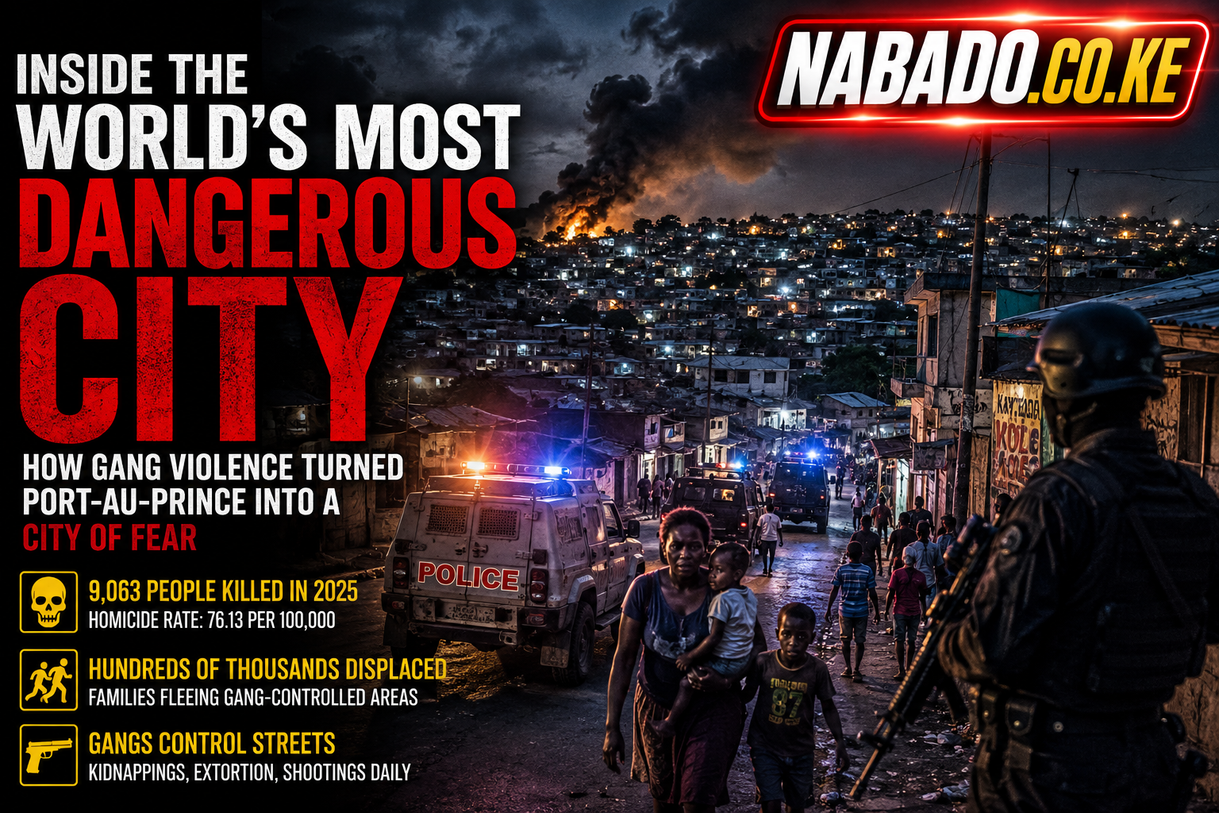
Port-au-Prince, Haiti, has become synonymous with extreme violence, gang control and displacement. Behind the alarming statistics are families struggling to work, children unable to attend school and communities fighting to survive.
For many people, a city represents opportunity.
It is where families build homes, businesses open their doors, children go to school and workers leave each morning hoping to earn enough to support those they love.
But in Port-au-Prince, Haiti, the meaning of everyday life has changed dramatically.
The Haitian capital has become one of the world’s most dangerous urban environments as heavily armed gangs have expanded their control, violent clashes have intensified and thousands of residents have been forced from their homes.
The crisis has gone far beyond conventional street crime.
Entire neighbourhoods have been caught up in battles for territory. Roads have become dangerous. Businesses have been forced to close. Schools and hospitals have struggled to operate. Families have fled with whatever belongings they could carry.
For residents, danger is no longer something that happens somewhere else.
It can be outside the front door.
Why Port-au-Prince Is Considered One of the World’s Most Dangerous Cities
There is no single official ranking that permanently determines which city is the “most dangerous” in the world.
Different organisations use different measurements. Some focus on homicide rates, while others consider violent crime, kidnappings, insecurity and public perceptions.
Port-au-Prince nevertheless stands out because of the extraordinary scale of violence affecting Haiti’s capital and surrounding areas.
The city has been at the heart of Haiti’s prolonged security crisis, with powerful criminal groups fighting for influence and control.
The result is a city where normal routines can be disrupted with frightening speed.
A road used by commuters one day may become inaccessible the next.
A neighbourhood that once had functioning businesses may suddenly be abandoned.
Families who have lived in the same community for years can find themselves packing their possessions and searching for somewhere safer.
Gang Violence Has Changed Daily Life
The most disturbing part of the crisis is the growing influence of armed gangs.
Gang organisations have developed significant territorial power in parts of the capital. Their activities have included shootings, kidnappings, extortion and attacks on communities and infrastructure.
Some groups have also formed alliances, increasing their ability to coordinate attacks and challenge government authority.
For ordinary residents, this creates an atmosphere of constant uncertainty.
People have to consider which roads are safe before travelling.
Parents worry about sending children to school.
Business owners face the possibility of losing their livelihoods.
Workers can be trapped at home when insecurity makes transportation too dangerous.
The psychological effect is enormous.
Living under the possibility of sudden violence can create a permanent state of fear, particularly for children and vulnerable families.
Thousands of Families Have Been Forced to Flee
One of the clearest signs of the crisis is the number of people who have been displaced.
When gangs seize territory or fighting erupts, residents often have little choice but to leave.
Some families flee to other parts of Haiti.
Others seek shelter with relatives or in temporary displacement sites.
Many leave behind homes, businesses, schools and entire communities.
Displacement also creates a second crisis.
People who escape violence may suddenly have nowhere to work, limited access to healthcare and little money to buy food.
Children can lose access to education.
Families that were already struggling financially can become even more vulnerable.
For many Haitians, escaping violence does not mean the crisis is over.
It simply means starting another difficult chapter somewhere else.
The Human Cost Behind the Numbers
Statistics can make violence seem distant.
But every homicide represents a person who had a family, friends, ambitions and a future.
United Nations reporting has documented thousands of killings across Haiti, with the overwhelming concentration of violence occurring in areas including the West Department, where Port-au-Prince is located.
The figures demonstrate the seriousness of the country’s security breakdown.
But the real impact is much larger than the number of people killed.
There are also people who survive shootings with life-changing injuries.
There are families separated by displacement.
There are businesses destroyed by violence.
There are children growing up surrounded by fear.
And there are communities attempting to rebuild normal lives while knowing that another outbreak of violence could occur at any time.
Women and Children Are Among the Most Vulnerable
The security crisis has created particular dangers for women and children.
Humanitarian organisations have documented sexual violence and exploitation in areas affected by armed groups.
Children have also been exposed to recruitment and exploitation by gangs.
For a child, growing up amid violence can have consequences that continue long after the immediate danger disappears.
School attendance can be disrupted.
Mental health can suffer.
Family structures can break down.
Young people may become increasingly vulnerable to recruitment by criminal organisations when education and economic opportunities disappear.
This creates a dangerous cycle.
Violence disrupts education.
A lack of education limits opportunities.
Limited opportunities can increase vulnerability to criminal groups.
And criminal recruitment can fuel even more violence.
Breaking that cycle is one of Haiti’s biggest challenges.
Hospitals and Schools Face the Consequences
A security crisis eventually affects almost every part of society.
Healthcare is no exception.
When roads are controlled by armed groups or become too dangerous to travel, patients can struggle to reach hospitals.
Medical workers may also face difficulties getting to work.
Supplies can become harder to transport.
Emergency services can be disrupted.
For someone suffering a serious illness or injury, a security problem on the road can quickly become a matter of life and death.
Education has faced similar challenges.
Schools in areas affected by violence have been forced to close or operate under difficult conditions.
Children who should be sitting in classrooms can instead find themselves at home or living in temporary shelters.
Every missed school day adds to the long-term consequences of the crisis.
Why Are Gangs So Powerful in Haiti?
Haiti’s security crisis cannot be explained by gangs alone.
The country has experienced years of political instability, poverty, weak institutions and economic hardship.
These problems have created an environment in which criminal organisations can expand their influence.
The availability of illegal firearms has also made the situation significantly more dangerous.
Powerful weapons allow criminal groups to challenge police forces, intimidate communities and fight for territory.
The weakness of public institutions makes the problem even harder to solve.
When residents cannot rely on effective policing or functioning courts, criminal groups can exploit the vacuum.
This is why the crisis is not simply a law-and-order problem.
It is also a political, economic and humanitarian crisis.
Port-au-Prince Is Not Defined by Its Violence
Despite the frightening headlines, Port-au-Prince is not simply a city of criminals and violence.
Millions of Haitians have continued trying to live ordinary lives despite the insecurity around them.
People still operate businesses.
Parents continue raising their children.
Workers continue looking for ways to earn a living.
Communities continue helping displaced families.
Haiti also has a rich cultural heritage, with traditions in music, art, food and community life that existed long before the current security crisis.
Calling Port-au-Prince one of the world’s most dangerous cities describes the severity of its security situation.
It does not describe the character of its people.
Most residents are victims of the crisis, not its architects.
International Efforts Have Failed to Produce an Easy Solution
The international community has attempted to support Haitian authorities as the security situation has deteriorated.
International security assistance has been deployed to help Haitian authorities confront armed groups and restore control over strategic areas.
Kenya has also played a major role in international efforts, with Kenyan police officers participating in the multinational security mission established to support Haiti.
But restoring security is a complicated task.
Armed operations may help reclaim territory, but they cannot by themselves solve poverty, political instability, unemployment and weak institutions.
Long-term stability requires functioning public services, effective policing, a credible justice system and economic opportunities for young people.
Without those foundations, criminal groups can continue finding ways to rebuild their influence.
What Happens If the Crisis Continues?
The longer extreme insecurity continues, the greater the risk that its consequences become permanent.
Children can lose years of education.
Businesses can disappear.
Professionals can leave the country.
Communities can become permanently displaced.
Investment can collapse.
Public trust can deteriorate.
And a generation can grow up believing that violence is simply part of everyday life.
That may be the most dangerous consequence of all.
A society cannot easily rebuild when fear becomes normal.
Can Port-au-Prince Become Safe Again?
The answer is yes, but rebuilding security will require more than a temporary reduction in shootings.
Haiti needs sustained investment in its institutions.
Police need the resources and training necessary to protect communities.
Courts need to function effectively.
Illegal weapons trafficking must be addressed.
Children need access to schools.
Young people need legitimate economic opportunities.
Families displaced by violence need assistance returning to safe communities or establishing new lives.
And political institutions need enough stability to support long-term reforms.
None of these solutions will happen overnight.
But without them, even successful security operations may only provide temporary relief.
The Real Story Behind the “Most Dangerous City” Label
The phrase “world’s most dangerous city” makes for a powerful headline.
But the reality behind it is much more complicated.
Port-au-Prince is not simply a place where crime happens.
It is a city caught inside a wider national crisis involving armed groups, political instability, poverty, displacement and weakened state institutions.
The victims are ordinary people.
They are mothers carrying children through dangerous streets.
They are fathers trying to reach work.
They are students whose classrooms have closed.
They are shopkeepers watching their businesses disappear.
They are patients struggling to reach medical facilities.
They are families leaving homes they may never see again.
That is the human story behind the statistics.
Port-au-Prince’s Crisis Is a Warning to the World
The experience of Port-au-Prince demonstrates how quickly insecurity can transform an urban society.
When criminal groups become powerful enough to challenge state authority, the consequences spread far beyond violent crime.
Transportation is affected.
Education suffers.
Healthcare suffers.
Businesses close.
Families flee.
The economy weakens.
And the government finds it increasingly difficult to restore order.
That is why Haiti’s crisis matters far beyond the Caribbean.
It is a warning about what can happen when political instability, poverty, weak institutions and heavily armed criminal networks collide.
Port-au-Prince
Has become one of the world’s most striking examples of how violence can reshape an entire city.
The statistics are alarming, but they tell only part of the story.
Behind every number is a person.
Behind every displaced family is a home that was abandoned.
Behind every closed school is a child whose future has been interrupted.
And behind every dangerous street is a community hoping to reclaim the ordinary life it once knew.
The challenge for Haiti is therefore not simply to make Port-au-Prince less violent.
It is to rebuild a city where people can once again work, travel, study, raise families and dream about the future without living in fear.
SUGGESTED READS
- Are You Actually Living—or Just Existing? The Brutal Truth About a Life Well-Lived
- The Hidden Reason You Still Don’t Know Who You Really Are
- Why Was Yugoslavia So Feared? The Powerful Military State That Refused to Bow to the Superpowers
- Why Does the Universe Exist Instead of Nothing? The Biggest Question Science Cannot Fully Answer
- Can Good Exist Without Evil? The Deep Philosophical Question About Morality
- Do We Have Free Will, or Is Everything Pre-Decided? The Question That Could Change How You See Life
- What Is the Meaning of Life? The Search for Purpose, Happiness and Why We Are Here

Support Our Website!
We appreciate your visit and hope you find our content valuable. If you’d like to support us further, please consider contributing through the TILL NUMBER: 9549825. Your support helps us keep delivering great content!
If you’d like to support Nabado from outside Kenya, we invite you to send your contributions through trusted third-party services such as Remitly, western union, SendWave, or WorldRemit. These platforms are reliable and convenient for international money transfers.
Please use the following details when sending your support:
Phone Number: +254701838999
Recipient Name: Peterson Getuma Okemwa
We sincerely appreciate your generosity and support. Thank you for being part of this journey!