

We aint done yet.. Expect another one.
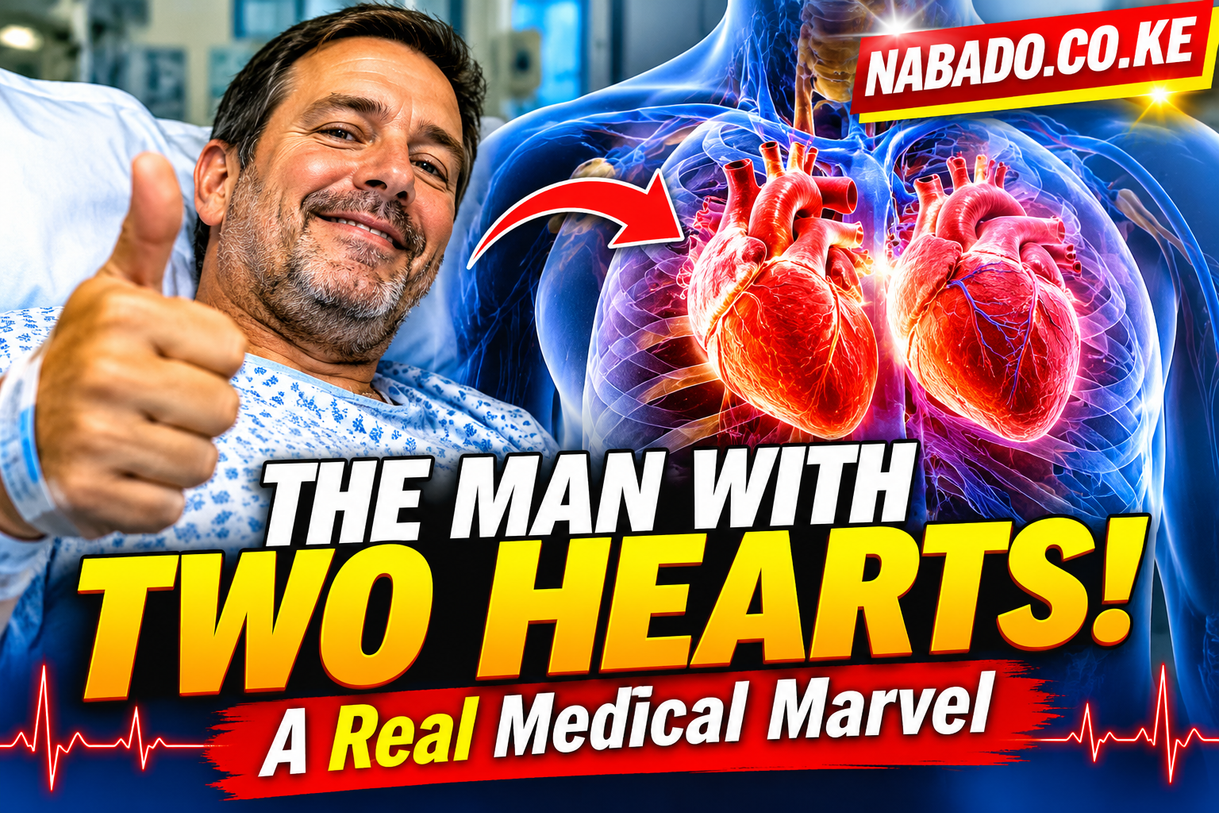
Imagine living your entire life with one heart, only to discover that another person can receive a second heart and continue walking around with both organs beating inside their chest.
It sounds unbelievable, almost like something taken from a science-fiction movie. Yet, this extraordinary medical phenomenon is real. Doctors have successfully performed rare operations that allow selected patients to live with two functioning hearts.
Unlike an ordinary heart transplant, where the damaged heart is removed and replaced with a donor organ, this unusual procedure allows the patient’s original heart to remain inside the chest. A second heart is implanted alongside it, creating a remarkable arrangement in which both organs help maintain blood circulation.
The procedure is known as heterotopic heart transplantation, sometimes called a piggyback heart transplant.
Although it is rarely performed today, documented medical cases have demonstrated that people can survive for many years with two hearts. One particularly remarkable patient lived for more than three decades following the operation.
But why would doctors give someone a second heart instead of replacing the damaged one? How do two hearts work inside the same body? And can both organs beat independently?
The Man Who Received a Second Heart at 36
One of the fascinating cases involved Tyson Smith, a 36-year-old man from San Diego, California.
In February 2011, Smith underwent an unusual heart transplant after developing serious heart problems.
Doctors discovered that his condition presented a complicated challenge. His original heart was failing, but he also had elevated resistance in the blood vessels supplying his lungs. This made a conventional transplant particularly risky because the newly donated heart could struggle against the pressure in his lung circulation.
Rather than remove his original heart, doctors decided to use a different surgical approach.
They implanted a donor heart alongside his existing organ, allowing both hearts to remain inside his chest.
The operation was designed to give his circulatory system additional pumping support while avoiding some of the risks associated with removing his original heart.
The result was extraordinary: Smith became one of the people living with two hearts following a successful transplant operation.
His case attracted attention because it demonstrated how doctors could use an unusual surgical technique to help patients facing complicated heart conditions.
For Smith, the second heart was not a medical curiosity. It was a chance to continue living.
How Can Two Hearts Work Inside One Human Body?
The human heart is a muscular organ responsible for pumping blood throughout the body. It supplies oxygen and nutrients to tissues while helping remove carbon dioxide and other waste products.
Normally, one heart performs this demanding job.
However, in a heterotopic heart transplant, surgeons introduce a second heart without removing the patient’s original organ.
The donor heart is placed alongside the existing heart and connected to the patient’s circulatory system through carefully constructed surgical connections.
The two organs can then contribute to maintaining blood circulation.
The original heart may continue performing part of its pumping function, while the donor heart provides additional support.
This arrangement is particularly useful in selected patients whose medical conditions make a conventional transplant unsuitable.
It is important to understand that the two hearts do not simply operate as completely independent pumping systems. Their surgical connections are designed to work together within the same circulatory system.
The Patient Who Survived More Than 30 Years With Two Hearts
Perhaps the most remarkable evidence that people can live for decades with two hearts comes from a medical case published in the journal ESC Heart Failure in 2023.
The report described a man who received a heterotopic heart transplant in November 1990, when he was just 25 years old.
His original heart had been severely damaged by myocarditis, an inflammation of the heart muscle. The resulting disease had significantly affected its ability to pump blood.
Doctors also identified severe pulmonary hypertension, making a conventional transplant a difficult option.
They therefore decided to implant a donor heart while retaining his original organ.
The operation was successful, and the patient continued receiving medical care and monitoring over the following years.
More than 30 years later, doctors reported that he was still alive and maintaining a stable condition.
During a physical assessment, he managed to walk 700 metres in a six-minute walking test, demonstrating a notable level of functional capacity.
His case provided remarkable evidence that a carefully selected patient could survive for decades following this unusual transplant procedure.
It also demonstrated that living with two hearts does not necessarily mean spending the rest of one’s life in a hospital.
Can Two Hearts Beat at Different Speeds?
One of the most fascinating aspects of this condition is that the two hearts can maintain separate electrical rhythms.
The heart has an internal electrical system responsible for controlling its contractions. During a heterotopic transplant, the donor heart retains its own electrical activity, while the original heart also maintains its electrical system.
Consequently, the two organs do not necessarily beat at exactly the same speed.
One heart may beat faster or slower than the other, depending on the body’s needs and individual medical circumstances.
This unusual arrangement requires careful medical monitoring because abnormalities affecting either heart can create serious complications.
In some documented cases, doctors have observed different heart rhythms in patients with two hearts.
It is another example of how the human body can function under extraordinary medical circumstances.
What Happens If One Heart Stops Working?
Having two hearts does not make someone immune to heart problems.
Both organs can develop complications, and problems affecting either one may threaten the patient’s health.
The donor heart can experience rejection, infection, coronary artery disease or abnormal electrical rhythms.
The original heart can also deteriorate, depending on the condition that made transplantation necessary in the first place.
Although the two organs may share some of the workload, one cannot automatically guarantee that it will compensate if the other stops functioning.
Patients therefore require regular examinations to assess the performance of both hearts.
They may also need lifelong immunosuppressive medication to prevent their immune systems from attacking the donated organ.
These medicines are essential for transplant survival, although they can increase the risk of infections and other complications.
Why Don’t Doctors Give Everyone With Heart Failure Two Hearts?
Although the procedure sounds like an effective solution, heterotopic heart transplantation is not suitable for every patient.
It was developed as an alternative for selected people whose medical circumstances made conventional transplantation particularly challenging.
One of the important considerations is pulmonary hypertension, which can place excessive pressure on the right side of the heart.
In certain patients, keeping the original heart allows it to continue supporting circulation while the donor organ provides additional pumping capacity.
However, modern medicine has developed several other ways of supporting people with severe heart failure.
These include ventricular assist devices, which are mechanical pumps that help move blood when the heart cannot pump sufficiently.
Improvements in conventional heart transplantation have also changed how doctors manage many patients.
As a result, heterotopic transplantation has become relatively uncommon.
Nevertheless, the documented cases show that the procedure remains an extraordinary achievement in the history of cardiovascular surgery.
Does Having Two Hearts Make Someone Stronger?
It might seem reasonable to assume that someone with two hearts would have twice the physical strength or endurance of an ordinary person.
However, that is not how the human body works.
The heart is only one part of the cardiovascular system. The lungs, blood vessels, muscles and other organs must work together to supply the body with oxygen and nutrients.
Having an additional heart does not automatically double physical strength, running speed or athletic performance.
The purpose of the second heart is to provide medical support to someone whose original heart cannot adequately maintain circulation.
It is a life-saving surgical intervention, not a way of creating a person with superhuman abilities.
Can Someone Be Born With Two Hearts?
There is an important difference between being born with two hearts and receiving a second heart through surgery.
The patients discussed in these documented cases received their additional hearts through transplantation.
They were not born with two fully functioning hearts.
There are rare congenital abnormalities involving unusual heart development, as well as conditions associated with incomplete conjoined twinning. However, these are different medical situations and should not be confused with heterotopic heart transplantation.
The two-heart transplant arrangement is created deliberately by surgeons to address specific medical challenges.
A Medical Achievement That Sounds Like Science Fiction
The story of people living with two hearts demonstrates just how far modern medicine has progressed.
For most people, the heart is something they rarely think about unless they experience a medical problem. It beats continuously, supplying blood to every part of the body without requiring conscious effort.
But for patients with severe heart failure, that simple process can become a daily struggle.
The possibility of receiving another heart without removing the original one represents an extraordinary medical option.
Cases such as Tyson Smith’s and the patient who survived for more than 30 years show that this unusual arrangement is not merely theoretical.
It has happened in real hospitals, involving real patients and highly specialised surgical teams.
Although having two hearts does not make someone invincible, it demonstrates the remarkable possibilities of modern medicine.
Sometimes, the most unbelievable human stories are not fictional. They are real medical experiences that reveal how science continues to challenge what people once thought was impossible.
SUGGESTED READS
- People Still Raise Their Beds Because of This Legendary Creature—And Some Killings Have Been Linked to It
- They Killed Their Neighbors in Just 100 Days: The Terrifying True Story of Rwanda’s Genocide
- The Child Witch Hunts: Africa’s Dark Secret That Stole Thousands of Childhoods
- The Basement of Fear: Inside the Dark Story of Kenya’s Nyayo House Torture Chambers
- What Fishermen Pulled From the Nile During Idi Amin’s Reign Still Haunts Uganda Today
- The Night Terror of Tsavo: When Two Lions Brought a Railway to Its Knees
- The Town That Never Stopped Burning: The Chilling Story of Centralia’s Underground Fire
- The Ghost That Helped Solve a Murder: The Chilling Story of the Greenbrier Ghost

Support Our Website!
We appreciate your visit and hope you find our content valuable. If you’d like to support us further, please consider contributing through the TILL NUMBER: 9549825. Your support helps us keep delivering great content!
If you’d like to support Nabado from outside Kenya, we invite you to send your contributions through trusted third-party services such as Remitly, western union, SendWave, or WorldRemit. These platforms are reliable and convenient for international money transfers.
Please use the following details when sending your support:
Phone Number: +254701838999
Recipient Name: Peterson Getuma Okemwa
We sincerely appreciate your generosity and support. Thank you for being part of this journey!