

simply amazing, always for you.
There’s a certain kind of relationship dynamic that feels intense, confusing, and strangely addictive at the same time. One person is always reaching out, trying to connect, trying to fix things. The other seems just out of reach—sometimes warm, sometimes distant, sometimes completely unavailable. The more one person moves closer, the more the other pulls away.
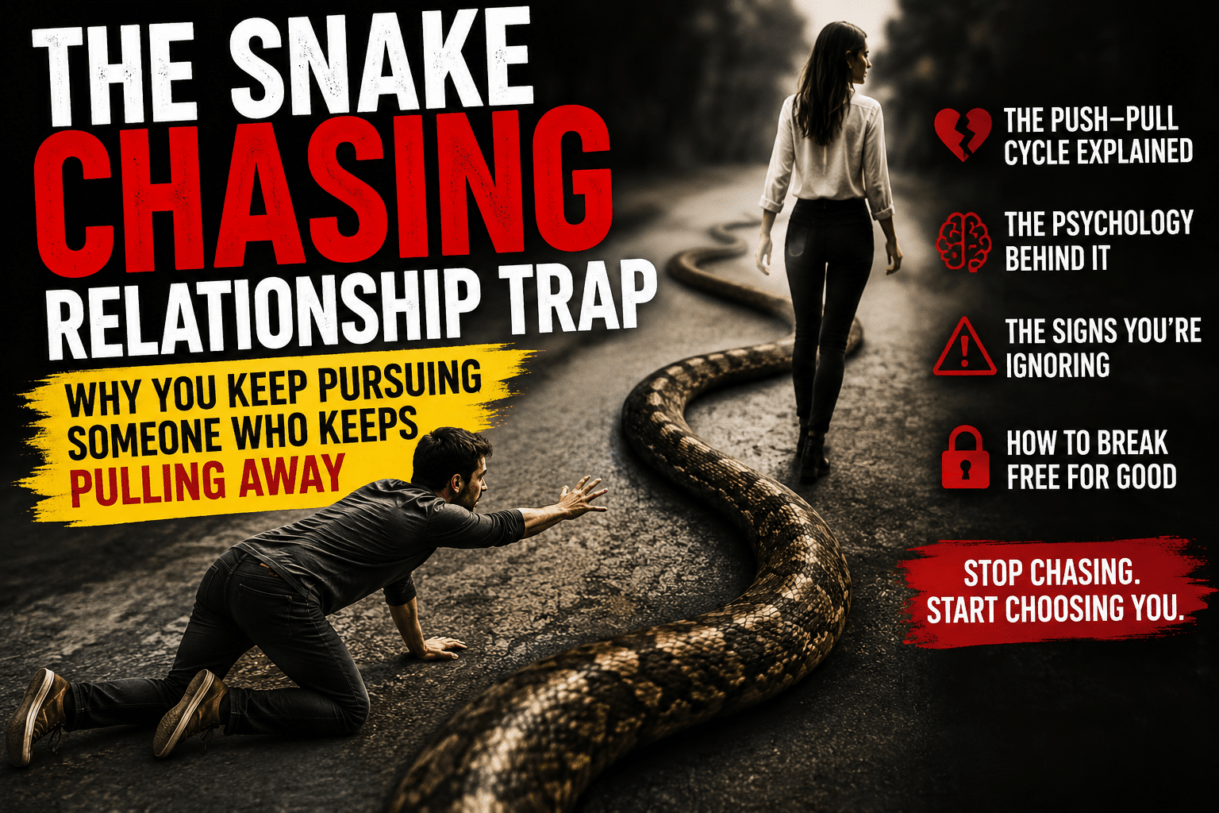
If that sounds familiar, you’re likely caught in what people informally call the “snake chasing” pattern.
It’s not a scientific term, but it’s an accurate metaphor. Imagine a snake constantly pursuing something it can’t quite catch. It moves, adjusts, circles, and keeps going—but never truly arrives. That’s exactly how this relationship dynamic feels.
This isn’t just about “liking someone more” or “trying harder.” It’s a repeating emotional loop that can quietly drain your energy, self-worth, and clarity if you don’t recognize it early.
Let’s break it down properly—what it is, why it happens, how to spot it, and most importantly, how to get out of it.
What the “Snake Chasing” Pattern Really Is
At its core, the snake chasing dynamic is a push–pull relationship cycle.
- One person consistently chases: seeking attention, reassurance, clarity, or commitment
- The other consistently withdraws: avoids, delays, becomes distant, or gives mixed signals
This doesn’t mean either person is “bad.” But together, they create a loop that feeds on itself.
Here’s how it usually unfolds:
- Things start well—there’s chemistry, connection, excitement
- One person begins to want more (clarity, consistency, deeper emotional connection)
- The other starts to feel pressured or overwhelmed and pulls back
- The first person senses the distance and tries harder
- The second person pulls back even more
And just like that, the cycle locks in.
Why This Dynamic Feels So Intense
If it’s so exhausting, why do people stay in it?
Because it mimics emotional highs and lows, which can feel like passion.
When the distant partner comes back—texts you, shows interest, gives attention—it feels rewarding. Almost like relief. That emotional spike tricks your brain into thinking the connection is special or worth chasing.
But in reality, it’s not stability—it’s inconsistency.
And inconsistency is what keeps the cycle alive.
The Psychology Behind It
This pattern often comes down to attachment styles—the way people are wired to connect emotionally.
1. The “Chaser” (Anxious Attachment Traits)
The person chasing usually:
- Craves closeness and reassurance
- Overthinks silence or distance
- Feels uneasy when communication drops
- Tries to fix things quickly
They’re not “too much.” They’re just operating from a place where connection equals security.
2. The “Runner” (Avoidant Attachment Traits)
The person pulling away often:
- Values independence strongly
- Feels overwhelmed by emotional intensity
- Avoids difficult conversations
- Needs space when things get serious
They’re not necessarily uninterested—they just associate closeness with pressure.
3. Why They Attract Each Other
This is where it gets interesting.
- The anxious partner is drawn to the emotional distance (because it feels like something to “win”)
- The avoidant partner is drawn to the initial warmth and attention (until it feels overwhelming)
So both people unintentionally trigger each other’s patterns.
It’s not random—it’s psychological.
Signs You’re in a Snake Chasing Relationship
Not every relationship has this dynamic. But if you notice several of these, you’re likely in it:
1. You Feel Like You’re Always the One Reaching Out
You initiate most conversations, plans, or emotional discussions.
2. Communication Is Inconsistent
Some days are great. Others feel like you’re being ignored.
3. You Overanalyze Everything
You reread messages, question tone, and try to “decode” behavior.
4. You Feel Relief When They Finally Respond
Not happiness—relief. That’s a key difference.
5. You Adjust Yourself to Keep Them Close
You hold back your needs or act differently to avoid pushing them away.
6. You’re Confused More Than You’re Secure
You spend more time wondering where you stand than actually enjoying the relationship.
The Hard Truth Most People Avoid
Here’s the part many people don’t want to hear:
Chasing someone rarely creates real connection—it usually weakens your position.
Not because you’re wrong for caring, but because:
- It creates imbalance
- It reduces mutual effort
- It shifts the relationship from partnership to pursuit
A healthy relationship doesn’t require one person to constantly prove their value.
Why “Trying Harder” Doesn’t Fix It
When you feel someone slipping away, the instinct is to do more:
- Send more messages
- Be more understanding
- Give more time
- Ask for clarity repeatedly
But in this dynamic, that usually backfires.
Why?
Because the other person already feels overwhelmed. More effort doesn’t feel like love to them—it feels like pressure.
So they pull away again.
And the cycle continues.
The Emotional Cost of Staying in the Cycle
If left unchecked, this pattern can take a real toll:
- Self-doubt increases – You start questioning your worth
- Anxiety rises – You’re always waiting, checking, wondering
- Confidence drops – You feel like you’re “not enough”
- Emotional exhaustion builds – You’re constantly investing without stability
Over time, you stop recognizing yourself in the process.
How to Break the Snake Chasing Cycle
Breaking this pattern isn’t about playing games or pretending you don’t care. It’s about restoring balance and clarity.
1. Stop Over-Investing Where There’s No Reciprocity
Look at actions, not words.
If effort isn’t mutual, reduce yours—not out of spite, but out of self-respect.
2. Get Clear on What You Actually Want
Do you want:
- Consistency?
- Clear communication?
- Emotional availability?
If the answer is yes, then you need to evaluate whether this person can realistically offer that.
3. Communicate Directly—Once
Say what you need clearly.
Not repeatedly. Not emotionally charged. Just directly.
For example:
“I value consistency and communication. If that’s not something you can offer, I need to know.”
Then observe—not chase.
4. Pay Attention to Behavior, Not Promises
Anyone can say:
- “I’ll do better”
- “I’ve just been busy”
- “I really like you”
But patterns don’t lie.
Consistency over time is the real answer.
5. Be Willing to Walk Away
This is the hardest step—and the most important.
If someone repeatedly shows they can’t meet you halfway, staying doesn’t fix it.
Leaving isn’t losing—it’s choosing stability over confusion.
What a Healthy Dynamic Looks Like Instead
To truly understand why the snake chasing pattern doesn’t work, it helps to see what does.
A healthy relationship has:
- Mutual effort – both people initiate and invest
- Consistency – communication doesn’t feel unpredictable
- Clarity – you know where you stand
- Emotional safety – you don’t feel like you’re “too much”
There’s no chasing—just connection.
Can This Pattern Be Fixed?
Yes—but only under specific conditions:
- Both people are aware of the dynamic
- Both are willing to adjust their behavior
- There’s open, honest communication
- Effort becomes balanced over time
If only one person is trying to fix it, it won’t work.
This isn’t a solo problem—it’s a two-person pattern.
Final Perspective: What This Pattern Is Really Telling You
The snake chasing dynamic isn’t just a relationship issue—it’s feedback.
It tells you:
- Where your emotional needs are not being met
- Where you might be overextending yourself
- Where compatibility might be lacking
And most importantly, it forces a question:
Do you want to keep chasing, or do you want to be chosen?
Because those are two very different experiences.
The “snake chasing method” in relationships is not romantic, strategic, or necessary—it’s a loop that thrives on imbalance and uncertainty.
Real connection doesn’t require constant pursuit. It requires alignment.
If you find yourself always moving toward someone who keeps stepping back, don’t just move faster.
Stop.
Look at the pattern.
And decide whether it’s something worth continuing—or something worth leaving behind.
SUGGESTED READS
- When Love Found Me: A Story of Redemption, Love, and Healing
- How to Handle Your Toddler’s Tantrums: A Guide for Parents
- Why Timeouts Aren’t Always Effective: Alternative Discipline Strategies
- How to Set Boundaries with Your Children (Without Feeling Bad)
- 7 Positive Discipline Strategies Every Parent Should Try
- How to Discipline Your Child Without Yelling or Punishment: Peaceful Techniques That Actually Work
- How to Be a Patient Parent (Even on the Hardest Days): Proven Strategies to Stay Calm and Connected

Support Our Website!
We appreciate your visit and hope you find our content valuable. If you’d like to support us further, please consider contributing through the TILL NUMBER: 9549825. Your support helps us keep delivering great content!
If you’d like to support Nabado from outside Kenya, we invite you to send your contributions through trusted third-party services such as Remitly, western union, SendWave, or WorldRemit. These platforms are reliable and convenient for international money transfers.
Please use the following details when sending your support:
Phone Number: +254701838999
Recipient Name: Peterson Getuma Okemwa
We sincerely appreciate your generosity and support. Thank you for being part of this journey!