

We Ain’t Done Yet… Expect Another One.
The Disappearances That Haunted KwaZulu-Natal
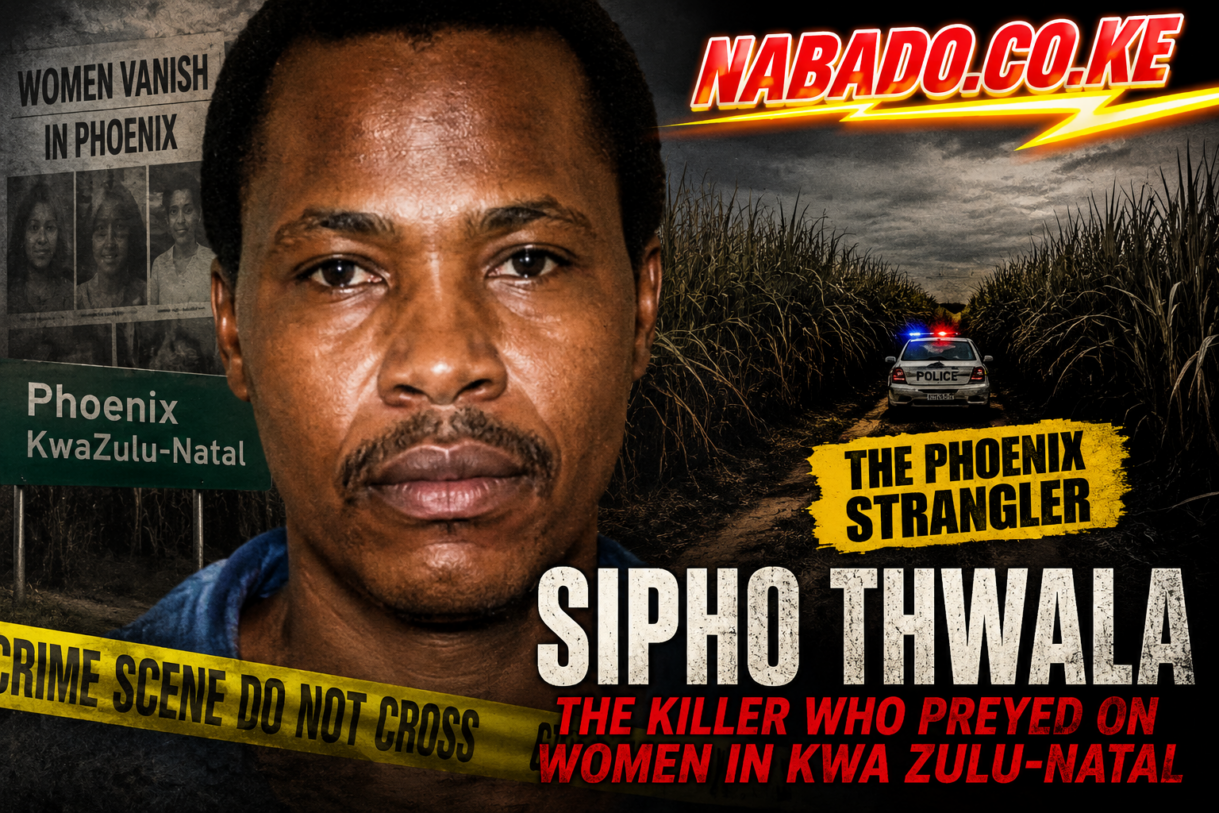
In the late 1990s, a disturbing pattern emerged around Phoenix and surrounding areas of KwaZulu-Natal. Women disappeared after encounters with a man who appeared to offer them something many desperately needed: employment.
That promise, according to the case against Sipho Thwala, became part of a deadly trap.
Thwala was eventually linked to the murders of several women and became known as the “Phoenix Strangler.” His crimes shocked communities north of Durban and highlighted the vulnerability of women searching for work in an area where unemployment and poverty were major social pressures.
A Deadly Promise of Work
Thwala’s alleged method was chillingly simple.
Women were reportedly approached with promises of employment. For someone struggling to find work, an offer of a job could appear to be an opportunity rather than a warning sign.
But investigators said the women were taken toward isolated areas, including sugarcane fields around Phoenix.
Sugarcane plantations can provide extensive cover. Dense vegetation and remote paths can make it difficult for victims to attract attention and challenging for investigators to reconstruct what happened.
For the women who disappeared, an ordinary search for employment became a journey from which they would never return.
The Sugarcane Fields
The sugarcane-growing areas around KwaZulu-Natal formed a disturbing backdrop to the investigation.
Once a victim entered an isolated plantation, there could be few witnesses and little immediate chance of intervention.
Investigators eventually began piecing together evidence surrounding multiple disappearances and murders. What initially might have appeared to be separate cases increasingly pointed toward a larger pattern.
The investigation would eventually lead authorities to Thwala.
The Investigation Closes In
Cases involving missing people can be extraordinarily difficult to solve, particularly when victims disappear from areas where there are few witnesses.
Investigators must establish where a person was last seen, identify people who may have encountered the victim, reconstruct movements and connect apparently unrelated evidence.
In Thwala’s case, the investigation became increasingly focused on links between him and women who had disappeared.
The evidence eventually resulted in his arrest and prosecution.
Conviction
Thwala was subsequently convicted of multiple murders.
His conviction transformed a disturbing series of disappearances into one of South Africa’s notable serial-killer cases from the period.
The case also exposed a broader vulnerability: criminals can exploit economic desperation by presenting themselves as providers of opportunities.
For women searching for employment, particularly those travelling alone or meeting strangers outside established workplaces, a seemingly ordinary job offer could carry enormous risks.
Why the Phoenix Strangler Case Still Matters
The story of Sipho Thwala is more than a catalogue of murders.
It is also a reminder of how vulnerable people can become when desperation intersects with deception.
The late 1990s were a difficult period for many South Africans dealing with unemployment and economic uncertainty. A promise of work could therefore be powerful enough to overcome natural caution.
That vulnerability appears repeatedly in cases involving predators who use employment, romance, money or other promises to gain victims’ trust.
Thwala’s case remains disturbing precisely because the initial encounter reportedly did not necessarily appear threatening. The danger was hidden behind an opportunity.
A Dark Chapter in KwaZulu-Natal
The Phoenix Strangler case became part of the grim history of serial murder in South Africa.
KwaZulu-Natal, like other parts of the country, has experienced notorious cases involving serial offenders. But each case leaves a different mark on the communities where victims lived, worked and disappeared.
For families, a missing relative is not simply a statistic. Behind every disappearance is a household waiting for someone to return, a phone that does not ring and questions that can remain unanswered for years.
The eventual conviction of Thwala brought a measure of legal accountability, but it could not undo the suffering caused by the murders.
The Warning Behind the Story
The most unsettling lesson from the Phoenix Strangler case is how easily trust can be exploited.
A job offer should be an opportunity, not a pathway into danger. Yet predators can deliberately disguise themselves as people offering help.
The case serves as a reminder of the importance of verifying employment opportunities, informing trusted people about meetings with strangers and being cautious when an unfamiliar person insists on travelling to an isolated location.
For the victims connected to the case, however, there was no second chance.
Their disappearances became part of a much darker story — one that eventually exposed a killer operating behind a façade of opportunity.
Sipho Thwala’s name remains associated with one of KwaZulu-Natal’s most disturbing serial-murder cases, and the women whose lives were taken remain at the centre of the tragedy.
SUGGESTED READS
- What Fishermen Pulled From the Nile During Idi Amin’s Reign Still Haunts Uganda Today
- The Night Terror of Tsavo: When Two Lions Brought a Railway to Its Knees
- The Town That Never Stopped Burning: The Chilling Story of Centralia’s Underground Fire
- The Ghost That Helped Solve a Murder: The Chilling Story of the Greenbrier Ghost
- The Russian Sleep Experiment Was Fake—But the Real Experiments Were Far More Terrifying
- The Corpse That Wouldn’t Decompose: The Haunting Mystery of Rosalia Lombardo
- Meet the Meru Man With 18+ Wives: Inside Kenya’s Most Extraordinary Family Empire
- The Green Children of Woolpit: The Medieval Mystery That Still Defies Explanation

Support Our Website!
We appreciate your visit and hope you find our content valuable. If you’d like to support us further, please consider contributing through the TILL NUMBER: 9549825. Your support helps us keep delivering great content!
If you’d like to support Nabado from outside Kenya, we invite you to send your contributions through trusted third-party services such as Remitly, western union, SendWave, or WorldRemit. These platforms are reliable and convenient for international money transfers.
Please use the following details when sending your support:
Phone Number: +254701838999
Recipient Name: Peterson Getuma Okemwa
We sincerely appreciate your generosity and support. Thank you for being part of this journey!