

We aint done yet.. Expect another one.
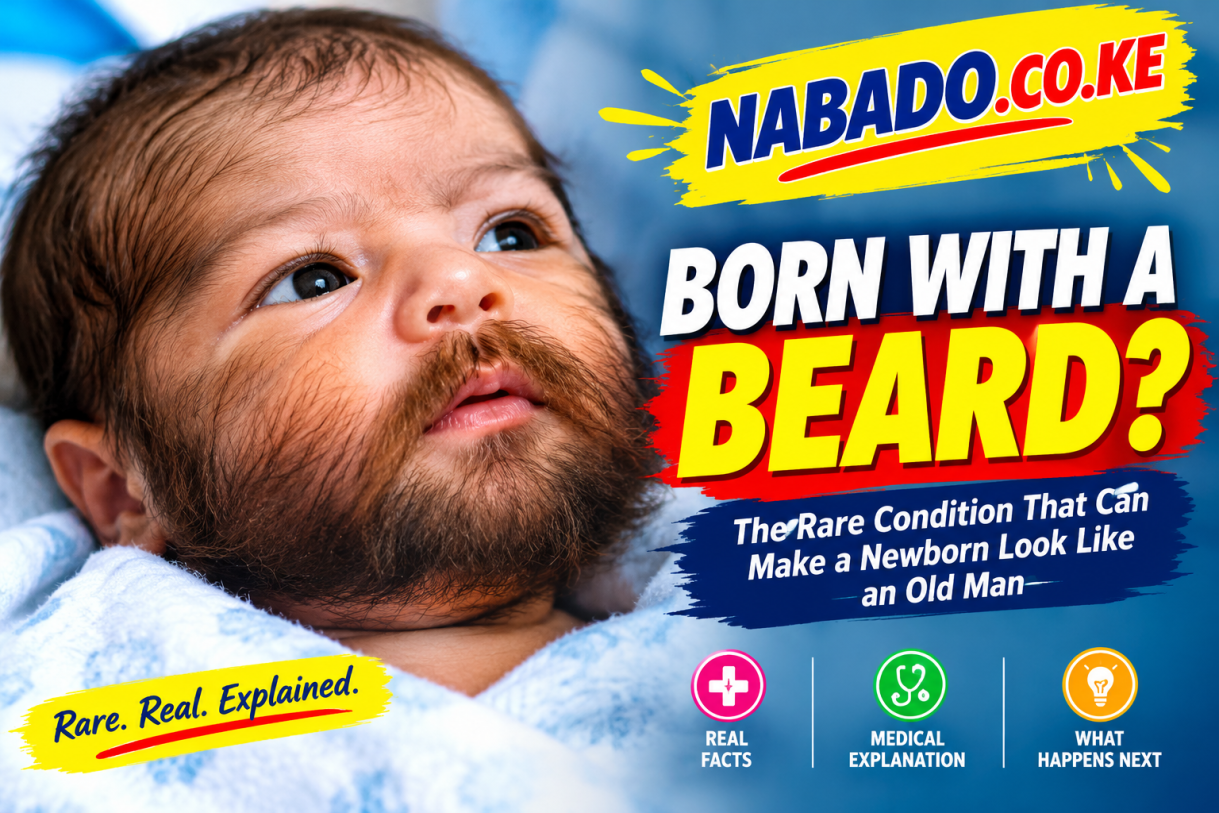
A baby born with a beard may sound like something out of a fictional story, but unusual facial hair growth in newborns is a real medical phenomenon. Although most babies are born with little visible facial hair, some arrive in the world with noticeable hair covering their cheeks, forehead, chin or other parts of their bodies.
For parents, seeing a newborn with beard-like hair can be surprising and sometimes frightening. The unusual appearance may also attract attention on social media, where photographs and videos of hairy babies can quickly go viral. However, behind such appearances may be a natural developmental process or, in rare cases, a medical condition that requires further investigation.
One of the conditions associated with excessive hair growth from birth is congenital hypertrichosis, a rare disorder that can cause unusually dense hair on the face and body. Another explanation is lanugo, the fine hair that develops while a baby is still in the womb.
But can a baby genuinely be born with a fully developed beard? What causes excessive hair growth in newborns, and does the hair disappear as the child grows?
Understanding the science behind this unusual condition helps separate medical facts from internet myths.
Can a Baby Really Be Born With a Beard?
Yes, a newborn can have prominent facial hair that resembles a beard. However, there is an important distinction between fine hair covering a baby’s face and the thick, coarse beard typically associated with adult men.
A baby born with noticeable facial hair may have an unusual distribution of normal newborn hair or a condition that causes excessive hair growth. In rare cases, the hair can be long, dark or dense enough to make the child’s face appear bearded.
Medical literature documents infants born with excessive hair growth across the face and body. Some reported cases involve congenital hypertrichosis lanuginosa, a rare condition characterised by excessive growth of fine, soft hair that may cover much of the body.
A report published in the medical literature described a newborn with excessive lanugo hair, with spontaneous hair loss beginning during infancy. Other documented cases describe children whose facial hair remained prominent even after some of the hair elsewhere on their bodies disappeared.
These cases demonstrate that unusually hairy newborns are medically possible. They do not mean that every photograph of a baby with a beard circulating online is authentic or that every hairy newborn has a rare disorder.
The appearance alone cannot establish a diagnosis. A medical assessment is needed to determine whether the hair is part of normal development or a sign of an underlying condition.
1. Lanugo: The Natural Hair Some Babies Have at Birth
One of the simplest explanations for a newborn’s hairy appearance is lanugo.
Lanugo is a type of fine, soft hair that develops on a baby’s body before birth. It plays a role in fetal development, including helping the protective coating known as vernix caseosa adhere to the skin.
This hair usually begins developing during pregnancy and gradually disappears before birth in many babies. However, some newborns still have visible lanugo, particularly if they are born prematurely.
Lanugo may appear on the shoulders, back, forehead, cheeks and other areas. Depending on the amount and distribution, it can make a baby look considerably hairier than people expect.
In most cases, lanugo is not a cause for alarm. The hair generally disappears naturally during the first weeks of life, although the timing varies.
The important distinction is that lanugo is usually soft and fine rather than the thick, coarse hair associated with an adult beard.
Parents should therefore avoid assuming that every baby with facial hair has a rare genetic disorder. Normal newborn development can sometimes produce an appearance that surprises people unfamiliar with the condition.
2. Congenital Hypertrichosis: When Hair Growth Is Unusually Excessive
A more unusual explanation is congenital hypertrichosis.
Hypertrichosis refers to excessive hair growth that is not explained simply by the usual effects of male-pattern hormones. Depending on the type, it may affect a specific area or cover large portions of the body.
When the condition is present from birth, it is described as congenital hypertrichosis.
One rare form, known as congenital hypertrichosis lanuginosa, is associated with excessive growth of fine, soft hair. The hair can cover much of the body while generally sparing the palms, soles and mucous membranes.
In some affected children, the hair is noticeable across the face, including the forehead and cheeks. In others, the distribution may extend across the trunk and limbs.
The appearance can be dramatic, particularly when the hair is dark or unusually long. Nevertheless, the condition varies significantly between individuals.
Some children experience a reduction in hair growth during childhood, while others continue to have prominent hair as they grow older.
Medical literature also indicates that congenital hypertrichosis may sometimes occur alongside other congenital abnormalities, although these are not present in every case.
Because different forms of hypertrichosis have different characteristics, a doctor must assess the child’s overall presentation rather than diagnosing the condition from photographs alone.
3. Could Genetics Cause a Baby to Be Born With Excessive Hair?
Genetics can play a role in some forms of congenital hypertrichosis.
Certain rare forms have been reported to run in families, while other cases appear sporadically, meaning there is no obvious family history.
In inherited cases, genetic changes can affect the normal regulation of hair growth. The resulting condition may cause hair to develop in places where it would ordinarily be less prominent.
However, genetics does not mean that a parent who has thick facial or body hair will necessarily have a child with congenital hypertrichosis.
Ordinary differences in hairiness are not the same as a rare congenital hair-growth disorder. A child may inherit characteristics related to hair colour, texture or density without having a medical condition.
Similarly, the absence of a family history does not completely rule out congenital hypertrichosis.
If a newborn has unusually extensive hair growth, a paediatrician may consider the family history as part of the examination and decide whether specialist assessment or genetic testing is appropriate.
4. Can Hormones Make a Newborn Grow a Beard?
Hormones influence hair growth throughout human development, but a newborn’s facial hair should not automatically be interpreted as evidence of unusually high testosterone.
The body uses different mechanisms to regulate fine hair and coarse terminal hair. During puberty, androgen hormones, including testosterone, contribute to the development of thicker hair in areas such as the beard region.
A newborn with prominent facial hair may have a different explanation entirely, particularly if the hair is soft and distributed across several parts of the body.
Nevertheless, hormonal abnormalities can occasionally contribute to unusual hair growth. Doctors may investigate endocrine conditions when the hair distribution, associated symptoms or medical history suggests that possibility.
For example, a published medical case report described a newborn with excessive hair growth in association with congenital hypothyroidism and other metabolic and hormonal findings. The case illustrates why unusual neonatal hair growth sometimes deserves medical investigation rather than being dismissed as a cosmetic difference.
This does not mean that a baby born with facial hair necessarily has a thyroid disorder or a testosterone problem. Such conditions are only possibilities that clinicians consider when the findings warrant further evaluation.
Parents should never attempt to correct a baby’s hair growth using hormone products, supplements or traditional remedies without medical guidance.
5. Does a Baby Born With a Beard Have a Serious Disease?
Not necessarily.
The amount of hair a newborn has is only one part of the clinical picture. A baby with a small amount of fine facial hair may be entirely healthy, while unusually extensive hair growth may require further assessment.
Doctors will consider several factors, including:
- Whether the hair is fine and soft or thick and coarse.
- Whether it is confined to the face or covers much of the body.
- Whether the hair was present at birth or appeared later.
- Whether the baby has other unusual physical features or symptoms.
- Whether there is a family history of excessive hair growth.
- Whether medications, hormonal conditions or other medical factors could be involved.
Some rare forms of congenital hypertrichosis have been associated with dental, eye or other congenital abnormalities. However, these associations do not mean that every affected child will experience such complications.
The correct approach is to identify the particular condition, assess the child’s general health and determine whether additional monitoring is necessary.
A baby should not be labelled as having a rare disorder simply because a photograph shows hair on the face.
6. Will the Beard Disappear as the Baby Grows?
The answer depends on what is causing the hair growth.
If the hair is ordinary lanugo, it will generally disappear naturally during early infancy.
If the child has congenital hypertrichosis, the outcome can be different. Some forms may become less noticeable with age, while others can persist into childhood or adulthood.
A medical case published in Archives of Disease in Childhood described a newborn with excessive lanugo hair. Spontaneous loss of body hair began when the child was around nine months old.
Other medical reports describe children whose facial hair persisted even after much of the hair elsewhere on their bodies had diminished.
These observations show why parents should avoid relying on a single prediction about how a child’s appearance will change.
A paediatrician can explain what is known about the suspected condition and advise whether follow-up is necessary.
Most importantly, parents should not feel pressured to remove a baby’s hair simply because it looks unusual.
7. Should Parents Shave a Baby Born With Facial Hair?
Parents should not shave a newborn’s face or use hair-removal products without first speaking to a healthcare professional.
A baby’s skin is delicate, and shaving can cause irritation, small cuts or inflammation. Chemical hair-removal products may also irritate or injure sensitive skin.
Waxing, bleaching and other cosmetic treatments are not appropriate solutions to try on a newborn without medical guidance.
Shaving does not change the number of hair follicles or correct the underlying cause of excessive hair growth. It also does not make hair biologically grow back thicker, although the blunt ends of shaved hair can temporarily feel coarser.
If hair removal is considered necessary for a child with a diagnosed condition, the appropriate approach should be discussed with a qualified clinician.
For many babies, the best initial course is observation and medical assessment rather than cosmetic treatment.
8. How Doctors Investigate Unusual Hair Growth in Babies
When a newborn has significant or unusual facial hair, doctors begin by examining the child’s skin and overall development.
They assess the hair’s texture, colour, distribution and extent. They also establish whether the hair was present at birth, whether it is increasing and whether other physical findings are present.
The baby’s birth history, gestational age, family history and medication exposures may also be relevant.
Depending on the findings, further investigations could include blood tests to assess thyroid function or hormones. Genetic testing or referral to a paediatric dermatologist or endocrinologist may be appropriate in selected cases.
Not every baby requires extensive testing. If the hair is consistent with ordinary lanugo and the child is otherwise healthy, reassurance and routine follow-up may be sufficient.
However, significant hair growth that is accompanied by other unusual findings should be evaluated by a healthcare professional.
Parents should arrange a medical assessment if the hair is unusually thick, widespread, rapidly increasing or accompanied by other concerning symptoms. Urgent symptoms, such as breathing difficulties, poor feeding with marked lethargy or a baby who appears seriously unwell, require prompt medical attention regardless of the hair growth.
9. Why Stories About Babies Born With Beards Attract So Much Attention
Images of newborns with unusual physical characteristics often spread quickly online because they challenge people’s expectations.
Most people associate beards with adolescence and adulthood. Seeing a newborn with dark facial hair therefore creates surprise and raises immediate questions about how such a feature could develop.
Social media can amplify this curiosity, especially when a photograph is accompanied by a dramatic headline.
However, viral posts may omit the child’s medical history, the precise diagnosis or whether a photograph has been edited. Some posts may also attach unsupported explanations involving curses, supernatural events or extraordinary genetic abilities.
There is no scientific evidence that a beard-like appearance at birth is proof of a curse or supernatural occurrence.
The medical explanation depends on the individual case. It may involve ordinary lanugo, a rare hair-growth disorder or another condition requiring clinical assessment.
Readers should also distinguish between a verified medical case and a photograph shared without a reliable source. A convincing image alone cannot establish that a baby was genuinely born with the appearance shown.
Responsible reporting should explain the possible medical causes without exaggerating the facts or presenting an unverified social media story as confirmed news.
10. Is Congenital Hypertrichosis Curable?
There is no single treatment that applies to every form of congenital hypertrichosis.
Management depends on the particular diagnosis, the extent of hair growth, any associated health problems and the needs of the affected child.
If a specific underlying medical condition is identified, treating that condition may improve the hair growth in some circumstances. However, this cannot be assumed for all forms of hypertrichosis.
When excessive hair growth persists without an underlying cause that can be treated, management may focus on skin health, appropriate cosmetic options when the child is older, and emotional support.
Children with conspicuous physical differences may experience unwanted attention or bullying as they grow. Supportive families and healthcare professionals can help ensure that the child’s health, confidence and dignity remain the priority.
It is also important to recognise that excessive hair growth does not automatically indicate an intellectual disability or poor general health. Each child’s development must be assessed individually.
The Truth About Babies Born with Beards
A child born with a beard-like appearance may seem extraordinary, but medicine provides several possible explanations for unusual facial hair in newborns.
In many cases, the hair may be lanugo, a normal type of fine hair associated with fetal development. In rarer situations, congenital hypertrichosis can cause excessive hair growth across the face and body. Hormonal or other medical conditions may also be considered when the clinical findings suggest them.
Whether the hair disappears depends on the underlying cause. Some forms resolve naturally, while others persist and may require ongoing assessment or management.
The most important lesson is that a baby born with facial hair should not automatically be considered sick, nor should the appearance be dismissed without assessment when the growth is unusual or extensive.
For parents, medical advice is more valuable than internet speculation. A qualified healthcare professional can assess the baby, explain the likely cause and recommend the safest course of action.
Ultimately, unusual facial hair does not define a child’s health, future or worth. Accurate information, appropriate medical care and respect for the child’s dignity should always come first.
SUGGESTED READS
- Why Do I Sometimes Forget What I Was About to Say? The Science Behind Losing Your Train of Thought
- What Would Happen If Humans Stopped Sleeping? The Terrifying Truth About Sleep Deprivation
- How to Prevent Cyclospora Infection and Explosive
- Tics and Tourette Syndrome: Causes, Symptoms, Diagnosis, and Treatment
- The Silent Killer That Turns Simple Infections Deadly
- Hantavirus: The Silent Threat from Rodents You Can’t Afford to Ignore
- Burned Out and Overwhelmed? Science Reveals Simple Ways to Relax Your Mind and Take Back Control

Support Our Website!
We appreciate your visit and hope you find our content valuable. If you’d like to support us further, please consider contributing through the TILL NUMBER: 9549825. Your support helps us keep delivering great content!
If you’d like to support Nabado from outside Kenya, we invite you to send your contributions through trusted third-party services such as Remitly, western union, SendWave, or WorldRemit. These platforms are reliable and convenient for international money transfers.
Please use the following details when sending your support:
Phone Number: +254701838999
Recipient Name: Peterson Getuma Okemwa
We sincerely appreciate your generosity and support. Thank you for being part of this journey!