

simply amazing, always for you.
Relationships can bring joy, love, and connection—but they can also stir up deep-seated fears and insecurities. If you find yourself constantly overthinking your partner’s words, actions, or commitment, you might be struggling with relationship anxiety.
Relationship anxiety is more common than you think. Whether you’re in a new relationship or have been with your partner for years, doubts and worries can creep in and steal your peace of mind. The good news? You can learn how to manage it in a healthy, empowering way.
In this guide, we’ll explore what relationship anxiety looks like, why it happens, and most importantly—how to cope with it so you can enjoy a loving and peaceful partnership.
What Is Relationship Anxiety?
Relationship anxiety refers to persistent worries or doubts about your romantic relationship. This could include:
- Fearing your partner will leave you
- Constantly questioning if they love you
- Worrying that you’re not “good enough”
- Overanalyzing texts, tone, or body language
- Avoiding emotional vulnerability out of fear of rejection
It’s important to distinguish this from actual red flags or incompatibility. Relationship anxiety is about internal fears rather than external realities. You may be in a healthy relationship, but your mind keeps anticipating the worst.
Common Causes of Relationship Anxiety
Understanding the root of your anxiety can help you manage it more effectively. Here are some common causes:
1. Attachment Style
People with anxious attachment styles tend to crave closeness but also fear abandonment. This often stems from inconsistent caregiving in childhood.
2. Low Self-Esteem
If you don’t feel worthy of love, it’s easy to assume your partner will eventually realize it and leave.
3. Past Trauma or Betrayal
If you’ve been cheated on, ghosted, or hurt in previous relationships, those scars can follow you into the present.
4. Overthinking and Perfectionism
The tendency to overanalyze everything, seek control, or expect “perfect” love can create constant inner conflict.
5. Lack of Communication
When partners don’t openly express love or reassurance, it can fuel doubts—especially in the absence of healthy communication habits.
How to Recognize Relationship Anxiety
Here are signs you might be dealing with relationship anxiety:
- You frequently need reassurance
- You interpret silence as rejection
- You compare your relationship to others’
- You feel like you’re “walking on eggshells”
- You fear expressing your needs or emotions
- You try to “test” your partner’s love (e.g., pulling away to see if they chase you)
If these thoughts and behaviors resonate, you’re not alone—and you’re not doomed to repeat them forever.
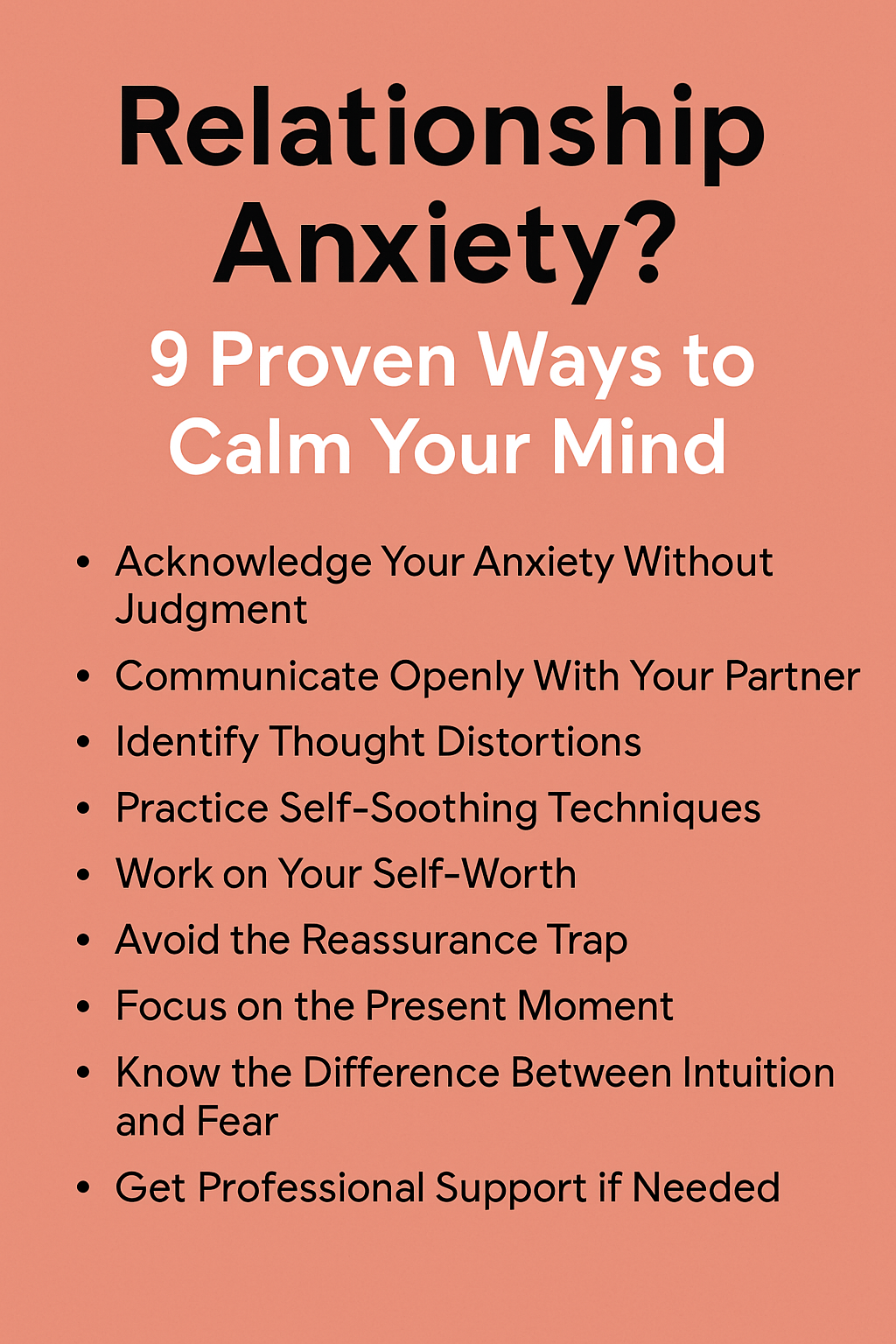
How to Cope With Relationship Anxiety
Let’s get into the practical, heart-centered strategies to help you calm your mind and nurture your relationship.
1. Acknowledge Your Anxiety Without Judgment
Start by recognizing your anxious thoughts instead of suppressing or denying them. Say to yourself:
“I’m feeling anxious about this. That’s okay. My feelings are valid, even if they’re uncomfortable.”
Creating space between your thoughts and your identity helps you respond with compassion instead of panic.
2. Communicate Openly With Your Partner
Anxiety often thrives in silence. Express your fears calmly and clearly to your partner—without blaming them. Try:
- “Sometimes I get in my head and worry you don’t care, even though I know you do.”
- “I’d love it if we could talk more about how we’re feeling.”
You’ll be surprised how many partners are willing to offer support when you open the door for connection instead of conflict.
3. Identify Thought Distortions
Anxious minds tend to exaggerate or misinterpret events. Watch for distorted thinking patterns like:
- Catastrophizing: “They didn’t text back—maybe they’re losing interest.”
- Mind reading: “They seem distracted. They must be mad at me.”
- All-or-nothing thinking: “If we fight, the relationship must be failing.”
Challenge those thoughts with evidence and ask yourself: “What else could be true here?”
4. Practice Self-Soothing Techniques
You can’t always rely on your partner to calm you down—nor should you have to. Build your own emotional toolkit:
- Deep breathing exercises
- Journaling your feelings
- Taking a mindful walk
- Talking to a therapist or trusted friend
- Listening to calming music
Self-regulation is key to staying grounded in moments of insecurity.
5. Work on Your Self-Worth
The stronger your relationship with yourself, the less likely you’ll feel destabilized in a relationship.
- Reconnect with hobbies and interests
- Affirm your worth daily
- Set boundaries and honor them
- Acknowledge your strengths and value
When you feel good about who you are, you stop tying your sense of security to how someone else feels about you.
6. Avoid the Reassurance Trap
While it’s okay to seek reassurance sometimes, constantly asking, “Do you love me?” or “Are we okay?” can push your partner away—and keep you dependent on their approval.
Instead, practice emotional self-validation:
“I may be feeling insecure right now, but that doesn’t mean the relationship is in danger.”
Trust in your bond, even in quiet or uncertain moments.
7. Focus on the Present Moment
Anxiety loves to live in the future—imagining breakups, abandonment, or disaster. Mindfulness can bring you back to what’s real right now.
Try:
- Body scans
- Guided meditations
- Focusing on your five senses
- Redirecting your attention to acts of love (a hug, a text, a shared laugh)
Presence is the antidote to panic.
8. Know the Difference Between Intuition and Fear
Sometimes, anxiety masks itself as “gut instinct.” Learning to tell them apart is crucial.
- Intuition feels calm, clear, and grounded.
- Anxiety feels urgent, obsessive, and chaotic.
Ask yourself:
“Is this a recurring fear I’ve had in other relationships? Or is this something truly off in this dynamic?”
Therapy or journaling can help you parse the difference over time.
9. Get Professional Support if Needed
Sometimes, relationship anxiety is too overwhelming to manage on your own. A licensed therapist—especially one trained in CBT (Cognitive Behavioral Therapy) or attachment theory—can help you unlearn patterns and build secure relationships.
There’s no shame in needing help. In fact, seeking support is a sign of emotional maturity.
A Gentle Reminder
Love isn’t about perfection—it’s about connection. If you’re struggling with relationship anxiety, it doesn’t mean you’re broken or unlovable. It means you care deeply and want to feel safe.
With awareness, practice, and patience, you can learn to love with more peace and less fear. You deserve a relationship that feels like a soft place to land—not a battleground of worry.
Your Relationship Can Thrive
Coping with relationship anxiety takes time, but it’s absolutely possible. Start small. Notice your thoughts, nurture your self-worth, and open your heart to clear and honest communication.
The more you work on your inner world, the more peace you’ll experience in your outer relationship.
You don’t have to be anxiety-free to be lovable—you just need to be aware, kind to yourself, and committed to growth.

Support Our Website!
We appreciate your visit and hope you find our content valuable. If you’d like to support us further, please consider contributing through the TILL NUMBER: 9549825. Your support helps us keep delivering great content!
If you’d like to support Nabado from outside Kenya, we invite you to send your contributions through trusted third-party services such as Remitly, SendWave, or WorldRemit. These platforms are reliable and convenient for international money transfers.
Please use the following details when sending your support:
Phone Number: +254701838999
Recipient Name: Peterson Getuma Okemwa
We sincerely appreciate your generosity and support. Thank you for being part of this journey!