

We Ain’t Done Yet… Expect Another One.
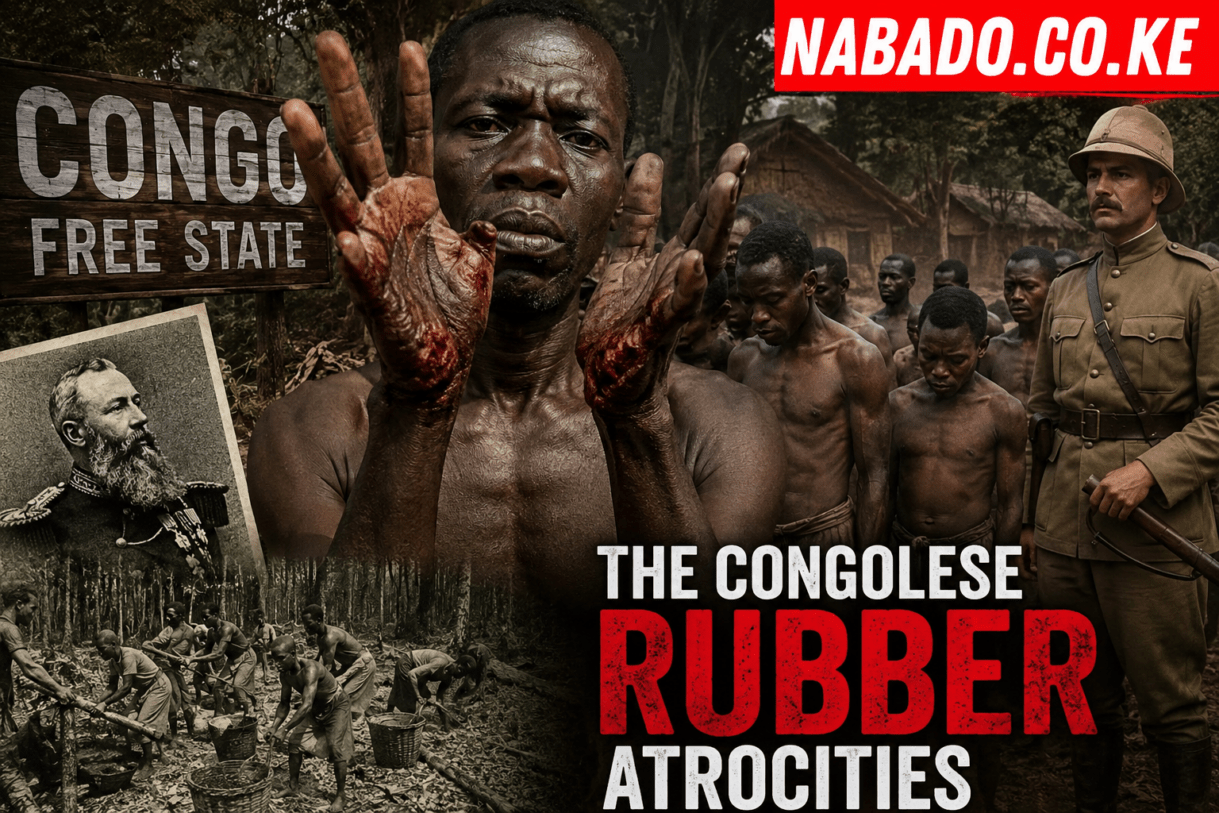
There are moments in history so horrifying that they almost seem impossible to believe. The story of the Congo Free State under the rule of Belgium’s King Leopold II is one of them. It is a chapter marked by unimaginable cruelty, where the pursuit of wealth mattered more than human life, and where millions of people paid the price for the world’s growing demand for rubber.
In the late 19th century, Europe was racing to expand its colonial empires across Africa. At the 1884–1885 Berlin Conference, European powers divided much of the continent among themselves. King Leopold II secured control over a vast territory in Central Africa that became known as the Congo Free State. Although he claimed his mission was to end slavery, promote trade, and bring civilization to the region, the reality on the ground was far different.
What unfolded in the Congo was one of the most brutal systems of colonial exploitation in modern history.
At first, ivory brought enormous profits to Leopold’s administration. But as bicycles, telegraph cables, electrical equipment, and eventually automobiles increased the world’s appetite for natural rubber, the forests of the Congo became even more valuable. Wild rubber vines grew abundantly throughout the region, and Leopold’s administration saw an opportunity to make a fortune.
That fortune, however, would come at a devastating human cost.
Villages across the Congo were ordered to collect rubber for colonial officials. Men were forced to leave their homes and spend days, sometimes weeks, deep inside dense rainforests harvesting latex from wild vines. The work was exhausting and dangerous. Collecting enough rubber to satisfy officials often meant abandoning farms, families, and normal village life.
The quotas imposed on workers were frequently impossible to meet. Yet failure was not considered an option.
To enforce production, the colonial administration relied on the Force Publique, a military force made up of European officers and African soldiers. Their job was not simply to oversee production but to ensure obedience through fear. Entire communities lived under the constant threat of violence.
When rubber quotas were missed, punishment followed swiftly. Villages were raided, homes were burned, and food supplies were destroyed. Men were beaten or imprisoned, while women and children were often taken hostage until the required amount of rubber had been delivered. Families found themselves trapped in a cycle where survival depended on meeting demands that grew more severe with each passing season.
One of the most chilling symbols of this period was the severing of hands.
The practice became associated with the Congo Free State because soldiers were expected to account for every bullet they fired. They were required to prove ammunition had not been wasted, often by presenting the severed right hand of a person they claimed to have killed. In reality, this system encouraged widespread abuse. Historical accounts and eyewitness testimony indicate that hands were sometimes cut from people who were still alive, while others were mutilated even when they had committed no crime.
Photographs of men, women, and children missing their hands later shocked the world and became enduring evidence of the brutality taking place in the Congo.
The violence reached far beyond individual punishments. Entire villages disappeared as frightened families fled into forests to escape forced labor. Farming was neglected because able-bodied adults spent most of their time gathering rubber. Crops failed, hunger spread, and diseases flourished among weakened communities.
Children lost parents, spouses were separated for months or years, and many communities never recovered from the destruction inflicted upon them.
The true number of people who died during Leopold’s rule will probably never be known with certainty. Reliable population records from the period were limited, making exact calculations impossible. However, many historians estimate that the population of the Congo declined by millions between the late nineteenth century and the early twentieth century. Deaths resulted not only from killings but also from famine, disease, exhaustion, displacement, and collapsing birth rates caused by the harsh conditions.
The human suffering was immense, regardless of the precise figure.
For years, much of the outside world knew little about what was happening inside the Congo. Leopold carefully promoted an image of himself as a humanitarian ruler. Meanwhile, reports of atrocities slowly emerged through missionaries, travelers, and government officials who witnessed the violence firsthand.
Among those who exposed the truth were British activist E.D. Morel and British diplomat Roger Casement. Morel noticed unusual shipping patterns between Belgium and the Congo, observing that weapons were being sent to Africa while valuable resources flowed back to Europe. Casement later traveled through the Congo and documented extensive evidence of forced labor, killings, hostage-taking, and widespread abuse.
Their reports, combined with photographs taken by missionaries, sparked one of the first international human rights campaigns in history. Newspapers across Europe and North America began publishing stories detailing the suffering of the Congolese people. Public outrage grew, placing increasing pressure on Leopold’s government.
Eventually, the international criticism became impossible to ignore.
In 1908, King Leopold II was forced to relinquish his personal ownership of the Congo Free State. The Belgian government assumed direct control of the territory. While some of the most extreme abuses declined after the transfer, colonial rule continued for decades, and many forms of exploitation remained deeply rooted.
Today, historians regard the Congo Free State as one of the starkest examples of how unchecked power and economic greed can produce catastrophic human suffering. The atrocities committed during the rubber boom continue to serve as a reminder of the devastating consequences of colonial exploitation and the importance of defending human rights.
Although more than a century has passed, the memories of that era remain significant. Survivors’ stories, missionary records, photographs, and historical research ensure that the victims are not forgotten. The Congo’s experience stands as a powerful warning about what can happen when profit is placed above human dignity.
The Congolese rubber atrocities were not simply a tragic episode in African history. They were a global lesson about the dangers of oppression, silence, and unchecked authority. Remembering what happened is not only about honouring those who suffered but also about ensuring that future generations understand the cost of allowing cruelty to flourish without accountability.
SUGGESTED READS
- The Town That Never Stopped Burning: The Chilling Story of Centralia’s Underground Fire
- The Ghost That Helped Solve a Murder: The Chilling Story of the Greenbrier Ghost
- The Russian Sleep Experiment Was Fake—But the Real Experiments Were Far More Terrifying
- The Corpse That Wouldn’t Decompose: The Haunting Mystery of Rosalia Lombardo
- Meet the Meru Man With 18+ Wives: Inside Kenya’s Most Extraordinary Family Empire
- The Green Children of Woolpit: The Medieval Mystery That Still Defies Explanation

Support Our Website!
We appreciate your visit and hope you find our content valuable. If you’d like to support us further, please consider contributing through the TILL NUMBER: 9549825. Your support helps us keep delivering great content!
If you’d like to support Nabado from outside Kenya, we invite you to send your contributions through trusted third-party services such as Remitly, western union, SendWave, or WorldRemit. These platforms are reliable and convenient for international money transfers.
Please use the following details when sending your support:
Phone Number: +254701838999
Recipient Name: Peterson Getuma Okemwa
We sincerely appreciate your generosity and support. Thank you for being part of this journey!