

simply amazing, always for you.
A True Story That Sounds Impossible
In the middle of one of the deadliest wars in human history, soldiers fighting for survival found comfort, laughter, and hope in the most unexpected companion imaginable — a bear.
Not a mascot.
Not a circus animal.
A real enlisted soldier.
His name was Wojtek, and somehow, against all odds, he became one of the most unforgettable figures of World War II.
Even decades later, people still struggle to believe the story is real. A bear carrying ammunition during battle sounds like something invented for a movie script or a children’s book. But Wojtek truly existed, and the soldiers who fought beside him never forgot him.
It Began With a Tiny Bear Cub
The story started in 1942 in the harsh landscapes of the Middle East.
Polish soldiers traveling through Iran encountered a young boy carrying a small Syrian brown bear cub. The cub had lost its mother, most likely killed by hunters. Weak, frightened, and alone, the bear would almost certainly have died in the wild.
The soldiers could not ignore him.
They traded supplies and food to take the cub with them, unaware that this tiny animal would eventually become a military legend.
The bear was named Wojtek, a Polish name meaning “happy warrior” or “joyful fighter.” At the time, nobody realized how perfectly that name would fit him.
The soldiers fed him condensed milk from an old vodka bottle. He slept beside them in tents and trucks as they crossed deserts and war-torn territories. In a world dominated by death and destruction, the little bear became a source of comfort.
For many soldiers who had endured prison camps, exile, starvation, and loss, Wojtek reminded them that life still contained innocence.
The Bear Who Behaved Like a Human
As Wojtek grew bigger, his personality became impossible to ignore.
He copied everything the soldiers did.
If they marched, he marched behind them. If they wrestled, he wrestled too. If they sat around smoking cigarettes, Wojtek would imitate them by holding the cigarettes in his mouth and sometimes even eating them.
He loved attention.
He loved wrestling with the troops.
And strangely enough, he loved beer. Soldiers would sometimes hand him a bottle, and Wojtek would gulp it down before happily stumbling around camp.
Despite growing into a massive bear weighing hundreds of pounds, he remained incredibly gentle with the men who raised him.
To the soldiers, he was no longer just an animal.
He was family.
A Bear Officially Joins the Army
As the Polish II Corps prepared to move toward the Italian front, a serious problem emerged.
Military regulations did not allow animals aboard transport ships.
The soldiers refused to abandon Wojtek.
So they came up with a solution so bizarre that it still shocks historians today: they officially enlisted the bear into the Polish Army.
Wojtek received a rank, a serial number, and official military status. On paper, he became a legitimate member of the army.
Only during a world war could something this unbelievable happen.
And somehow, everyone accepted it.
The giant bear boarded the ship with the troops and continued the journey toward one of the bloodiest battles of the war.
The Battle That Made Wojtek Famous
In 1944, Allied forces faced one of their toughest challenges at the Battle of Monte Cassino.
German forces controlled defensive positions high in the mountains of Italy. The battle became a nightmare of artillery fire, explosions, mud, and death.
Thousands of soldiers died trying to break through.
Amid this chaos, Wojtek did something nobody expected.
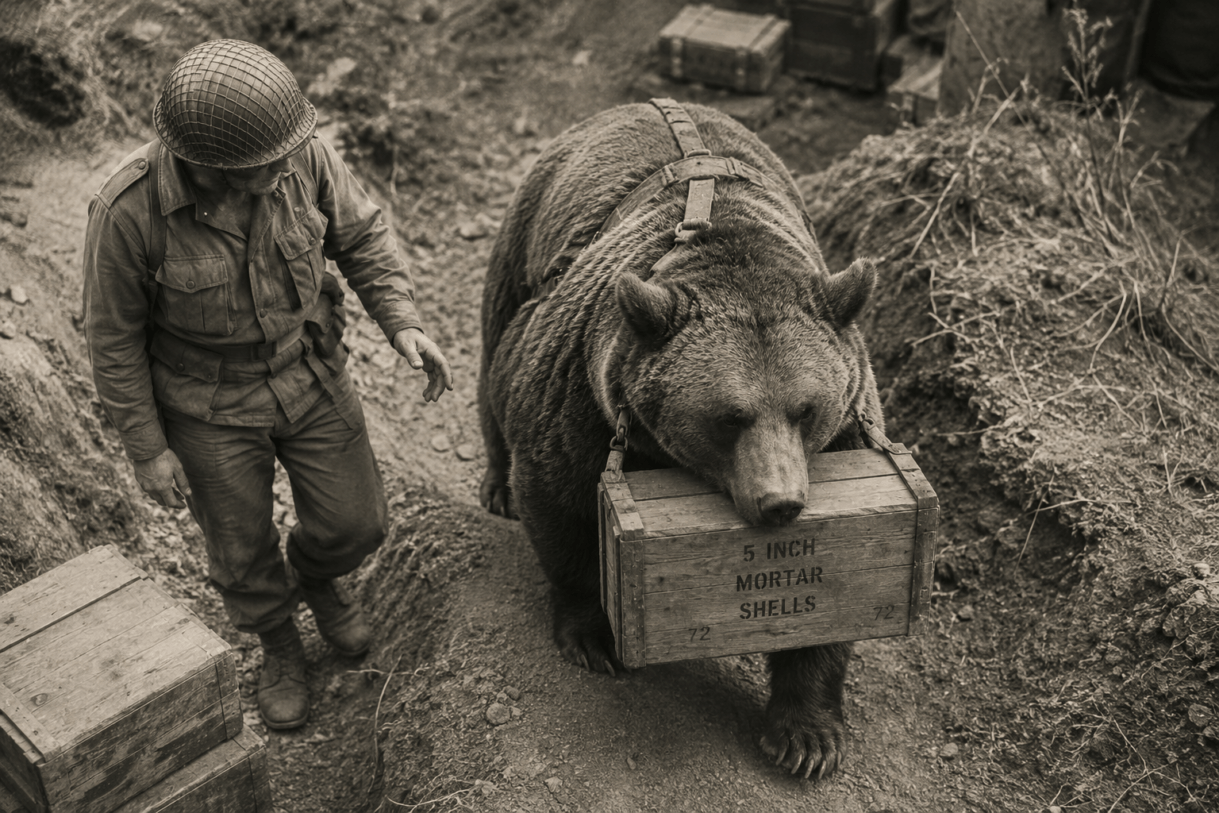
The soldiers noticed the bear watching them carry heavy crates of artillery shells. Instead of panicking at the noise and destruction, Wojtek began helping.
Witnesses said he lifted ammunition crates and carried them to waiting trucks and artillery positions.
Unlike many frightened humans during battle, the bear reportedly showed no fear.
He simply carried the boxes back and forth beside the soldiers.
The image became legendary: a massive brown bear transporting ammunition through a war zone while explosions thundered around him.
The Polish troops were stunned.
Soon, Wojtek’s actions became part of military folklore.
To honor him, the Polish 22nd Artillery Supply Company redesigned its official emblem to feature a bear carrying an artillery shell.
That symbol still survives today.
More Than a Mascot
Many wartime animals became symbols.
Wojtek became something deeper.
The soldiers who served beside him had lost homes, families, and entire countries to war. Many had survived Soviet labor camps before joining Allied forces. Trauma surrounded them constantly.
Yet the presence of this strange, playful bear gave them moments of humanity during unimaginable suffering.
He reminded exhausted men how to laugh again.
Some veterans later said Wojtek boosted morale better than speeches ever could.
He was living proof that even during war, kindness and friendship could survive.
Life After the War
When the war finally ended, peace did not arrive easily for the Polish troops.
Many could not safely return home because Poland had fallen under Soviet control. Instead, large numbers of Polish soldiers relocated to Britain.
Wojtek traveled with them to Scotland.
Eventually, he was placed in the Edinburgh Zoo, where crowds quickly became fascinated by the famous soldier bear.
But for the men who had fought beside him, visiting the zoo was emotional.
Former soldiers would call out his name in Polish, and witnesses claimed Wojtek still recognized their voices years later. Some reportedly climbed into the enclosure to wrestle and play with him one last time.
To outsiders, he was a curiosity.
To the soldiers, he was their brother-in-arms.
The Death of a Legend
Wojtek died in 1963.
But his story never disappeared.
Over time, documentaries, books, museums, and historians helped introduce him to new generations. Statues honoring him now stand in places like Edinburgh, London, and Kraków.
Children learn about him in schools.
Military historians study him.
And millions online continue to discover the unbelievable bear who became a soldier.
Why Wojtek’s Story Still Matters Today
The world has heard countless war stories filled with destruction, hatred, and death.
But Wojtek’s story feels different.
It reminds people that even during humanity’s darkest moments, compassion can still exist.
A group of exhausted soldiers could have ignored a starving cub beside a road in Iran.
Instead, they saved him.
And somehow, in return, the bear helped save part of them too.
That is why people continue sharing Wojtek’s story decades later. Not simply because it is strange, but because it feels deeply human.
In a war designed to destroy humanity, a bear helped soldiers remember theirs.
SUGGESTED READS
- Inside Kenya’s Protest Culture: Why Anger Keeps Exploding—and Why Hope Refuses to Die
- Voters Are Exhausted — Inside Kenya’s Rising Political Fatigue
- Kenya’s Democracy Is Being Tested — And Many Fear It’s Quietly Slipping Away
- What the 2027 Elections Mean for Kenya’s Economy and Jobs
- How Politics Is Quietly Reshaping Daily Life in Kenya
- Are Protests Becoming a Way of Life in Kenya? Inside a Country That Won’t Stay Silent
- Why Kenya’s Youth Are Angry — And Why Ignoring Them Is Dangerous

Support Our Website!
We appreciate your visit and hope you find our content valuable. If you’d like to support us further, please consider contributing through the TILL NUMBER: 9549825. Your support helps us keep delivering great content!
If you’d like to support Nabado from outside Kenya, we invite you to send your contributions through trusted third-party services such as Remitly, western union, SendWave, or WorldRemit. These platforms are reliable and convenient for international money transfers.
Please use the following details when sending your support:
Phone Number: +254701838999
Recipient Name: Peterson Getuma Okemwa
We sincerely appreciate your generosity and support. Thank you for being part of this journey!