

simply amazing, always for you.
There are criminals who steal money, and then there are criminals who steal identities, trust, and entire realities. Few people in modern history blurred the line between genius and deception quite like Frank Abagnale.
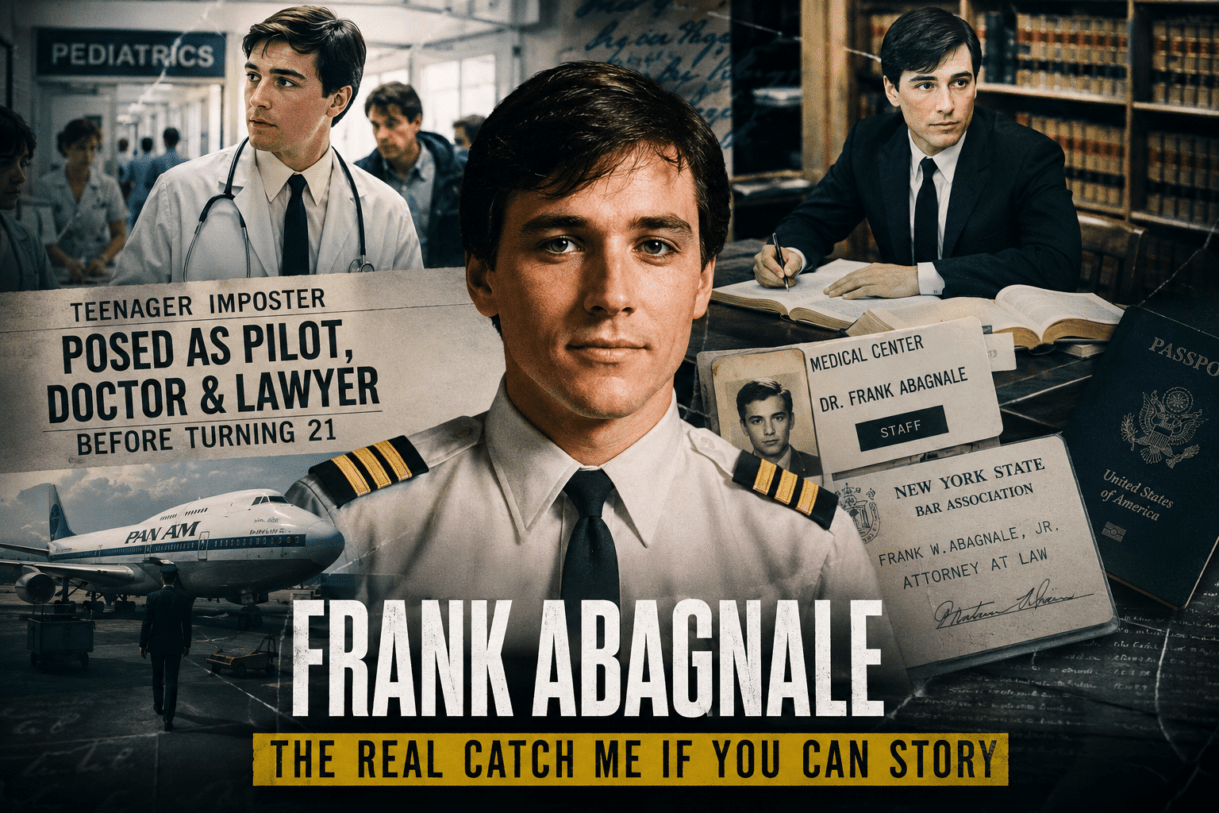
Before most young adults even finish college, Abagnale had already traveled the world pretending to be a pilot, lawyer, and doctor. He forged checks worth millions of dollars, tricked banks across several countries, escaped authorities multiple times, and somehow managed to stay ahead of law enforcement while still in his teenage years.
His unbelievable story later became the foundation of the hit film Catch Me If You Can starring Leonardo DiCaprio and Tom Hanks. But the movie only scratches the surface of how outrageous, daring, and psychologically fascinating his real-life adventures truly were.
The story of Frank Abagnale is more than a tale about fraud. It is a story about intelligence, confidence, manipulation, loneliness, ambition, and the dangerous power of appearances.
Who Is Frank Abagnale?
Frank William Abagnale Jr. was born on April 27, 1948, in New York City. At first glance, he seemed like an ordinary American teenager growing up in a middle-class household. But behind the scenes, his childhood was shaped by instability, emotional struggles, and a growing desire to escape reality.
His parents divorced when he was young, and according to Abagnale, the separation deeply affected him. The emotional damage reportedly pushed him toward rebellion and deception at an early age.
Unlike most teenage troublemakers, however, Abagnale possessed something unusual: exceptional intelligence combined with fearless confidence. He understood human psychology remarkably well for someone his age. He quickly learned that people often trust appearances more than facts.
That lesson became the foundation of one of the most infamous impersonation sprees in history.
The Beginning of the Fraud
Abagnale’s criminal journey reportedly began with small scams. As a teenager, he manipulated his father’s credit card to obtain cash and goods. While these early crimes were relatively minor compared to what would come later, they revealed his creativity and willingness to bend rules without guilt.
Eventually, he ran away from home and began living independently while still a teenager. With limited money and no formal qualifications, he needed a way to survive.
Instead of getting a normal job, he decided to create entirely new identities.
That decision changed everything.
Pretending to Be a Pilot
One of Abagnale’s most famous impersonations involved pretending to be an airline pilot for Pan Am.
The idea itself sounds impossible. Becoming a pilot normally requires years of training, licenses, and technical expertise. Yet Abagnale managed to convince people that he was a legitimate pilot while barely out of his teens.
He reportedly forged identification documents and obtained a pilot uniform. The uniform alone gave him instant credibility. People saw the outfit and automatically assumed authority and professionalism.
This was one of the greatest lessons from Abagnale’s scams: humans are heavily influenced by symbols of status.
As a fake pilot, Abagnale used a practice called “deadheading,” which allowed airline staff to travel for free while off duty. By exploiting this system, he flew across the world without paying for tickets.
He stayed in hotels, interacted with airline crews, and moved through airports confidently enough that few people questioned him.
The sheer audacity of the scam amazed investigators later. Most people would be terrified of getting caught within hours. Abagnale maintained the role for an extended period while traveling internationally.
The Fake Doctor Scandal
Perhaps even more shocking was his period pretending to be a doctor.
According to widely circulated accounts, Abagnale posed as a pediatrician in Georgia while still very young. He allegedly introduced himself under a false identity and temporarily worked around a hospital environment.
The terrifying part of this story is not just the fraud itself, but how easily people accepted his presence.
Hospitals are supposed to be places of strict professional standards. Doctors undergo intense education, licensing exams, and years of supervised training. Yet a teenager with confidence and forged credentials reportedly managed to convince medical professionals that he belonged there.
Fortunately, Abagnale later claimed he avoided performing actual medical procedures because he feared harming someone. Whether entirely true or partially exaggerated, the story still exposed serious weaknesses in verification systems during that era.
The incident became one of the most disturbing examples of how appearances and confidence can override scrutiny.
Becoming a Fake Lawyer
As if pretending to be a pilot and doctor was not outrageous enough, Abagnale also impersonated a lawyer.
According to his accounts, he forged legal credentials and even passed the Louisiana bar exam after intense self-study. While some details of his stories have been debated over the years, there is little doubt that he successfully convinced people he was a legitimate legal professional for a period of time.
Again, his success relied heavily on psychology.
Most people assume professionals must be genuine if they speak confidently, dress appropriately, and understand enough technical language. Abagnale exploited this assumption repeatedly.
His ability to adapt to different industries demonstrated remarkable intelligence and observational skills. He studied how professionals behaved, how they talked, and how institutions operated.
Then he stepped into those worlds pretending he belonged there.
And often, people believed him.
The Art of Check Forgery
While his impersonations grabbed headlines, forged checks were actually the foundation of Abagnale’s criminal empire.
During the 1960s, banking systems were far less technologically advanced than today. Verification processes were slower, communication between banks was limited, and identification standards were easier to manipulate.
Abagnale exploited these weaknesses brilliantly.
He created fake checks, altered account information, and manipulated bank procedures to cash fraudulent payments across multiple countries. Authorities estimated the total damage reached millions of dollars in today’s value.
His methods were sophisticated for someone so young. He understood printing techniques, banking routines, document design, and timing. He also knew how to exploit human trust.
Many bank employees simply assumed a confident, well-dressed young man could not possibly be a criminal.
That assumption cost financial institutions enormous sums of money.
How Confidence Became His Greatest Weapon
One reason Frank Abagnale’s story continues to fascinate people decades later is because his greatest tool was not technology or violence.
It was confidence.
He understood something powerful about human behavior: most people avoid confrontation and rarely question someone who appears legitimate.
A uniform, a professional title, or confident speech often becomes enough to bypass suspicion.
This psychological phenomenon still exists today.
People continue falling for scams because fraudsters know how to create credibility. Whether online or in person, scammers exploit trust, urgency, authority, and appearance.
Abagnale mastered these tactics long before the digital age.
Living a Double Life
Behind the glamorous image of travel and deception was a lonely and exhausting reality.
Living under fake identities meant constant fear of exposure. Every conversation carried risk. Every encounter with authorities could end in arrest.
Abagnale reportedly had to memorize false backgrounds, maintain fake documents, and constantly adjust his stories depending on the situation.
Imagine being a teenager carrying the pressure of international fraud investigations while pretending to be respected professionals every day.
The mental strain must have been enormous.
Many experts believe his behavior reflected not just criminal ambition but also emotional instability and a desperate search for identity.
The Global Manhunt
Eventually, authorities around the world began connecting the dots.
Banks, airlines, and law enforcement agencies realized a highly intelligent young fraudster was operating internationally. The scale of the deception triggered a global investigation.
Abagnale became one of the most wanted con artists of his era.
For years, he managed to evade capture by constantly moving between locations and identities. But eventually, the law caught up with him.
In 1969, French police arrested him after a flight attendant reportedly recognized him and alerted authorities.
He was imprisoned in France before later being transferred to Sweden and eventually the United States.
At the time of his arrest, he was still extremely young.
That fact shocked investigators even more than the fraud itself.
Prison and Transformation
Many criminal stories end in tragedy or lifelong criminal behavior. Abagnale’s story took a different direction.
After serving prison time, he reportedly began cooperating with federal authorities, especially the FBI. His expertise in fraud, document security, and scams became valuable to law enforcement agencies trying to combat financial crime.
Instead of continuing down a destructive path, he reinvented himself.
Over time, Abagnale built a legitimate career as a security consultant and fraud prevention expert. He advised banks, corporations, and government agencies on how to identify weaknesses in their systems.
Ironically, the same skills that once helped him deceive institutions were later used to protect them.
This transformation became one of the most fascinating aspects of his legacy.
Did Everything Really Happen?
Over the years, some journalists and researchers have questioned parts of Abagnale’s story.
Certain claims from his autobiography have reportedly been difficult to verify completely. Some investigators believe portions of his adventures may have been exaggerated or dramatized over time.
This debate has added another layer of mystery to his reputation.
Even if some details were embellished, however, there is no doubt that Abagnale committed major frauds, impersonated professionals, and became one of the most famous con artists in American history.
In many ways, the uncertainty itself fits perfectly with his legend.
After all, deception was his specialty.
The Success of Catch Me If You Can
In 2002, Hollywood transformed Abagnale’s life story into a blockbuster film.
Catch Me If You Can became one of the most popular crime dramas of the decade. Directed by Steven Spielberg, the movie starred Leonardo DiCaprio as Frank Abagnale and Tom Hanks as the FBI agent pursuing him.
The film combined suspense, humor, emotion, and psychological drama. Audiences were captivated by the idea of a teenager successfully deceiving entire industries.
Leonardo DiCaprio’s performance helped turn Abagnale into a pop culture icon.
The movie also explored deeper emotional themes, especially Frank’s fractured relationship with his parents and his longing for stability.
Rather than portraying him as a simple villain, the film showed a complicated young man searching for belonging while spiraling deeper into deception.
Why the Story Still Fascinates the World
The Frank Abagnale story remains popular decades later because it taps into several universal human fascinations.
1. The Genius Criminal Archetype
People are often intrigued by highly intelligent criminals who outsmart powerful systems. From fictional masterminds to real-life con artists, society has long been fascinated by people who manipulate institutions using brains instead of violence.
2. The Power of Appearance
His story reminds people how easily humans judge credibility based on appearances. A uniform, title, or confident attitude can influence perception dramatically.
3. The Rebellion Fantasy
Many people secretly fantasize about escaping rules and reinventing themselves. Abagnale represented a dangerous version of that fantasy.
4. Redemption
Unlike many criminals, he eventually transformed his life and used his knowledge constructively. That redemption arc made his story even more compelling.
Lessons Modern Society Can Learn
Although Abagnale’s story feels almost cinematic, it contains serious lessons that remain relevant today.
Verification Matters
Modern organizations now invest heavily in background checks, identity verification, and cybersecurity because deception can have devastating consequences.
Confidence Is Not Proof
People should avoid assuming someone is trustworthy simply because they appear professional or confident.
Fraud Evolves
While Abagnale used forged checks and fake documents, modern scammers use phishing emails, fake websites, AI-generated voices, and identity theft.
The methods change, but the psychology remains similar.
Frank Abagnale’s Legacy Today
Today, Frank Abagnale is widely known not just for his crimes but also for his work in fraud prevention.
He has written books, given lectures, and worked with businesses to improve security systems. His life story continues to inspire documentaries, articles, podcasts, and discussions about identity, trust, and criminal psychology.
Some people view him as a redeemed expert.
Others still see him primarily as a con artist whose legend may contain exaggerations.
Either way, his impact on popular culture is undeniable.
The Thin Line Between Intelligence and Manipulation
One of the most unsettling aspects of the Frank Abagnale story is how intelligence can be used in completely opposite directions.
The same creativity that could build innovation can also build deception.
The same confidence that inspires trust can manipulate people.
Abagnale’s story forces society to confront uncomfortable questions about human nature, institutions, and vulnerability.
Why do people trust symbols of authority so easily?
Why are appearances often more convincing than evidence?
How many systems rely more on assumption than verification?
These questions remain deeply relevant in the digital age.
The story of Frank Abagnale sounds almost too unbelievable to be real. A teenager pretending to be a doctor, lawyer, and airline pilot while cashing forged checks across the world feels more like a Hollywood script than actual history.
Yet the reality is that confidence, intelligence, and manipulation allowed him to fool institutions that were supposed to be secure.
His journey from runaway teenager to global con artist and eventually fraud consultant remains one of the most extraordinary transformation stories ever recorded.
Whether viewed as a cautionary tale, a psychological study, or a fascinating piece of criminal history, Frank Abagnale’s life continues to captivate audiences because it reveals something unsettling about the world:
Sometimes people do not believe what is true.
They believe what looks believable.
SUGGESTED READS
- How a Harvard Teenager Accidentally Built One of the World’s Biggest Companies
- The Bird That Lived Without a Head for 18 Months
- The Man Who Survived Two Atomic Bombs: The Unbelievable Story of Tsutomu Yamaguchi
- The 3-Meter Mistake That Almost Cost Her Life
- Captain Irene Koki Mutungi: The Girl Who Touched the Sky
- Maina Njenga: Prophet, Cult Leader or Political Pawn?
- The Mau Mau Rebellion: Kenya’s First War for Freedom

Support Our Website!
We appreciate your visit and hope you find our content valuable. If you’d like to support us further, please consider contributing through the TILL NUMBER: 9549825. Your support helps us keep delivering great content!
If you’d like to support Nabado from outside Kenya, we invite you to send your contributions through trusted third-party services such as Remitly, western union, SendWave, or WorldRemit. These platforms are reliable and convenient for international money transfers.
Please use the following details when sending your support:
Phone Number: +254701838999
Recipient Name: Peterson Getuma Okemwa
We sincerely appreciate your generosity and support. Thank you for being part of this journey!