

simply amazing, always for you.
The Great Emu War: The Real Battle Australia Fought Against Emus
It sounds like something invented for a comedy movie or a viral internet meme. An entire government sending armed soldiers with machine guns to fight giant birds sounds impossible. But the “Great Emu War” was absolutely real.
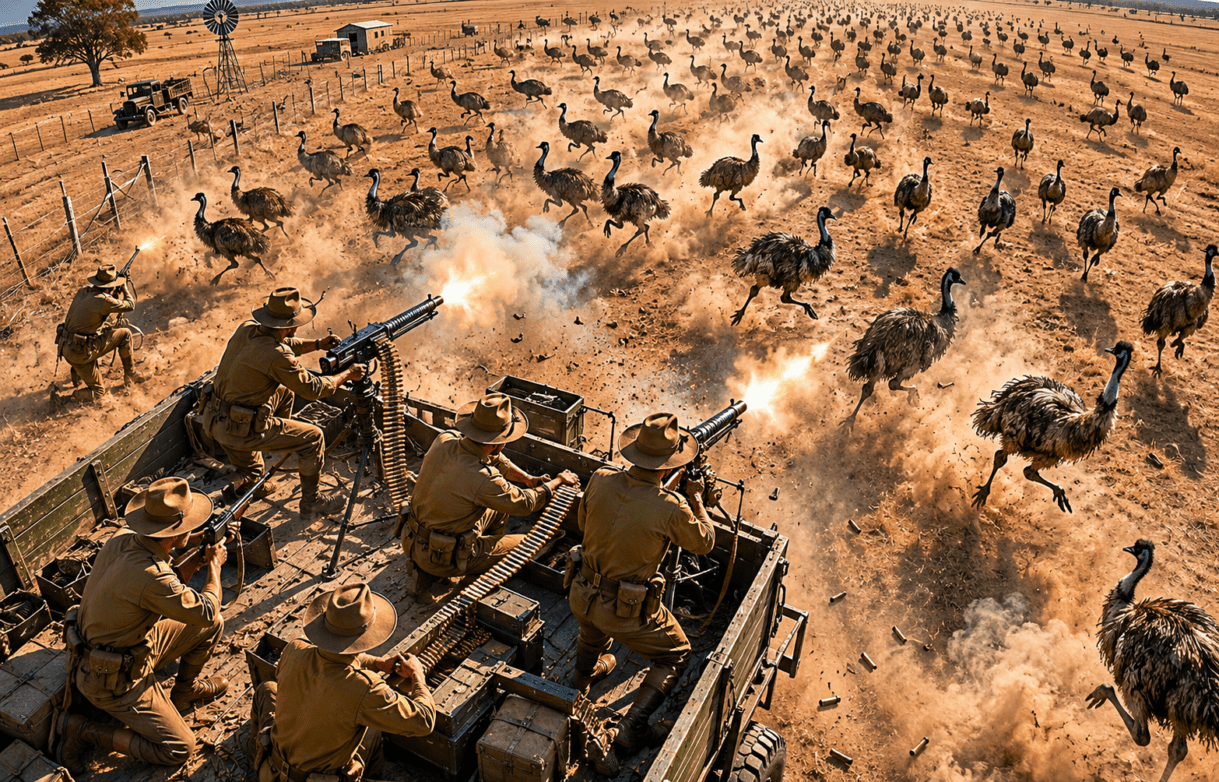
In 1932, the Australian military was deployed to Western Australia to stop an invasion of emus that were devastating farmland. The soldiers carried rifles and Lewis machine guns. The enemy? Around 20,000 large, fast, stubborn birds.
And somehow, despite all the firepower, the emus came out looking like the winners.
The story of the Emu War has become one of the most bizarre chapters in modern history. But behind the jokes lies a real economic crisis, desperate farmers, political pressure, and a military operation that quickly turned into a national embarrassment.
What Is the Emu War?
The “Emu War” refers to a wildlife management operation carried out in Australia in late 1932. The Australian government sent soldiers to Western Australia to reduce the massive emu population that was destroying crops during the Great Depression.
The emus were not attacking people. They were raiding farmland.
After World War I, many Australian veterans were encouraged to settle in Western Australia and become farmers. The government divided land and gave former soldiers farming opportunities as part of a settlement program. But the area faced harsh agricultural conditions, poor rainfall, and financial struggles.
Then came another problem: emus.
Every year, huge flocks of emus migrated inland after breeding season. In 1932, around 20,000 emus moved into farming regions near Campion and Walgoolan in Western Australia. The birds trampled crops, damaged fences, and consumed large amounts of wheat.
For struggling farmers already suffering through the Great Depression, the losses were devastating.
Why Emus Became a Massive Problem
Emus are enormous flightless birds native to Australia. They can grow nearly six feet tall and run at speeds up to 50 kilometers per hour. They are powerful, resilient, and surprisingly difficult to stop.


4
Farmers discovered that traditional fencing did little to keep the birds out. Once emus entered the farmland, they ate crops rapidly and created openings in fences that allowed rabbits to invade as well.
The situation became so serious that farmers demanded government intervention.
At first, they asked for military assistance because many of the farmers were former soldiers themselves. They believed machine guns could quickly eliminate the emu threat.
The government agreed.
That decision would become legendary.
Australia Sends Soldiers Into Battle
In November 1932, the Australian government deployed soldiers led by Major G.P.W. Meredith of the Royal Australian Artillery. The military operation included two Lewis machine guns and around 10,000 rounds of ammunition.
The mission sounded simple: reduce the emu population and protect farmland.
Reality turned out very different.
The soldiers quickly discovered that emus were not easy targets. The birds moved in scattered groups, making them difficult to hit effectively. They were also incredibly fast and could suddenly change direction while running.
Major Meredith later described the birds almost like military opponents.
According to reports, emu groups appeared organized. Some birds even seemed to act as lookouts while others fed. When danger approached, the flock scattered rapidly.
Machine guns struggled to hit moving targets across rough terrain.
The First Attack Failed Miserably
The first major ambush took place near Campion. Soldiers spotted around 50 emus and prepared to open fire.
But before the machine guns could fully engage, the birds scattered in multiple directions.
Only a handful were killed.
Another attempt involved setting up near a dam where emus frequently gathered. This operation initially seemed more promising. Hundreds of birds approached the area.
But then the gun jammed.
By the time the weapon was operational again, most of the emus had escaped.
The operation quickly became embarrassing.
Journalists began mocking the military campaign. Newspapers turned the entire event into a national joke. Headlines compared the emus to an undefeated army humiliating trained soldiers.
The Emus Adapted Faster Than Expected
One reason the military struggled was because emus naturally behave unpredictably.
Unlike tightly packed animal herds, emus move loosely and react instantly to danger. When attacked, they scatter at high speed, making machine-gun fire inefficient.
Major Meredith reportedly admired the birds’ toughness. Some wounded emus continued running long distances even after being shot.
The soldiers even mounted machine guns onto trucks in an attempt to chase the birds. But the rough terrain made accurate firing nearly impossible. The trucks could not keep up with the fast-moving emus.
At one point, the military reportedly fired thousands of rounds with relatively few confirmed kills.
The birds simply kept coming.
Public Humiliation and Political Pressure
As news spread, the Emu War became an international curiosity.
People around the world laughed at the idea of a modern military struggling against giant birds.
Australian politicians faced criticism over the operation’s cost and effectiveness. Questions emerged about why military resources were being used in such an unusual campaign during difficult economic times.
After several failed attempts, the government temporarily withdrew the soldiers.
But the emu problem did not disappear.
Farmers continued pleading for help as crops were destroyed. Eventually, military operations resumed briefly later in 1932, leading to more bird casualties.
Still, the overall campaign was considered unsuccessful.
The emus remained widespread across the region.
Did the Emus Actually “Win”?
Technically, thousands of emus were killed during the operations and later control programs. But the military failed to achieve its original goal of significantly reducing the population or ending the agricultural destruction.
That is why people jokingly say the emus won the war.
The phrase became part of internet culture decades later. Today, the Emu War is often used as an example of how nature can sometimes outsmart humans despite advanced technology.
Memes portray the birds as victorious warriors who defeated machine guns through speed, chaos, and sheer numbers.
But beneath the humor, the situation reflected real hardship for Australian farmers.
The Great Depression Played a Huge Role
To fully understand the Emu War, it is important to remember the historical context.
Australia was suffering economically during the Great Depression. Wheat prices were low. Farming conditions were harsh. Many veterans who settled the land were struggling financially.
The emu invasion was not just an inconvenience. For some families, it threatened their survival.
The government initially promised financial assistance and farming support, but many farmers felt abandoned when those promises failed to fully materialize.
The military operation was partly an attempt to show action during mounting frustration.
Instead, it became one of history’s strangest public relations disasters.
How Australia Eventually Managed the Problem
After the failed military campaign, Australia shifted toward more practical methods of wildlife management.
Better fencing became one of the most effective solutions. Exclusion barriers helped reduce crop damage more efficiently than machine guns ever did.
The government also introduced bounty systems that rewarded hunters for killing emus.
Over time, agricultural strategies improved, and the crisis became more manageable.
But the legend of the Emu War never disappeared.
Why the Emu War Still Fascinates People Today
The story continues to go viral because it combines absurdity with reality.
People are fascinated by the idea that:
- A government officially launched a military operation against birds
- Soldiers used machine guns against wildlife
- The operation failed badly enough to become historical comedy
- The “enemy” was a flock of giant flightless birds
It feels fictional, yet it happened.
The Emu War also survives because it reflects a deeper truth about human confidence. History is full of moments where people underestimated nature.
The Australian military entered the operation believing modern weapons would easily solve the problem.
Instead, they encountered an opponent perfectly adapted to the terrain.
What Are Emus Actually Like?


6
Emus are the second-largest living birds in the world after ostriches. Native to Australia, they are highly adaptable and capable of surviving in extreme conditions.
Some fascinating facts about emus include:
- They can sprint at high speeds
- They have powerful legs capable of long-distance travel
- They can survive with limited water
- Male emus incubate eggs and raise chicks
- They are highly alert and difficult to corner
Their intelligence and mobility were major reasons the military struggled during the 1932 operation.
The Emu War Became Internet Legend
In recent years, the Emu War has exploded online through memes, documentaries, podcasts, YouTube videos, and social media discussions.
The phrase “Australia lost a war to birds” has become shorthand for unexpected failure.
The story is often exaggerated humorously, but the core events are historically documented.
Even historians sometimes describe the episode with amusement because of how surreal it sounds.
Yet it remains one of the most unique examples of human conflict with wildlife in modern history.
Lessons From the Emu War
The Emu War may sound hilarious today, but it also teaches several lessons:
- Nature is often harder to control than expected
- Technology does not guarantee success
- Poor planning can turn serious problems into public embarrassment
- Wildlife management requires long-term solutions, not quick fixes
Most importantly, it reminds people that history is sometimes stranger than fiction.
Very few countries can say they deployed soldiers with machine guns against birds and failed to decisively win.
Australia can.
And that is exactly why the Great Emu War continues to fascinate the world nearly a century later.
The Great Emu War remains one of the weirdest true stories ever recorded. What began as an agricultural crisis during the Great Depression transformed into an unforgettable historical event that still entertains people decades later.
Thousands of emus marched across Australian farmland. Soldiers arrived with military weapons. Machine guns opened fire.
And somehow, the birds kept running.
That strange combination of comedy, history, and chaos is why the Emu War has become legendary.
Sometimes the most unbelievable stories are the real ones.
SUGGESTED READS
- The Rise, Evolution, and Impact of the Sungusungu Vigilantes in Kisii, Kenya
- Mungiki: The Rise, Fall, and Shadows of Kenya’s Most Feared Underground Movement
- The Coffin Thief of Nairobi: The True Story of John Kibera
- The Dark Legacy of Okija Shrine: Nigeria’s Most Notorious Traditional
- How Foday Sankoh Led Sierra Leone into Chaos: The Ruthless Rise of a Rebel
- The Last Blessing: The Man Who Made It Rain From Heaven
- The Blood Oath: Rise of the Bakassi Boys

Support Our Website!
We appreciate your visit and hope you find our content valuable. If you’d like to support us further, please consider contributing through the TILL NUMBER: 9549825. Your support helps us keep delivering great content!
If you’d like to support Nabado from outside Kenya, we invite you to send your contributions through trusted third-party services such as Remitly, western union, SendWave, or WorldRemit. These platforms are reliable and convenient for international money transfers.
Please use the following details when sending your support:
Phone Number: +254701838999
Recipient Name: Peterson Getuma Okemwa
We sincerely appreciate your generosity and support. Thank you for being part of this journey!