

simply amazing, always for you.
In the history of aviation disasters, few stories are as shocking, mysterious, and unbelievable as the survival of Vesna Vulović. Imagine falling from more than 33,000 feet without a parachute, after your airplane explodes in midair, and somehow surviving. It sounds like something from a Hollywood movie, but it really happened.
For more than five decades, the story of Vesna Vulović has fascinated historians, aviation experts, journalists, and ordinary people around the world. Her survival remains one of the greatest miracles in modern history and earned her a permanent place in the Guinness World Records.
What happened aboard that doomed flight in 1972 continues to raise questions even today. Was it luck? Fate? Science? Or an extraordinary combination of all three?
This is the full story of the woman who survived the deadliest fall ever recorded without a parachute.
Who Was Vesna Vulović?
Vesna Vulović was born on January 3, 1950, in what was then Yugoslavia, now modern-day Serbia. Like many young people at the time, she dreamed of seeing the world. She became fascinated with travel after listening to stories from a friend who had visited London.
Determined to work in aviation, she joined the national airline known as JAT Yugoslav Airlines. She trained as a flight attendant and quickly embraced the exciting lifestyle that came with international travel.
Friends and coworkers described her as cheerful, ambitious, and adventurous. Nobody could have imagined that she would one day become part of one of the most horrifying aviation incidents in history.
Ironically, some reports later suggested that Vesna may not even have been supposed to be on the flight that changed her life forever. According to popular accounts, another employee with a similar name was originally assigned to the route, and a mix-up led to Vulović boarding the aircraft instead.
Whether that detail is entirely true or partly exaggerated over time, it only adds to the mystery surrounding the event.
The Flight That Ended in Disaster
On January 26, 1972, JAT Yugoslav Airlines Flight 367 departed from Stockholm, Sweden, heading toward Belgrade, Yugoslavia, with scheduled stops along the way.
The aircraft used for the flight was a McDonnell Douglas DC-9, a popular passenger jet at the time. There were 28 people aboard, including crew members and passengers.
Everything appeared normal during the early stages of the journey.
But high above Czechoslovakia, disaster struck.
At approximately 33,000 feet, the aircraft suddenly exploded in midair.
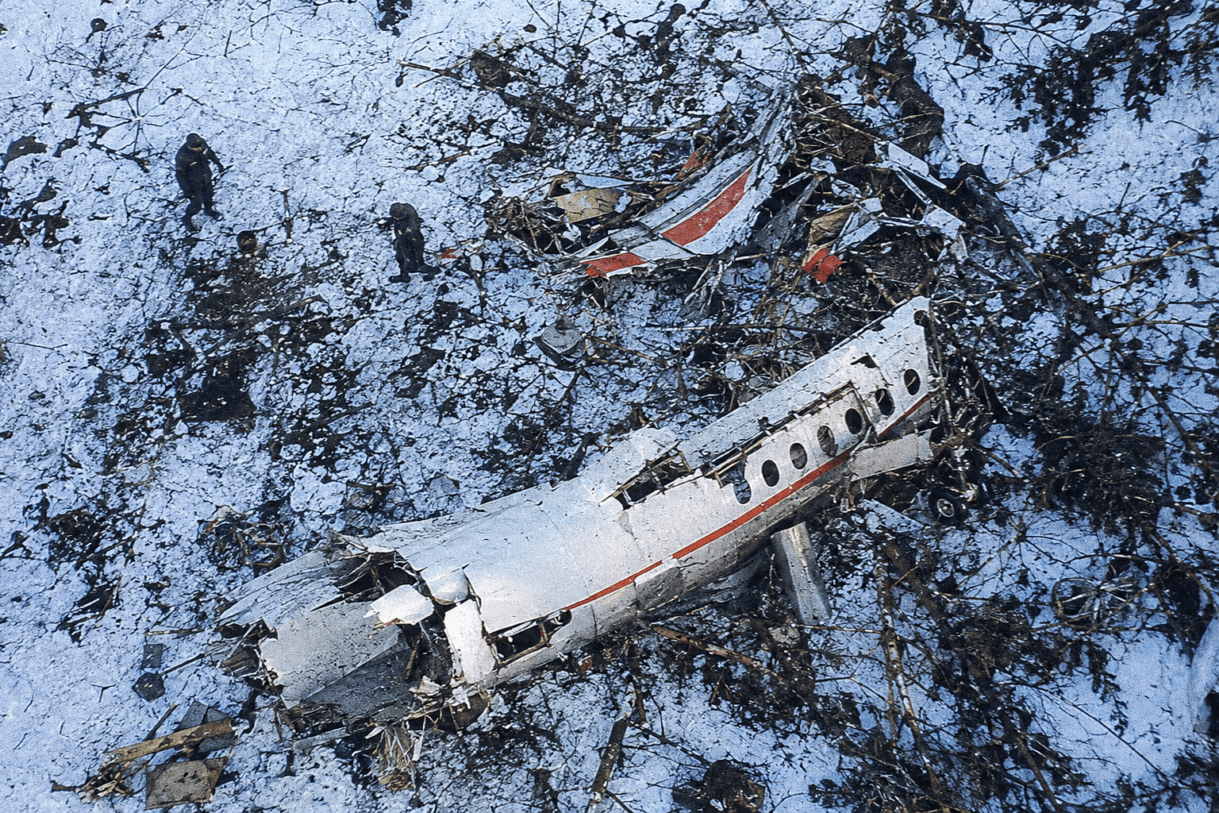
The blast tore the plane apart almost instantly, scattering wreckage across snowy mountains and forests near the village of Srbská Kamenice in what is now the Czech Republic.
Most people aboard died immediately during the explosion or the fall.
Yet somehow, against every law of probability, one person survived.
That person was Vesna Vulović.
Falling From the Sky
When the aircraft disintegrated, pieces of the plane plummeted toward Earth at terrifying speed. Under normal circumstances, surviving such a fall would be considered impossible.
Experts later concluded that Vulović was trapped inside a section of the aircraft fuselage. A food cart reportedly pinned her inside the wreckage, preventing her from being thrown completely out into open air.
The section of the plane she was trapped in crashed into a heavily wooded, snow-covered mountainside. Those conditions likely reduced the impact force enough to make survival barely possible.
Even then, her injuries were catastrophic.
She suffered:
- A fractured skull
- Broken ribs
- Broken legs
- A fractured pelvis
- Crushed vertebrae
- Internal bleeding
- Temporary paralysis
Most people would not survive even a fraction of those injuries.
But somehow, she did.
The Man Who Found Her Alive
One of the most important figures in the story was a local villager named Bruno Honke.
Honke, a former medic during World War II, rushed toward the crash site after hearing the explosion. As he searched through the wreckage, he discovered Vulović alive inside part of the aircraft.
She was severely injured and drifting in and out of consciousness.
His wartime medical experience may have helped keep her alive long enough for rescuers to arrive.
Without him, Vesna Vulović might not have survived the crash at all.
Weeks in a Coma
After the accident, Vulović was transported to a hospital in Prague in critical condition.
Doctors initially doubted she would survive.
She remained in a coma for several days and required multiple surgeries over the following months. Her injuries were so severe that medical teams struggled to stabilize her condition.
At one point, her lower body was temporarily paralyzed.
Yet even during recovery, her resilience shocked doctors.
Gradually, she began regaining movement and strength.
Although she would continue to experience physical pain for much of her life, she eventually recovered enough to walk again and resume many normal activities.
Perhaps most astonishingly, she reportedly had no memory of the explosion itself.
The last thing she remembered before the crash was greeting passengers as they boarded the plane.
Her next memory was waking up in a hospital.
The Guinness World Record
Because of the altitude involved, Vesna Vulović was officially recognized by Guinness World Records for surviving the highest fall without a parachute.
Her fall was measured at approximately 10,160 meters, or 33,333 feet.
No other person has survived a freefall from a greater height without parachute equipment.
The record still stands today.
Over the years, countless people have survived incredible accidents, but Vulović’s case remains unique because of the altitude, the violence of the explosion, and the sheer improbability of survival.
Even aviation experts continue to describe the event as almost impossible.
What Caused the Plane Explosion?
The official investigation concluded that a bomb exploded inside the aircraft’s baggage compartment.
Authorities at the time suspected Croatian nationalist extremists were responsible for the attack. During the political tensions of the era, Yugoslavia experienced several acts of terrorism linked to separatist groups.
Investigators believed an explosive device detonated aboard Flight 367, causing the aircraft to break apart in midair.
However, like many historical disasters, alternative theories later emerged.
Some journalists and researchers questioned aspects of the official investigation decades later. A controversial theory suggested the plane may have been accidentally shot down by military aircraft at a lower altitude rather than destroyed by a bomb at cruising height.
Despite those claims, the official explanation remains that a bomb caused the disaster.
Regardless of the exact cause, one fact remains undeniable:
Vesna Vulović survived one of the deadliest falls in human history.
How Was Survival Even Possible?
The biggest question surrounding the story is simple:
How did she survive?
Scientists and aviation experts have proposed several explanations.
1. She Was Trapped Inside the Fuselage
Instead of falling directly through open air, Vulović remained trapped within part of the aircraft structure. That reduced direct wind exposure and may have distributed impact forces differently.
2. Snow and Trees Softened the Impact
The wreckage landed on a snow-covered mountainside surrounded by dense trees. Those natural conditions likely absorbed some of the crash energy.
3. Low Blood Pressure May Have Helped
Doctors reportedly believed Vulović’s unusually low blood pressure prevented her heart from bursting during the rapid decompression caused by the explosion.
4. Pure Luck
Even experts admit luck played a massive role.
Tiny differences in angle, speed, terrain, or body position could have resulted in death.
Many describe her survival as a statistical miracle.
A Global Symbol of Survival
After recovering, Vesna Vulović became internationally famous.
People around the world saw her as a symbol of hope, resilience, and human endurance.
Newspapers called her “the luckiest woman alive.”
She appeared in interviews, documentaries, and television programs discussing the disaster and her recovery.
Interestingly, she reportedly disliked being viewed as a celebrity.
Friends later said she struggled emotionally with the attention and with the trauma of being the sole survivor of such a tragedy.
Survivor’s guilt became part of her life.
While the world celebrated her miracle, she carried the memories of the people who died aboard the flight.
Returning to Aviation
One surprising part of her story is that Vulović did not develop a fear of flying.
After recovering, she even returned to work for JAT Yugoslav Airlines, although she was assigned desk duties rather than cabin service.
Her courage impressed many people.
Most individuals would likely never board another airplane after such an experience.
But Vulović reportedly remained calm about flying and did not allow fear to dominate her life.
That attitude only increased public fascination with her story.
Media Fascination and Pop Culture
The story of Vesna Vulović has inspired books, documentaries, television specials, and endless online discussions.
People remain fascinated because the event seems to defy logic.
Searches related to her survival continue trending online decades later:
- Woman survived 33,000-foot fall
- Highest fall survived without parachute
- Plane explosion survivor
- Miracle aviation survival stories
- Vesna Vulović true story
Her name has become permanently connected to the idea of impossible survival.
Even in today’s world of viral internet stories, her experience still sounds unbelievable.
The Psychology of Surviving the Impossible
Stories like Vulović’s deeply affect people because they challenge our understanding of fate and mortality.
Most people instinctively believe that certain situations are unsurvivable.
Falling from a destroyed aircraft at cruising altitude certainly qualifies.
Yet rare cases like this remind us that probability is not certainty.
Psychologists say humans are naturally drawn to survival stories because they represent hope against overwhelming odds.
They force us to confront difficult questions:
- Why do some people survive disasters while others do not?
- Is survival random?
- Does the human body possess hidden resilience?
- How much of life is luck?
These questions partly explain why the story continues captivating new generations.
Other Incredible Survival Stories
Although Vesna Vulović holds the official world record, there have been several other astonishing aviation survival cases.
Juliane Koepcke
Juliane Koepcke survived after falling from an airplane into the Peruvian rainforest in 1971. She was still strapped to her seat when she fell thousands of feet through the jungle canopy.
She survived and walked through the rainforest for days before rescue.
Alan Magee
Alan Magee survived a fall from approximately 22,000 feet during World War II after his bomber was destroyed over France.
He crashed through a glass roof, which helped reduce the impact.
Nicholas Alkemade
Nicholas Alkemade survived a 1944 fall from 18,000 feet without a parachute after jumping from a burning aircraft.
Trees and snow softened his landing.
Even among these extraordinary cases, Vesna Vulović’s survival remains unmatched in recorded history.
Did She Remember the Fall?
One of the strangest parts of the story is that Vulović reportedly had no memory of the actual explosion or descent.
Trauma can sometimes cause memory loss surrounding catastrophic events.
According to interviews, her memory stopped shortly before the explosion and resumed only after waking in the hospital.
Some experts believe this memory gap may actually have protected her psychologically.
Experiencing the terror consciously could have caused even deeper emotional trauma.
The Lasting Physical Effects
Although she survived, the accident permanently affected her body.
She continued dealing with chronic pain and mobility issues for much of her life.
Her injuries were severe enough that full recovery was never completely possible.
Still, many people considered her survival itself extraordinary enough that even partial recovery seemed miraculous.
The fact that she regained the ability to walk was already beyond what many doctors expected.
A Story That Still Feels Unreal
More than 50 years later, the story of Vesna Vulović still spreads across documentaries, social media posts, history forums, and aviation discussions.
Why?
Because it sounds impossible.
Modern audiences are used to dramatic movie plots and exaggerated internet stories, yet this case is fully documented in historical records.
A woman really did survive a fall from over 33,000 feet.
That reality continues to shock people around the world.
The Human Body’s Incredible Limits
Cases like Vulović’s also highlight the extraordinary resilience of the human body.
Medical science continues discovering how people survive events once considered unsurvivable.
Rare survival cases often involve unusual combinations of environmental conditions, body position, terrain, timing, and medical response.
Even then, many experts still admit they cannot fully explain some survival stories.
Vesna Vulović became one of the greatest examples of that mystery.
Legacy of Vesna Vulović
Vesna Vulović passed away in 2016, but her story continues inspiring people worldwide.
To many, she represents:
- Survival against impossible odds
- Human resilience
- Courage after trauma
- Hope in disaster
- The unpredictability of fate
Her name remains permanently connected to one of the greatest survival stories ever recorded.
Even decades later, people hearing the story for the first time often react the same way:
“There’s no way that can be real.”
But it is.
The story of Vesna Vulović is more than an aviation mystery. It is one of the most astonishing survival stories in human history.
A routine flight turned into a catastrophe high above Europe. An explosion destroyed an aircraft at 33,000 feet. Twenty-seven people lost their lives.
Yet somehow, one young flight attendant survived.
Her survival challenged science, stunned investigators, and captured the imagination of the world.
Even today, no one has broken her record for the highest fall survived without a parachute.
In a world full of unbelievable stories, few are more extraordinary than the true story of the woman who fell from the sky and lived to tell the tale.
SUGGESTED READS
- The Blood Oath: Rise of the Bakassi Boys
- The Last Blessing: The Man Who Made It Rain From Heaven
- How Foday Sankoh Led Sierra Leone into Chaos: The Ruthless Rise of a Rebel
- The Dark Legacy of Okija Shrine: Nigeria’s Most Notorious Traditional
- The Coffin Thief of Nairobi: The True Story of John Kibera
- Mungiki: The Rise, Fall, and Shadows of Kenya’s Most Feared Underground Movement

Support Our Website!
We appreciate your visit and hope you find our content valuable. If you’d like to support us further, please consider contributing through the TILL NUMBER: 9549825. Your support helps us keep delivering great content!
If you’d like to support Nabado from outside Kenya, we invite you to send your contributions through trusted third-party services such as Remitly, western union, SendWave, or WorldRemit. These platforms are reliable and convenient for international money transfers.
Please use the following details when sending your support:
Phone Number: +254701838999
Recipient Name: Peterson Getuma Okemwa
We sincerely appreciate your generosity and support. Thank you for being part of this journey!