

simply amazing, always for you.
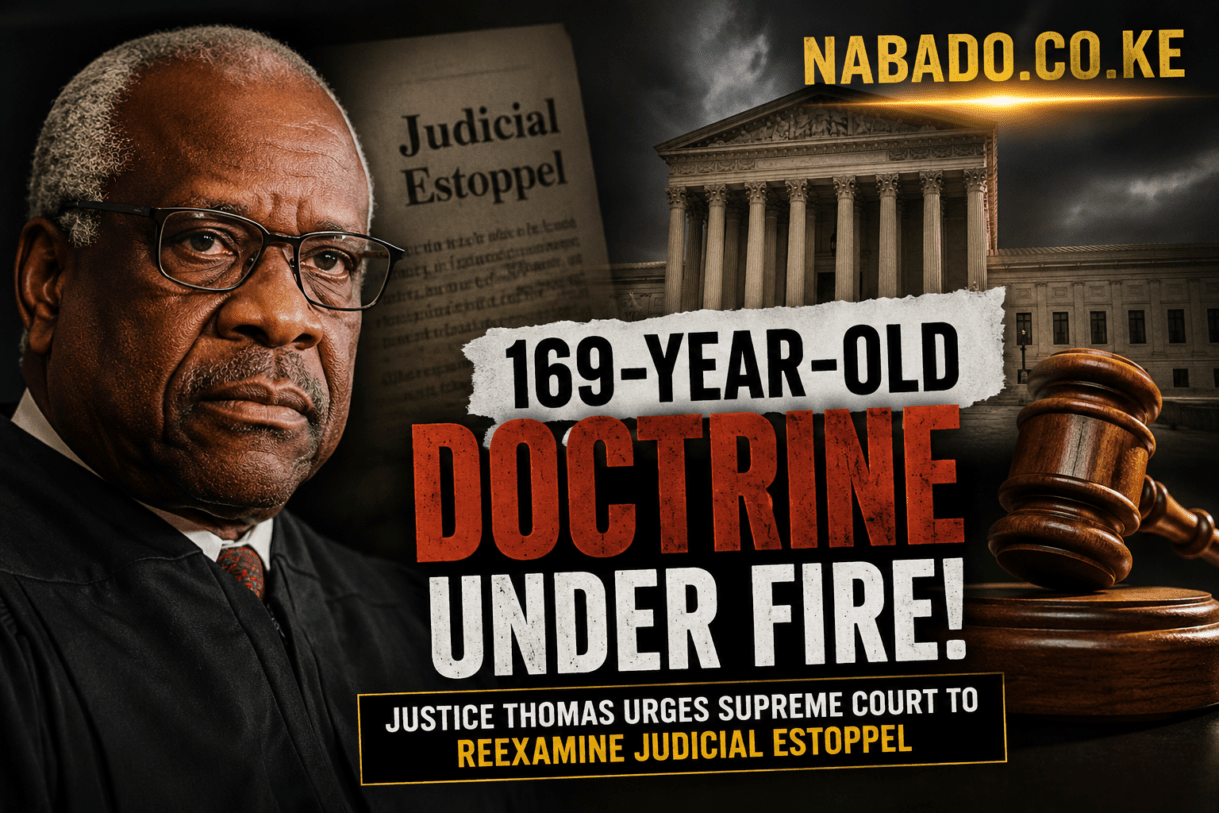
Justice Thomas Sparks Legal Storm by Targeting 169-Year-Old Court Doctrine
A decades-old legal principle that has shaped courtrooms across the United States is now facing fresh scrutiny after U.S. Supreme Court Justice Clarence Thomas urged the nation’s highest court to reconsider its validity.
In a move that has already sparked intense debate among legal scholars and attorneys, Thomas called for the Supreme Court to “reexamine” the doctrine of judicial estoppel, a legal principle that has been part of American jurisprudence for nearly 170 years.
The doctrine generally prevents individuals or organizations from taking contradictory positions in separate legal proceedings. Courts have long relied on it to protect the integrity of the justice system and ensure litigants cannot manipulate outcomes by changing their stories when it becomes convenient.
However, Thomas believes the doctrine deserves a closer look.
A Rare Challenge to a Longstanding Legal Principle
The remarks came in a unanimous Supreme Court ruling involving a bankruptcy dispute. While all nine justices agreed on the final outcome, Thomas used a separate concurring opinion to raise broader concerns about judicial estoppel itself.
According to Thomas, the doctrine may not have a sufficiently strong foundation in federal law and could have expanded beyond its original purpose over time.
His comments did not alter the Court’s decision in the case, but they sent a clear signal that at least one member of the nation’s highest court is interested in revisiting a principle that has guided legal proceedings for generations.
Legal analysts say such statements are often closely watched because they can lay the groundwork for future challenges before the Supreme Court.
What Is Judicial Estoppel?
Judicial estoppel is designed to prevent parties from “playing both sides” of a legal dispute.
For example, if a person makes a claim in one court proceeding and later adopts a completely opposite position in another case, judges may invoke judicial estoppel to stop them from benefiting from those conflicting arguments.
Supporters of the doctrine argue it is essential for maintaining trust in the judicial process.
Without it, critics say litigants could manipulate courts by presenting whichever version of events best serves their interests at a particular moment.
The principle has been cited in countless cases involving bankruptcy, employment disputes, business litigation, and personal injury claims.
Why Thomas Wants It Revisited
Justice Thomas has built a reputation as one of the Supreme Court’s strongest advocates for revisiting long-established legal doctrines.
Throughout his tenure, he has repeatedly argued that courts should rely more heavily on constitutional text, statutory language, and historical legal traditions when interpreting the law.
In this latest opinion, Thomas suggested that judicial estoppel may not be firmly grounded in those sources.
His concerns center on whether courts have created and expanded the doctrine without clear authorization from Congress or historical legal precedent.
For Thomas, that raises fundamental questions about the proper role of judges in shaping legal rules.
A Decision With Potentially Far-Reaching Consequences
Although Thomas’s comments do not immediately change existing law, legal experts believe they could influence future litigation.
If the Supreme Court eventually agrees to reconsider judicial estoppel, the outcome could affect a wide range of cases across the country.
Bankruptcy proceedings, civil lawsuits, employment disputes, and commercial litigation could all be impacted by any major shift in how courts apply the doctrine.
Some legal observers argue that narrowing or eliminating judicial estoppel could provide litigants with greater flexibility in presenting claims.
Others warn that weakening the doctrine could undermine public confidence in the justice system and encourage inconsistent legal arguments.
Legal Community Divided
Thomas’s call has already generated discussion among lawyers, academics, and legal commentators.
Supporters say reexamining old doctrines is healthy for the legal system and ensures that courts remain faithful to constitutional principles.
Critics, however, argue that judicial estoppel has proven its value over decades and remains an important safeguard against abuse.
Many legal experts expect the debate to continue as future cases make their way through federal courts.
Looking Ahead
For now, judicial estoppel remains firmly in place.
But Justice Thomas’s remarks have opened the door to a broader conversation about the role of courts, the limits of judicial authority, and whether longstanding legal doctrines should be reconsidered in the modern era.
As future cases reach the Supreme Court, legal observers will be watching closely to see whether other justices join Thomas in questioning one of America’s oldest and most established judicial principles.
The debate may have started with a single opinion, but its impact could shape the future of U.S. law for years to come.
SUGGESTED READS
- How to Register and Run for President in Kenya
- You’re Probably Spiritually Drained — Here Are the Signs Most People Ignore
- Meet the 10 Wealthiest Banks in the World Dominating Global Finance
- The Great Shift: Why the World Is Choosing Experiences Over Possessions
- Naked and Unashamed: The Shocking Truth Behind the World’s Most Controversial Festivals
- How to Love Yourself More Every Day: The Real, Practical Guide to Building Unshakable Self-Worth
- Who Invented Tattooing and Why Humans First Marked Their Skin

Support Our Website!
We appreciate your visit and hope you find our content valuable. If you’d like to support us further, please consider contributing through the TILL NUMBER: 9549825. Your support helps us keep delivering great content!
If you’d like to support Nabado from outside Kenya, we invite you to send your contributions through trusted third-party services such as Remitly, western union, SendWave, or WorldRemit. These platforms are reliable and convenient for international money transfers.
Please use the following details when sending your support:
Phone Number: +254701838999
Recipient Name: Peterson Getuma Okemwa
We sincerely appreciate your generosity and support. Thank you for being part of this journey!
Given the deep history of American jurisprudence mentioned in the article, how do legal scholars view the potential impact if the Supreme Court actually decides to eliminate judicial estoppel? Would removing it create a massive backlog of conflicting cases in federal courts, or would it just provide necessary flexibility as some argue? I tried comparing this to similar shifts in other legal frameworks discussed at GuiadeBetplaycolumbia.com but since that page seems down, I would appreciate any insights on how this might change the daily strategy for defense attorneys.