

simply amazing, always for you.
The winter air in Ohio carried a strange kind of silence in 1935. In the small rural communities scattered across the state, nights felt longer back then. Roads were darker. Houses sat farther apart. And once the sun disappeared beyond the trees, most families stayed indoors with their doors locked and curtains drawn.
Entertainment was simple in those years. People gathered around glowing radios in their living rooms, listening closely to music, dramas, weather reports, and evening news broadcasts. The radio was more than a machine. It was a lifeline to the outside world.
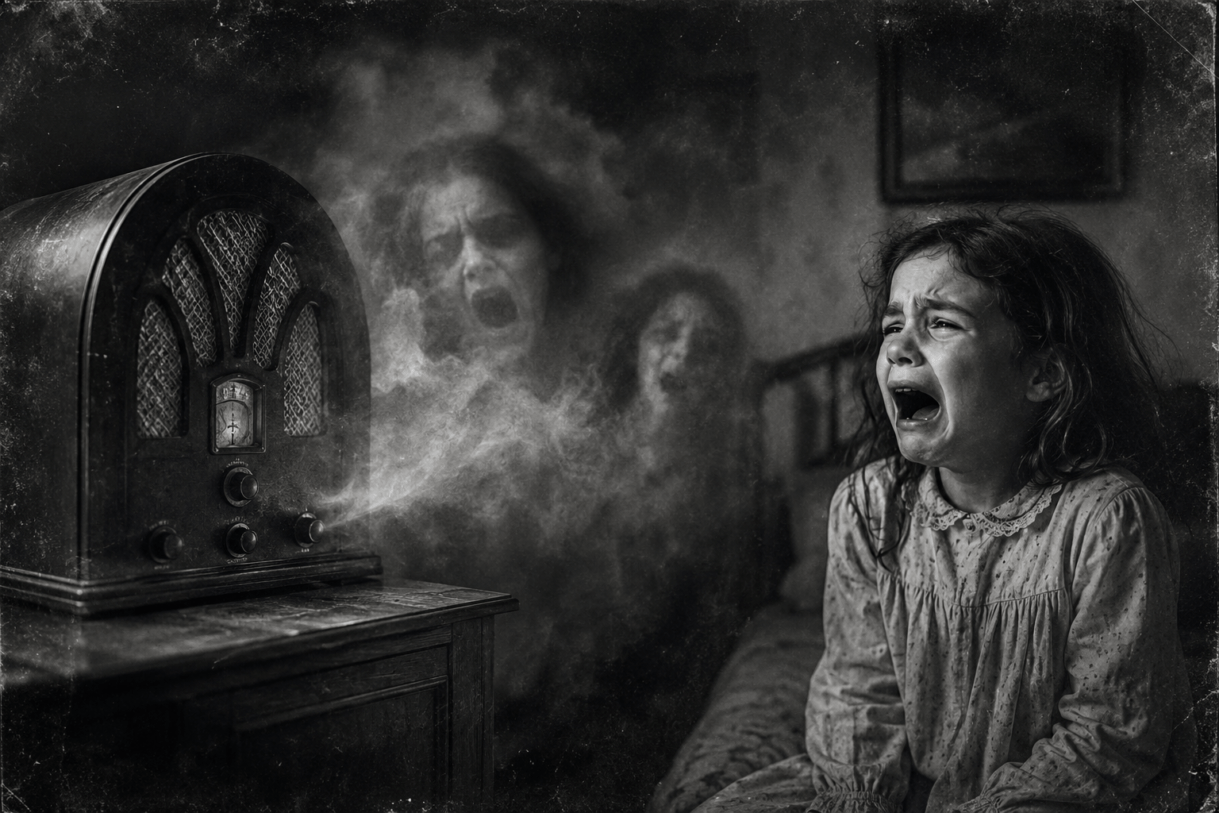
But during one terrifying period in 1935, some listeners claimed their radios began broadcasting something they were never supposed to hear.
Screams.
Desperate screams from what sounded like a young girl.
And according to the chilling legend, those horrifying sounds may have been connected to the disappearance and murder of a girl named Nannette Eppers.
Even nearly a century later, the story remains one of America’s strangest unsolved paranormal mysteries — a tale blending true crime, urban legend, fear, and unexplained radio broadcasts into something that still unsettles people today.
A Girl Vanishes Without a Trace
Little is fully known about Nannette Eppers, which only adds to the mystery surrounding her story. According to local legends passed down over generations, Nannette was a young girl living somewhere in rural Ohio during the mid-1930s.
Then one day, she disappeared.
At first, her disappearance seemed like the kind of tragedy that occasionally shook small communities during that era. Children could vanish quickly in isolated areas where communication and law enforcement resources were limited. Investigations moved slowly. Search parties relied mostly on neighbors, volunteers, and word of mouth.
As concern spread throughout the community, families became frightened. Parents warned their children not to wander far from home. Farmers kept watch over dirt roads and wooded paths. People whispered about strangers, kidnappers, and dangers lurking in the countryside.
Nobody knew what had happened to Nannette.
But then something even stranger began happening.
The Terrifying Sounds on the Radio
Not long after the girl vanished, radio listeners reportedly started hearing disturbing interruptions during normal broadcasts.
Music programs would suddenly dissolve into static.
News reports would cut out unexpectedly.
Then came the screams.
Listeners claimed they heard a young female voice crying out in terror. Some described the sounds as frantic pleas for help. Others said the voice sounded weak and desperate, as though the girl was trapped somewhere and begging somebody to save her.
The interruptions reportedly lasted only seconds before the broadcasts returned to normal.
At first, people assumed the noises were technical problems. Radio technology in the 1930s was still relatively primitive compared to modern communication systems. Static interference was common, especially during storms or atmospheric disturbances.
But these sounds felt different.
Too human.
Too emotional.
Too horrifying.
Soon, more listeners began claiming they had heard the same terrifying interruptions. Fear spread rapidly across local communities as rumors connected the radio screams to Nannette’s disappearance.
Some people became convinced they were hearing the final moments of the missing girl’s life broadcast through the airwaves.
Why Radio Felt So Mysterious in the 1930s
To understand why this story terrified so many people, it is important to understand how Americans viewed radio during the 1930s.
Today, technology surrounds us constantly. Phones, televisions, social media, and streaming services dominate modern life. But in the early twentieth century, radio felt almost magical.
Invisible voices traveled through the air into homes.
Families sat quietly around wooden radio cabinets each evening, listening together in complete silence. People trusted what came through those speakers. Radio personalities felt intimate, almost like members of the family.
Because the technology itself seemed mysterious to many listeners, strange interruptions could easily create panic.
Most ordinary citizens did not understand how radio signals worked. Static noises, overlapping frequencies, and accidental transmissions often sounded eerie and unnatural. During certain weather conditions, distant broadcasts could suddenly appear on local stations.
To frightened listeners already worried about a missing girl, hearing unexplained screams through a radio speaker felt deeply disturbing.
The imagination filled in the rest.
The Rumors Grow Darker
As the legend spread, the story became increasingly sinister.
Some versions claimed the screams happened repeatedly over several nights. Others said people heard faint words hidden beneath the static. A few listeners allegedly insisted the voice specifically cried for help before disappearing completely.
Soon, communities became obsessed with the mystery.
People contacted radio stations demanding explanations.
Station operators reportedly denied knowing anything about the interruptions. Some engineers blamed interference. Others refused to discuss the incidents at all.
But the rumors continued growing.
The timing seemed too strange to ignore. A missing girl. Terrifying screams. Sudden radio interruptions.
To many frightened residents, it felt impossible that these events were unrelated.
Some believed a murderer had somehow accidentally transmitted the sounds over radio frequencies during the crime itself. Others feared something supernatural was happening.
And in an era already filled with ghost stories, superstitions, and fascination with the paranormal, many people became convinced the broadcasts were not ordinary interference at all.
Was the Radio Broadcasting a Murder?
This question became the center of the entire legend.
Did listeners unknowingly hear fragments of a real crime?
Or was the entire story simply the result of fear and imagination?
Nobody knows for certain.
Some paranormal enthusiasts believe the emotional trauma surrounding Nannette’s death somehow imprinted itself onto radio waves. According to this theory, listeners were hearing supernatural echoes from a violent event.
This idea resembles modern paranormal beliefs surrounding electronic voice phenomena, often called EVP. Some ghost hunters claim spirits can communicate through electronic devices such as radios, televisions, or recording equipment.
Although scientists reject these claims due to lack of evidence, stories like the Nannette Eppers legend continue fueling paranormal speculation.
For believers, the story feels too specific and emotionally intense to dismiss entirely.
The Scientific Explanation
Skeptics offer a much simpler explanation.
Radio interference.
During the 1930s, radio technology was highly unpredictable. Signals frequently crossed paths. Atmospheric conditions could distort transmissions dramatically. Amateur radio operators sometimes accidentally interfered with commercial broadcasts.
In some cases, listeners might hear fragments of unrelated conversations or distorted noises mixed into local programming.
Human psychology also plays an important role.
Once rumors about Nannette’s disappearance spread, frightened listeners may have interpreted ordinary static or unclear sounds as screams. The human brain naturally searches for meaning in chaos, especially during moments of fear.
Psychologists call this phenomenon pareidolia — the tendency to hear recognizable voices or sounds in random noise.
The same effect explains why people sometimes hear hidden messages in songs or believe they hear voices during storms.
According to skeptics, terrified communities essentially scared themselves into believing the broadcasts were supernatural.
Could It Have Been a Hoax?
Another theory suggests the entire incident may have been an elaborate prank.
By the 1930s, some amateur radio enthusiasts possessed equipment capable of interfering with nearby frequencies under certain conditions. It is possible that pranksters intentionally transmitted disturbing sounds over local broadcasts after hearing news about the missing girl.
If true, the prank may have spiraled far beyond what anyone expected.
Fear spreads quickly during uncertain times, especially in isolated communities already shaken by tragedy. What may have started as a cruel joke could easily have transformed into a full-blown urban legend.
However, there is no definitive evidence proving this theory either.
Like many old mysteries, the lack of reliable documentation leaves enormous gaps in the story.
The Problem With Historical Records
One reason the legend remains controversial is because historical evidence surrounding Nannette Eppers is extremely limited.
Researchers investigating the story decades later struggled to locate consistent newspaper archives or official police records confirming every detail. Some historians believe the story may have evolved gradually over time through oral storytelling.
In small towns, local legends often become exaggerated as they pass from one generation to another.
A real disappearance may have blended with unrelated radio incidents, ghost stories, and community fears until the facts became impossible to separate from fiction.
This process is common in American folklore.
Over time, people unconsciously add dramatic details to stories. Witness accounts change. Events merge together. What began as a tragic local incident transforms into something larger, darker, and more mysterious.
That may be exactly what happened here.
But uncertainty only makes the story more fascinating.
America’s Fascination With Haunted Radio
The Nannette Eppers legend emerged during a period when radio itself already carried an eerie reputation.
Throughout the early twentieth century, many Americans viewed radio as mysterious and even supernatural. The idea of invisible voices traveling through the air felt almost unbelievable to people experiencing the technology for the first time.
This fascination sometimes produced widespread panic.
One famous example occurred in 1938 when Orson Welles aired his dramatic adaptation of The War of the Worlds radio broadcast. Some listeners reportedly believed aliens were genuinely invading Earth because the broadcast sounded so realistic.
That event demonstrated how emotionally powerful radio could become.
Against that cultural backdrop, stories about ghostly screams interrupting broadcasts felt entirely believable to many listeners.
People feared what they could not explain.
And radios seemed capable of bringing invisible mysteries directly into their homes.
Why the Story Still Haunts People Today
The legend of Nannette Eppers continues surviving because it taps into several deeply human fears at once.
First, there is the fear of children disappearing without answers. Few tragedies disturb people more deeply than unsolved cases involving young victims.
Second, there is the fear of technology behaving unpredictably. Even today, strange noises from electronic devices can feel unsettling. In the 1930s, that fear was magnified enormously because radio technology seemed so unfamiliar.
Third, the story raises an especially disturbing possibility:
What if people really did hear somebody’s final moments?
That idea transforms ordinary radio static into something horrifying.
The concept of a dying voice trapped forever in the airwaves creates a chilling emotional image that lingers in the imagination long after the story ends.
Urban Legend or Paranormal Truth?
The debate surrounding the story continues today.
Skeptics argue there is insufficient evidence proving the broadcasts ever happened exactly as described. They believe the tale evolved naturally through fear, rumor, and exaggerated storytelling.
Paranormal believers disagree.
They point to the emotional consistency of witness accounts and the strange timing surrounding Nannette’s disappearance. Some insist there are mysteries science still cannot fully explain.
Others take a middle position, believing a real disappearance probably occurred while the radio story grew larger over time through folklore.
That uncertainty may be the reason the legend remains so powerful.
Unlike modern crimes solved through surveillance footage and digital evidence, mysteries from the early twentieth century often remain unresolved forever. Missing records, unreliable witness testimony, and fading memories leave enormous gaps that imagination eagerly fills.
And sometimes, those gaps become legends.
The Chilling Legacy of Nannette Eppers
Today, the story appears regularly in paranormal documentaries, true-crime discussions, ghost-story collections, and online mystery forums. Many versions differ dramatically from one another, but the core idea always remains the same:
A missing girl.
A terrified community.
And unexplained screams interrupting radio broadcasts in the dead of night.
Whether the events truly happened exactly as described may never be known.
But the legend survives because it captures something timeless about fear itself. Humans are deeply unsettled by voices without bodies, sounds without explanations, and tragedies without closure.
The Nannette Eppers mystery combines all three.
Even now, nearly one hundred years later, old radios still produce occasional bursts of static and distorted noise. Most people ignore them without a second thought.
But for those familiar with this story, that crackling sound can still trigger an uncomfortable feeling deep in the mind.
A quiet question.
What if somebody was trying to speak?
What if those listeners in Ohio really heard something impossible?
And if they did…
Who was screaming through the radio?
SUGGESTED READS
- Embracing Imperfection: Why Making Mistakes is Better Than Faking Perfection
- The Humility and Obedience of Christ
- No Revenge: Why Naturally Ugly People Destroy Their Own Lives
- The Power of Boundaries: Protecting Your Well-Being and Letting Go of Toxic Relationships
- Dance before the music is over, live before your life is over
- The Greatest Commandments
- Nothing Drains Your Energy Faster Than Your Thoughts: Protect Your Peace
- Understanding Human Mistakes: Growth Beyond the Past Choices

Support Our Website!
We appreciate your visit and hope you find our content valuable. If you’d like to support us further, please consider contributing through the TILL NUMBER: 9549825. Your support helps us keep delivering great content!
If you’d like to support Nabado from outside Kenya, we invite you to send your contributions through trusted third-party services such as Remitly, western union, SendWave, or WorldRemit. These platforms are reliable and convenient for international money transfers.
Please use the following details when sending your support:
Phone Number: +254701838999
Recipient Name: Peterson Getuma Okemwa
We sincerely appreciate your generosity and support. Thank you for being part of this journey!