

simply amazing, always for you.
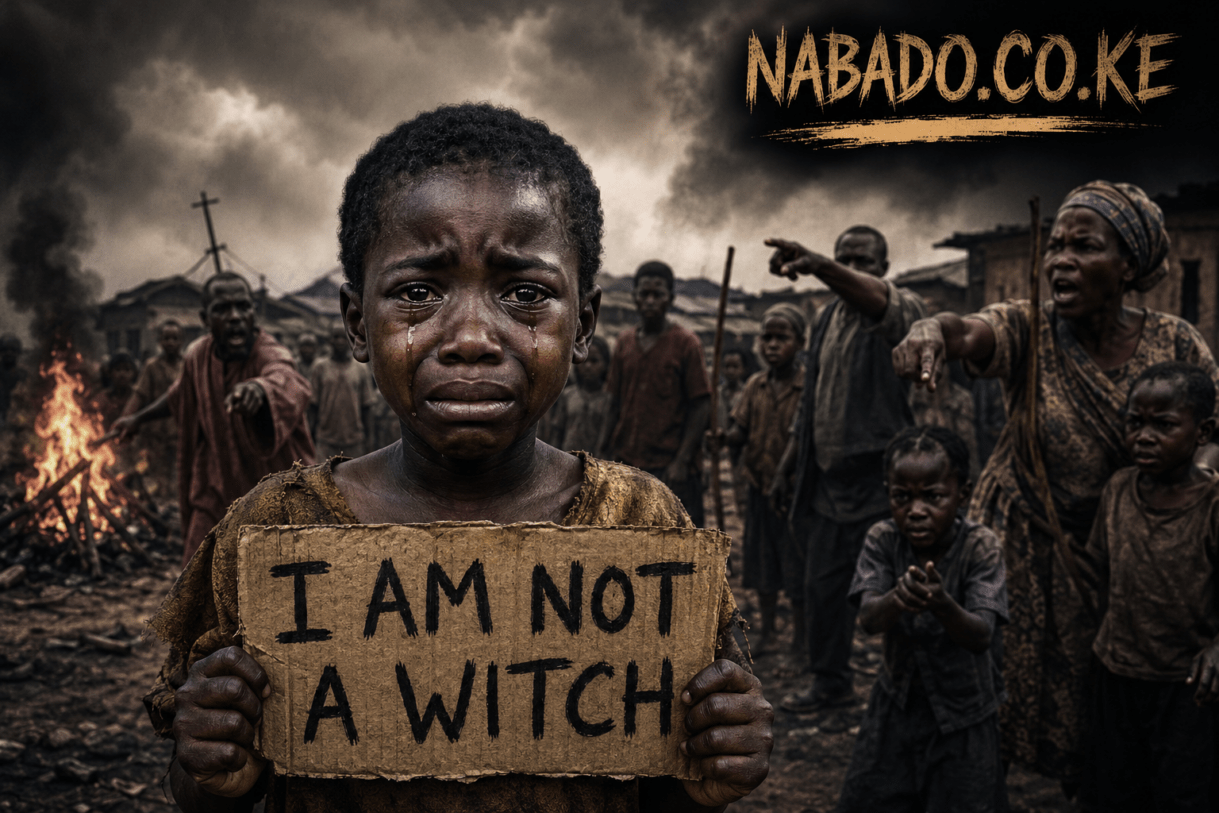
Imagine being eight years old and waking up one morning to discover that your family believes you are responsible for every bad thing that has happened to them.
Your mother is sick.
Your father has lost his job.
The family has no money.
A younger sibling died unexpectedly.
The crops have failed.
The neighbors are whispering.
And somehow, all fingers point to you.
Not because of anything you did.
Not because there is evidence.
But because people believe you are a witch.
For thousands of children across parts of Africa, this has not been a nightmare or a fictional horror story. It has been reality.
Over the last few decades, human rights organizations, journalists, social workers, and aid groups have documented horrifying cases of children being accused of witchcraft and subjected to abuse that is almost impossible to comprehend.
Some were beaten.
Others were poisoned.
Some were burned.
Many were abandoned.
Others never survived the accusations.
Their stories expose one of the most disturbing human rights crises of modern times—a tragedy often hidden from the global spotlight.
This is the story of the child witch hunts.
When Childhood Becomes a Crime
Children are often seen as symbols of innocence.
Societies around the world invest enormous effort in protecting young people because childhood is supposed to be a period of learning, growth, and discovery.
But in communities where witchcraft accusations become widespread, childhood can suddenly become dangerous.
A child who was loved yesterday can become feared tomorrow.
A child who played with friends in the morning can be sleeping on the streets by nightfall.
A simple accusation can transform a normal boy or girl into an outcast.
The consequences can be devastating.
In some cases, entire communities turn against children based on rumors, suspicions, dreams, or interpretations of ordinary events.
The accused are often too young to even understand what witchcraft means.
Yet they are treated as if they possess terrifying supernatural powers.
The Origins of Witchcraft Accusations
Belief in witchcraft is not unique to Africa.
Throughout history, many cultures have believed that certain individuals could use supernatural powers to cause harm.
Europe experienced infamous witch hunts centuries ago.
Parts of Asia have documented similar beliefs.
Communities in Latin America have also reported witchcraft-related accusations.
What makes the African child witch hunts particularly alarming is the targeting of children.
Traditionally, accusations of witchcraft in many societies were directed toward adults.
However, beginning in the late twentieth century, some regions witnessed a dramatic rise in allegations against young children.
Experts suggest several factors contributed to this shift.
Poverty.
Conflict.
Disease outbreaks.
Family breakdown.
Urbanization.
Lack of education.
Religious extremism.
Social instability.
Together, these factors created environments where fear and uncertainty flourished.
And when communities searched for explanations for their suffering, vulnerable children often became easy targets.
The Rise of Child Witch Accusations
The phenomenon gained international attention during the 1990s and early 2000s.
Reports emerged from several African countries describing large numbers of children accused of supernatural crimes.
Some communities believed certain children could:
- Cause illness
- Trigger financial problems
- Bring bad luck
- Kill relatives through spiritual means
- Destroy businesses
- Create infertility
- Cause accidents
Many accusations stemmed from ordinary events.
A family member falls sick.
A business fails.
A parent loses employment.
A child behaves differently.
Someone has a disturbing dream.
Soon, suspicion begins to grow.
Rumors spread.
Fear takes hold.
The child becomes the focus of blame.
The Tragic Stories Behind the Headlines
Statistics help illustrate the scale of the problem, but the human stories reveal the true horror.
Imagine a young boy whose parents die from disease.
He moves in with relatives.
The relatives struggle financially.
Food becomes scarce.
One day a neighbor claims the child is cursed.
Suddenly every misfortune is attributed to him.
He is beaten and thrown out.
Now homeless, he wanders city streets searching for food.
This story has been repeated countless times.
Some children have described being forced to confess to acts they never committed.
Others were told that unless they admitted to being witches, the punishment would continue.
Faced with unbearable pain, many eventually confessed simply to make the abuse stop.
Their false confessions were then used as proof of guilt.
Nigeria and the Child Witch Crisis
Few countries became as closely associated with child witch accusations as Nigeria.
Particularly in parts of southern Nigeria, thousands of children found themselves accused of witchcraft.
The stories shocked the world.
Investigators documented cases involving children abandoned by their families after being labeled witches.
Many ended up living on the streets.
Others suffered severe abuse before escaping.
In some communities, certain religious figures claimed they could identify witches.
Families seeking explanations for their hardships sometimes turned to these individuals.
Accusations often followed.
Once labeled, children could face rejection by everyone around them.
The consequences were life-changing.
Some children never returned home.
Others spent years trying to recover emotionally from the trauma.
The Democratic Republic of the Congo
The crisis was not limited to Nigeria.
In the Democratic Republic of the Congo, similar patterns emerged.
Years of conflict, poverty, displacement, and instability created conditions in which witchcraft accusations flourished.
Street children became particularly vulnerable.
Many had already lost parents due to war, disease, or economic hardship.
Without protection, they were easy targets.
Some churches conducted aggressive exorcisms intended to remove alleged evil spirits.
Children endured frightening rituals and physical punishment.
Many eventually fled.
Major cities witnessed growing populations of homeless children accused of witchcraft.
Their lives became a daily struggle for survival.
Why Children Become Targets
One question continues to puzzle many observers.
Why children?
Why would communities blame young boys and girls for complex problems?
Researchers have identified several recurring factors.
Poverty
Extreme poverty places enormous pressure on families.
When resources become scarce, tensions rise.
Families often search for explanations for their suffering.
In some cases, children become scapegoats.
Orphanhood
Children who lose one or both parents are particularly vulnerable.
Without strong parental protection, accusations become easier.
Disability
Children with physical or developmental disabilities have frequently been targeted.
Misunderstandings about medical conditions can lead to dangerous assumptions.
Behavioral Differences
Children who are unusually quiet, highly active, withdrawn, or different from peers sometimes attract suspicion.
Ordinary childhood behavior can be misinterpreted as evidence of supernatural influence.
Family Conflict
Domestic disputes, inheritance disagreements, and family rivalries can also trigger accusations.
The Violence That Followed
The abuse inflicted on accused children is among the most disturbing aspects of the crisis.
Human rights organizations have documented cases involving:
Severe beatings.
Burnings.
Starvation.
Poisoning.
Isolation.
Public humiliation.
Forced confessions.
Abandonment.
Children have reported being tied up, denied food, and subjected to prolonged physical punishment.
Others were forced to undergo dangerous rituals intended to remove alleged witchcraft.
The psychological damage can last a lifetime.
Even survivors who escape physical harm often struggle with anxiety, depression, trust issues, and emotional trauma.
The Business of Fear
One disturbing aspect of some documented cases is the role played by individuals who profited from accusations.
Families desperate for answers sometimes paid large sums of money for exorcisms or spiritual interventions.
The more fear spread, the greater the demand for these services.
This created financial incentives that encouraged further accusations.
Children became victims not only of superstition but also of exploitation.
Fear became a business.
And vulnerable children paid the highest price.
Life on the Streets
For many accused children, being labeled a witch marked the beginning of another nightmare.
Homelessness.
Rejected by their families, they often ended up on city streets.
Life there was brutal.
Children faced:
Hunger.
Violence.
Disease.
Exploitation.
Human trafficking.
Drug abuse.
Criminal gangs.
Without shelter or support, survival became their primary concern.
Some spent years living in abandoned buildings, markets, and bus stations.
Others never escaped the streets.
The Psychological Scars
Physical wounds can heal.
Psychological wounds are often harder to overcome.
Imagine being told repeatedly that you are evil.
Imagine hearing your own parents say they fear you.
Imagine losing your home because people believe you possess dark powers.
Such experiences leave deep emotional scars.
Many survivors report struggles with:
Low self-esteem.
Nightmares.
Trust issues.
Fear of relationships.
Depression.
Anxiety.
Post-traumatic stress.
The trauma frequently follows them into adulthood.
The Children Who Survived
Despite unimaginable suffering, many survivors have demonstrated extraordinary resilience.
Some were rescued by charities and shelters.
Others found foster families.
Many returned to school.
Some eventually became advocates for children’s rights.
Their stories reveal remarkable courage.
After experiencing rejection and abuse, they chose to rebuild their lives.
Some now help other children escape similar circumstances.
Their resilience offers hope amid tragedy.
The Organizations Fighting Back
Numerous organizations have worked tirelessly to combat child witch accusations.
Their efforts include:
Rescuing abandoned children.
Providing medical treatment.
Offering counseling services.
Reuniting families.
Conducting public awareness campaigns.
Supporting education programs.
Advocating legal reforms.
These organizations have saved countless lives.
Yet the challenge remains enormous.
Changing deeply rooted beliefs requires patience, education, and sustained community engagement.
The Role of Education
Education remains one of the most effective tools for combating harmful accusations.
When communities understand the real causes of disease, poverty, disability, and mental health conditions, fear often decreases.
Schools play a critical role.
Teachers can help children learn critical thinking skills.
Community education programs can challenge myths and misinformation.
Medical professionals can explain illnesses that might otherwise be attributed to supernatural causes.
Knowledge helps replace fear with understanding.
Government Responses
Several governments have introduced laws aimed at protecting children from witchcraft-related abuse.
These measures include:
Child protection legislation.
Criminal penalties for abuse.
Public awareness initiatives.
Support for vulnerable families.
However, enforcement remains a challenge in some regions.
Legal reforms alone cannot eliminate deeply entrenched beliefs.
Long-term change requires cooperation among governments, community leaders, educators, religious figures, and families.
The Influence of Social Conditions
Many experts argue that witchcraft accusations are symptoms of broader social problems.
When societies face:
Economic instability.
High unemployment.
Disease outbreaks.
Political conflict.
Displacement.
Weak social services.
People often search for explanations.
In uncertain environments, supernatural explanations can become attractive.
Addressing underlying social challenges may therefore reduce the likelihood of accusations.
Lessons from History
History provides many examples of societies blaming vulnerable groups during times of crisis.
Witch hunts in Europe targeted thousands.
Other societies have scapegoated minorities, outsiders, and marginalized individuals.
The child witch hunts remind us that fear can be powerful.
When communities become desperate, rational thinking can give way to suspicion.
The consequences can be devastating.
Understanding these patterns helps prevent future tragedies.
A Global Human Rights Concern
Although the child witch hunts are most commonly associated with certain African regions, the underlying issues are universal.
Fear.
Ignorance.
Poverty.
Misinformation.
Scapegoating.
These forces exist everywhere.
The crisis serves as a reminder that protecting children requires constant vigilance.
Every society must ensure that vulnerable individuals are not blamed for problems beyond their control.
The Road Ahead
Progress has been made.
Awareness has increased.
Many children have been rescued.
Governments and organizations continue to intervene.
Yet challenges remain.
Thousands of children across various regions still face risks linked to witchcraft accusations.
Ending the problem requires more than laws.
It requires cultural change.
It requires education.
It requires compassion.
Most importantly, it requires recognizing that children deserve protection, not persecution.
The child witch hunts represent one of the darkest chapters in the modern struggle for children’s rights.
Behind every accusation is a child whose life has been transformed by fear and misunderstanding.
Many lost their homes.
Some lost their families.
Others lost their lives.
Yet amid the tragedy, there is hope.
Survivors continue to rebuild.
Advocates continue to fight.
Communities continue to learn.
The story of the child witch hunts is ultimately a warning about the dangers of fear, but it is also a testament to human resilience and the enduring belief that every child deserves safety, dignity, and love.
As awareness grows and protections strengthen, the hope remains that future generations of children will never again have to endure the nightmare of being accused of crimes that exist only in the fears of others.
SUGGESTED READS
- The Basement of Fear: Inside the Dark Story of Kenya’s Nyayo House Torture Chambers
- What Fishermen Pulled From the Nile During Idi Amin’s Reign Still Haunts Uganda Today
- The Night Terror of Tsavo: When Two Lions Brought a Railway to Its Knees
- The Town That Never Stopped Burning: The Chilling Story of Centralia’s Underground Fire
- The Ghost That Helped Solve a Murder: The Chilling Story of the Greenbrier Ghost
- The Russian Sleep Experiment Was Fake—But the Real Experiments Were Far More Terrifying
- The Corpse That Wouldn’t Decompose: The Haunting Mystery of Rosalia Lombardo
- Meet the Meru Man With 18+ Wives: Inside Kenya’s Most Extraordinary Family Empire
- The Green Children of Woolpit: The Medieval Mystery That Still Defies Explanation

Support Our Website!
We appreciate your visit and hope you find our content valuable. If you’d like to support us further, please consider contributing through the TILL NUMBER: 9549825. Your support helps us keep delivering great content!
If you’d like to support Nabado from outside Kenya, we invite you to send your contributions through trusted third-party services such as Remitly, western union, SendWave, or WorldRemit. These platforms are reliable and convenient for international money transfers.
Please use the following details when sending your support:
Phone Number: +254701838999
Recipient Name: Peterson Getuma Okemwa
We sincerely appreciate your generosity and support. Thank you for being part of this journey!