

simply amazing, always for you.
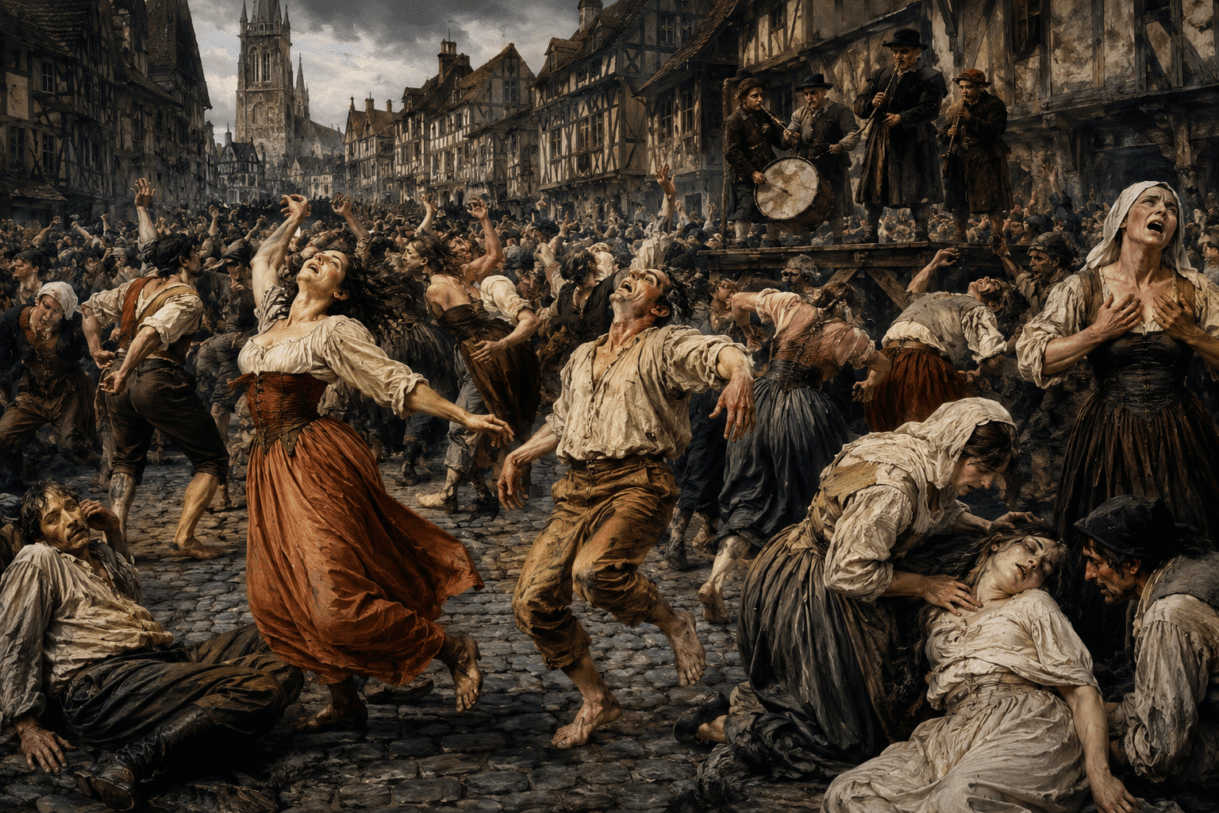
Imagine walking down the street and seeing people dancing nonstop in the middle of a hot summer day. At first, you might assume it’s some kind of celebration or festival. But then the hours pass, and they keep dancing. Days go by, and they still don’t stop. Their feet become swollen and bloody, their bodies grow weak, and some eventually collapse from exhaustion.
As unbelievable as it sounds, this actually happened.
Known as the Dancing Plague of 1518, this strange event took place in Strasbourg, a city that was part of the Holy Roman Empire at the time. More than 500 years later, historians and scientists are still trying to figure out exactly what caused it.
A Dance That Began With One Woman
The story began in July 1518 with a woman named Frau Troffea.
For reasons no one could explain, she stepped into a street in Strasbourg and started dancing.
There was no music.
There was no celebration.
There was no clear reason for her behavior.
According to historical accounts, she danced for hours without stopping. When night arrived, she continued. The next day, she was still dancing. By the third and fourth days, she showed no signs of slowing down.
People were stunned.
Some believed she was possessed by evil spirits. Others thought she had lost her mind. Whatever the explanation, nobody understood what they were witnessing.
Then things became even stranger.
Other people started dancing too.
The Outbreak Spreads
Within a week, dozens of people had joined the bizarre dance.
Men and women from different walks of life began moving uncontrollably through the streets. Historical records suggest that around 30 people were dancing at the same time during the early stages of the outbreak.
The number continued to rise.
Within a month, reports claimed that hundreds of people had become involved.
Many of them appeared distressed rather than joyful.
Some cried while dancing.
Others screamed.
Many begged for help.
Yet they seemed unable to stop moving.
Witnesses described the dancers as exhausted and desperate, almost as if they were trapped inside their own bodies with no control over what was happening.
Dancing Until Death
The physical consequences were severe.
Anyone who has danced for even a few hours knows how exhausting it can be. Now imagine doing it for days with little rest, food, or water.
The human body simply cannot endure that forever.
Historical accounts suggest that many dancers collapsed from exhaustion.
Some reportedly suffered heart attacks.
Others experienced strokes.
Several are believed to have died.
While historians still debate the exact number of deaths, there is little doubt that the outbreak caused real suffering.
Families watched helplessly as loved ones pushed their bodies beyond their limits.
What began as a mystery quickly turned into a tragedy.
Authorities Make a Fatal Mistake
City officials desperately wanted to stop the outbreak.
Unfortunately, their solution may have made things worse.
Medical experts at the time believed the dancers suffered from an excess of what they called “hot blood.” Based on this theory, they concluded that the only cure was to let the affected people dance until the condition worked its way out of their systems.
So instead of preventing the dancing, they encouraged it.
Officials built wooden stages.
They hired musicians.
They brought in drummers and entertainers.
Their goal was simple: keep the dancers moving until they recovered.
But the plan backfired.
The music and public attention appeared to attract even more participants.
Rather than ending the outbreak, authorities may have unintentionally helped it spread.
As the number of dancers increased, fear swept through the city.
Fear Grips Strasbourg
Life in Strasbourg was already difficult before the dancing plague began.
The region had suffered from crop failures, disease, poverty, and food shortages.
Many people were struggling just to survive.
Stress and uncertainty were part of everyday life.
As the outbreak grew, so did public anxiety.
People worried they might suddenly become victims themselves.
Parents feared for their children.
Neighbors became suspicious of one another.
Rumors spread rapidly.
Some believed the dancers were cursed.
Others thought God was punishing the city.
The atmosphere became filled with fear, confusion, and desperation.
The Religious Explanation
At the time, many people believed the outbreak had a supernatural cause.
One popular belief involved Saint Vitus, a Christian saint who, according to local folklore, could curse people with uncontrollable dancing.
Because of this belief, many victims were taken to shrines dedicated to Saint Vitus.
Religious ceremonies were performed in hopes of breaking the curse.
Authorities eventually organized pilgrimages and spiritual rituals as part of their response.
Interestingly, the number of dancers gradually began to decline afterward.
Whether this happened because of the religious interventions or for other reasons remains unclear.
The Ergot Poisoning Theory
Over the centuries, researchers have proposed several scientific explanations.
One of the most well-known theories involves ergot, a toxic fungus that can grow on rye grain.
When consumed, ergot can produce effects similar to those caused by certain hallucinogenic substances.
Symptoms may include hallucinations, muscle spasms, convulsions, and unusual behavior.
Some researchers suggested that contaminated bread might have triggered the outbreak.
At first, the idea seems reasonable.
However, many experts are skeptical.
People suffering from ergot poisoning are usually too sick and physically impaired to dance continuously for days. The symptoms also don’t perfectly match the historical descriptions of the dancers.
As a result, most historians believe ergot poisoning alone cannot fully explain what happened.
The Mass Hysteria Theory
Today, many experts favor a different explanation.
They believe the Dancing Plague may have been an example of mass psychogenic illness, sometimes referred to as mass hysteria.
This occurs when intense stress, fear, and social pressure trigger real physical symptoms that spread through a group of people.
The symptoms are genuine.
The people affected are not pretending.
Their bodies are responding to psychological distress in very real ways.
History contains several examples of communities experiencing unusual collective behavior during periods of extreme hardship.
Strasbourg in 1518 may have been the perfect environment for such an event.
People were dealing with hunger, disease, poverty, and constant uncertainty.
Fear was everywhere.
When one person began dancing uncontrollably, others may have unconsciously followed, creating a chain reaction that spread throughout the city.
One of History’s Greatest Mysteries
Even after centuries of study, no one knows exactly what caused the Dancing Plague of 1518.
The event sits at the crossroads of medicine, psychology, religion, and folklore.
Every explanation seems to answer some questions while leaving others unanswered.
Why did so many people become affected?
How did the behavior spread so quickly?
Why did it eventually stop?
These questions continue to puzzle researchers today.
Why We Still Talk About It
The Dancing Plague remains fascinating because it challenges what we think we know about human behavior.
It highlights the powerful connection between the mind and body.
It shows how fear and stress can affect entire communities.
And it reminds us that even in a world driven by science and technology, some mysteries remain unsolved.
More than five centuries later, the image of hundreds of exhausted people dancing through the streets of Strasbourg still feels unsettling.
Whether the cause was mass hysteria, poisoning, religious belief, or something we have yet to understand, the Dancing Plague of 1518 remains one of the strangest events ever recorded in history.
And perhaps the most chilling part is this:
No one knows for sure why it happened.
SUGGESTED READS
- The Man Who Could’ve Been
- Youth and the 2027 Elections: How Young Voters Could Shape the Next General Election in Kenya
- Living with a Shared Secret: Psychological Consequences for Couples
- How Rumors Shape and Destroy Trust in Marriages
- The Link Between Rage, Violence, and Betrayal in Intimate Relationships
- Silent Prisons: Couples Bound by Secrets They Cannot Share
- Betrayal Trauma: How Infidelity Impacts the Human Mind

Support Our Website!
We appreciate your visit and hope you find our content valuable. If you’d like to support us further, please consider contributing through the TILL NUMBER: 9549825. Your support helps us keep delivering great content!
If you’d like to support Nabado from outside Kenya, we invite you to send your contributions through trusted third-party services such as Remitly, western union, SendWave, or WorldRemit. These platforms are reliable and convenient for international money transfers.
Please use the following details when sending your support:
Phone Number: +254701838999
Recipient Name: Peterson Getuma Okemwa
We sincerely appreciate your generosity and support. Thank you for being part of this journey!