

simply amazing, always for you.
In the dead of winter, deep inside the frozen wilderness of the northern Ural Mountains, nine experienced young hikers disappeared under horrifying and unexplained circumstances. What investigators discovered weeks later became one of the most disturbing mysteries of the 20th century — a case so bizarre that even Soviet authorities could not fully explain it.
The event would later become famous around the world as the Dyatlov Pass Incident.
More than six decades later, people are still obsessed with the terrifying details: a tent ripped open from the inside, bodies scattered across the snow without shoes, strange injuries with no visible wounds, missing tongues, and an official conclusion that blamed an “unknown compelling force.”
Was it an avalanche? A secret Soviet military experiment? Paranormal activity? Or something even darker hiding in the mountains?
This is the eerie story of the Dyatlov Pass tragedy.
A Dangerous Expedition Begins
In January 1959, a group of ten university students and outdoor enthusiasts set out on a skiing expedition across the harsh northern Ural Mountains in what was then the Soviet Union.
The team was led by 23-year-old engineering student Igor Dyatlov. The hikers were highly experienced. Most held advanced certifications in ski touring and mountain survival. They were not amateurs wandering blindly into danger. These were disciplined adventurers trained to survive brutal winter conditions.
Their goal was to reach a mountain called Otorten, a remote and unforgiving area known for savage weather and near-total isolation.
One member of the group, Yuri Yudin, became ill early in the journey and turned back before the team reached the dangerous mountain region. That decision likely saved his life.
The remaining nine hikers continued into the snowy wilderness.
None of them would ever return.
The Last Known Photographs
Before vanishing, the hikers kept journals and cameras documenting their journey. The photographs they left behind have become legendary because they show smiling young people joking, skiing, and setting up camp — completely unaware of the horror approaching them.
The final known images were taken on February 1, 1959.
That night, the group established camp on the slopes of a mountain called Kholat Syakhl, a name from the indigenous Mansi language often translated as “Mountain of the Dead.”
The name alone would later fuel countless conspiracy theories.
But at the time, it was simply another stop on their expedition.
Or so they thought.
When the Hikers Failed to Return
The expedition was expected to send a telegram after completing the route. Days passed with no communication.
At first, nobody panicked. Delays were common during winter expeditions.
But eventually, relatives became concerned, and search teams were organized.
What rescuers found in late February shocked everyone involved.
The Tent Ripped Open From the Inside
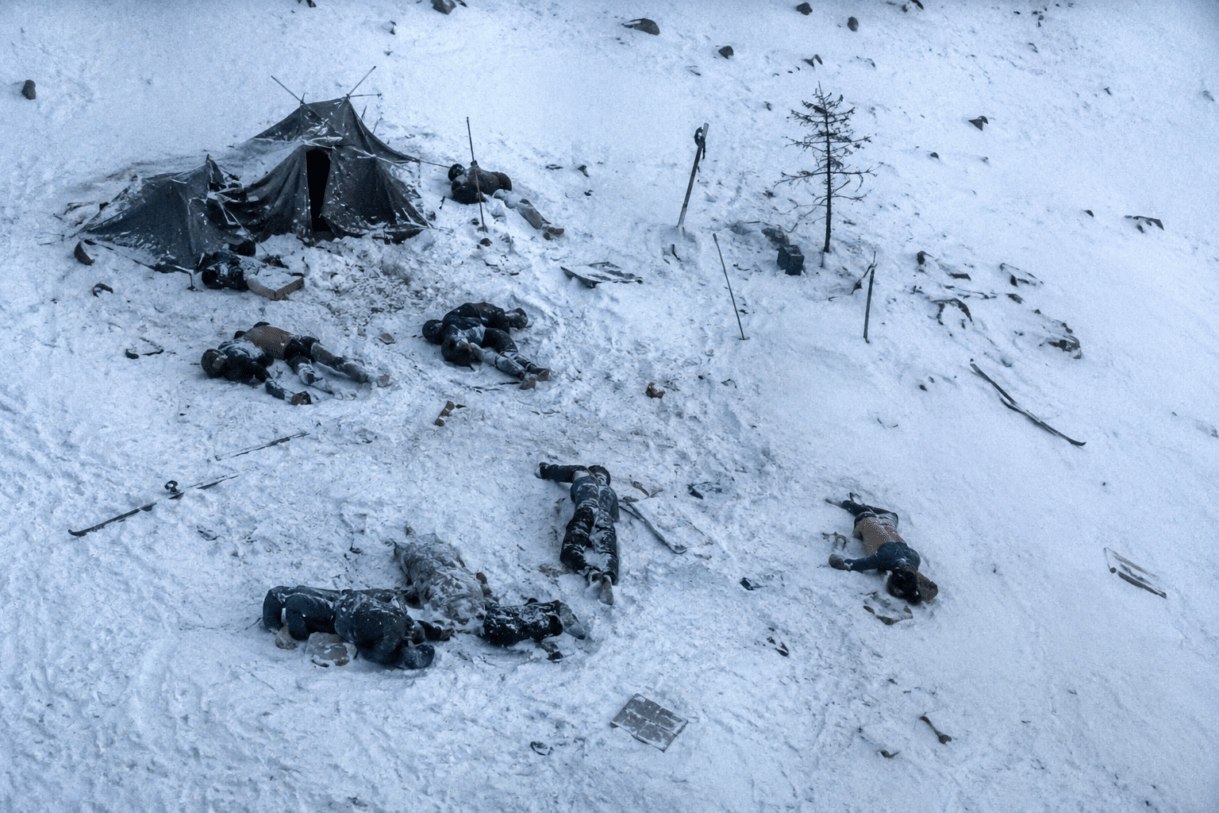
The team’s tent was discovered partially buried in snow on the slope of the mountain.
Something was immediately wrong.
The tent had been slashed open from the inside.
Not from outside.
Inside the campsite, rescuers found abandoned boots, warm clothing, food, cameras, and personal belongings. It looked as though the hikers had fled suddenly in absolute terror.
Investigators later determined the group escaped into the freezing darkness wearing little or no protection from the brutal temperatures.
Some were barefoot.
Others wore only socks.
In temperatures estimated at below -25°C (-13°F), this was almost a death sentence.
Why would experienced hikers run half-naked into a deadly blizzard?
That question still haunts investigators today.
The First Bodies
Searchers followed footprints leading away from the campsite toward a forest roughly 1.5 kilometers away.
Under a cedar tree, they discovered the first two bodies:
Yuri Krivonischenko
and
Yuri Doroshenko.
The men were barefoot and dressed only in underwear.
Nearby evidence suggested they had attempted to build a fire before dying from hypothermia.
Branches high in the cedar tree were broken, leading some investigators to believe one or both victims had climbed the tree, possibly trying to look back toward the tent or escape something terrifying on the ground.
Between the cedar tree and the tent, rescuers later found three more bodies:
Igor Dyatlov,
Zinaida Kolmogorova, and
Rustem Slobodin.
It appeared they had been trying to crawl back toward the campsite before collapsing in the snow.
But the strangest discoveries were still waiting beneath the ice.
The Terrifying Final Discovery
Months later, after snow began melting, search teams discovered the remaining four hikers buried in a ravine under several meters of snow.
These victims had injuries so horrifying that investigators struggled to explain them.
Lyudmila Dubinina had severe chest trauma and was missing her tongue.
Semyon Zolotaryov suffered crushed ribs.
Nikolai Thibeaux-Brignolle had catastrophic skull fractures.
Yet investigators reported almost no major external wounds on some victims.
One Soviet examiner allegedly compared the force of the injuries to the impact of a car crash.
How could hikers in an isolated mountain wilderness suffer such devastating internal trauma without obvious external damage?
That detail became one of the central mysteries of the case.
The Missing Tongue and Eyes
Perhaps the most disturbing detail involved missing body parts.
Some victims were missing eyes.
Dubinina’s tongue was gone.
This fueled endless speculation involving secret experiments, mutilation, or paranormal attacks.
However, modern forensic experts often argue these injuries may have resulted from natural decomposition and scavenging by animals after the bodies remained exposed in harsh conditions for weeks.
Still, the imagery surrounding the case became nightmare fuel for generations of conspiracy theorists.
Strange Radiation and Orange Lights
The mystery grew even darker when reports emerged claiming some clothing tested positive for radiation.
At the same time, witnesses in nearby areas allegedly reported strange glowing orange spheres moving across the night sky around the time of the tragedy.
Because the Soviet Union was deeply involved in Cold War military research during that era, theories exploded.
Some believed the hikers accidentally witnessed secret weapons testing.
Others suspected missile experiments or airborne mines.
The Soviet government’s secrecy only intensified suspicion.
Investigators eventually closed the case with a vague and unsettling conclusion:
The hikers died due to “a compelling natural force.”
No detailed explanation was given.
For many people, that sounded less like an answer and more like a cover-up.
Avalanche Theory
For decades, the leading explanation has been an avalanche.
According to this theory, the hikers heard or felt shifting snow above their campsite and believed a deadly avalanche was imminent.
In panic, they cut open the tent and fled quickly into the darkness.
Later, while attempting to survive the freezing conditions, they died from exposure and injuries caused by snow collapse or falls into the ravine.
In recent years, scientists revisited the case using modern computer simulations and terrain analysis. Some researchers concluded a small slab avalanche may indeed explain many aspects of the tragedy.
Yet critics point out major problems with the theory:
- The slope where the tent stood did not appear steep enough for a major avalanche.
- Investigators reportedly found footprints still visible in the snow.
- The tent itself was not heavily buried.
- Some injuries seemed unusually severe.
Because of these inconsistencies, many people remain unconvinced.
The Infrasound Theory
Another famous explanation involves something called infrasound.
This theory suggests unusual wind patterns around the mountain may have created low-frequency sound waves capable of causing panic, paranoia, nausea, or psychological terror.
Supporters argue the hikers may have suddenly experienced overwhelming fear and irrational behavior, causing them to flee the tent in confusion.
While intriguing, critics say the theory lacks strong evidence and does not explain the severe injuries.
Secret Soviet Weapons Testing?
One of the most persistent theories involves Soviet military activity.
The Cold War was at its peak in 1959, and the Soviet Union conducted many classified weapons tests in remote areas.
Some researchers believe the hikers accidentally entered a military testing zone and were killed by experimental explosives or shockwave weapons.
This theory attempts to explain:
- The radiation traces
- The severe internal injuries
- Witness reports of glowing lights
- Government secrecy surrounding the investigation
However, no definitive proof has ever emerged linking the incident to military operations.
Paranormal and Alien Theories
Because the evidence feels so strange and fragmented, paranormal explanations have flourished for decades.
Some theories involve:
- UFO encounters
- Cryptids such as the Yeti
- Supernatural forces
- Dimensional anomalies
- Secret psychic experiments
Books, documentaries, and internet forums have transformed the Dyatlov Pass Incident into one of the world’s most famous unsolved mysteries.
Despite countless investigations, no theory fully explains every detail.
That uncertainty is what keeps the legend alive.
The 2020 Russian Reinvestigation
In 2020, Russian authorities reopened the case and announced a new conclusion.
Officials stated the hikers most likely died in an avalanche-related accident combined with hypothermia.
According to the reinvestigation, dangerous snow movement forced the group from the tent, and poor visibility prevented them from returning.
But for many observers, the answer still felt incomplete.
Too many strange details remained.
Too many unanswered questions lingered in the frozen mountains.
Why the Mystery Still Haunts the World
The story of the Dyatlov Pass Incident continues to fascinate people because it feels like a real-life horror film — except it actually happened.
Nine intelligent, experienced hikers entered the wilderness.
Something terrified them enough to abandon safety in subzero darkness.
Weeks later, they were found dead under bizarre and terrifying circumstances.
Even after decades of investigations, scientific studies, documentaries, and theories, nobody can say with complete certainty what happened that night on the slopes of Kholat Syakhl.
And maybe that is why the mystery refuses to die.
Because somewhere in the icy silence of the Ural Mountains, the full truth may still be buried beneath the snow forever.
SUGGESTED READS
- The Man Who Received Calls From the Dead
- The Radio Station That Predicted a Murder
- The Bear Who Went to War: The Unbelievable Story of Wojtek
- The Woman Who Fell 33,000 Feet and Lived: The Astonishing Story of Vesna Vulović
- The Great Emu War: When Australia Lost a Battle Against Birds
- The Teenager Who Fooled the World: The Unbelievable Story of Frank Abagnale

Support Our Website!
We appreciate your visit and hope you find our content valuable. If you’d like to support us further, please consider contributing through the TILL NUMBER: 9549825. Your support helps us keep delivering great content!
If you’d like to support Nabado from outside Kenya, we invite you to send your contributions through trusted third-party services such as Remitly, western union, SendWave, or WorldRemit. These platforms are reliable and convenient for international money transfers.
Please use the following details when sending your support:
Phone Number: +254701838999
Recipient Name: Peterson Getuma Okemwa
We sincerely appreciate your generosity and support. Thank you for being part of this journey!