

simply amazing, always for you.
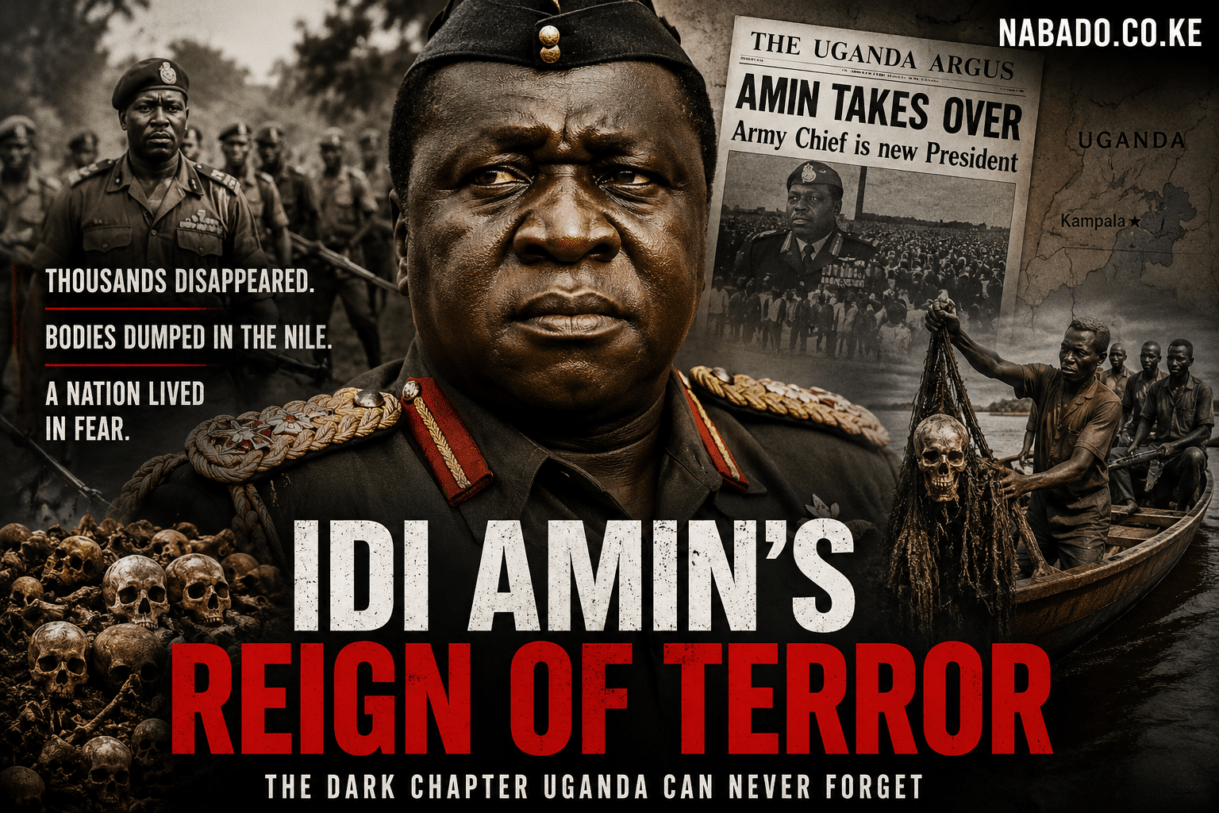
History is filled with rulers whose names became synonymous with power, ambition, and influence. Yet there are also leaders whose legacies are remembered for fear, suffering, and tragedy. Few African leaders fit that description more than Idi Amin, the military ruler who governed Uganda from 1971 to 1979.
For many people around the world, Idi Amin remains one of the most infamous dictators of the twentieth century. His story is so unbelievable that it often sounds like fiction. Tales of mass disappearances, political assassinations, bizarre public statements, and brutal repression made headlines across the globe. To outsiders, Amin sometimes appeared eccentric, almost theatrical. But behind the spectacle was a reality far darker than most could imagine.
During his rule, Uganda became a nation gripped by fear. Families lost loved ones without explanation. Political opponents vanished. Entire communities lived under the shadow of violence. Rivers became dumping grounds for victims, and countless citizens learned that speaking out could cost them their lives.
This is the story of Idi Amin’s reign of terror, one of the darkest chapters in African history.
The Soldier Who Rose to Power
Before becoming Uganda’s ruler, Idi Amin was a soldier.
Born around 1925 in what was then British colonial Uganda, Amin had little formal education. However, he possessed physical strength, confidence, and a commanding presence that helped him advance through military ranks.
He joined the King’s African Rifles, a colonial military force operated by the British Empire. During his years in service, Amin earned a reputation as a capable soldier. After Uganda gained independence in 1962, he continued climbing the ranks of the newly formed national army.
As Uganda struggled with political divisions, Amin became one of the most powerful military figures in the country. His influence grew alongside tensions between the government and military leadership.
By the late 1960s, the relationship between President Milton Obote and Amin had become increasingly strained. Allegations of corruption, power struggles, and mistrust fueled conflict between the two men.
Then came the moment that changed Uganda forever.
The Coup That Shocked Uganda
On January 25, 1971, while President Obote was attending a Commonwealth conference abroad, Amin seized power in a military coup.
Tanks rolled through the streets.
Soldiers took control of strategic locations.
The government was overthrown almost overnight.
Many Ugandans initially celebrated the coup. Obote’s administration had become unpopular among sections of the population, and some believed Amin would restore stability and national unity.
Crowds welcomed the new leader.
People cheered.
Hope filled the air.
Unfortunately, that optimism would not last.
The Beginning of Fear
Soon after taking power, Amin began eliminating perceived enemies.
Military officers suspected of loyalty to the previous government were targeted first.
Arrests became common.
Executions followed.
What started as political purges quickly evolved into a widespread campaign of terror.
Citizens discovered that criticism of the government could have deadly consequences.
Journalists disappeared.
Students disappeared.
Religious leaders disappeared.
Businessmen disappeared.
In many cases, families never learned what happened to their loved ones.
A knock on the door late at night became a source of dread.
The sound of military vehicles approaching a neighborhood could send entire communities into panic.
People learned to keep their opinions to themselves.
Silence became a survival strategy.
The Rise of State Violence
As Amin consolidated power, violence became deeply embedded in the state’s operations.
Security agencies were granted enormous authority.
Special intelligence units emerged.
Detention centers became notorious for torture.
Survivors later described horrific treatment at military barracks, prisons, and secret interrogation facilities.
Victims were beaten, electrocuted, and subjected to unimaginable abuse.
Many never left these facilities alive.
The exact number of people killed during Amin’s rule remains disputed.
Some estimates suggest that between 100,000 and 500,000 Ugandans lost their lives.
Regardless of the precise figure, historians agree that the scale of violence was staggering.
Entire regions were affected.
Entire families were destroyed.
Entire communities lived under constant fear.
The Nile River and the Horrors It Carried
One of the most chilling symbols of Amin’s rule was the Nile River.
Stories began circulating that bodies of executed victims were being dumped into the river to conceal evidence.
The accounts became so widespread that they gained international attention.
Fishermen reported horrifying discoveries.
Bodies were occasionally found floating downstream.
Human remains became grim reminders of the violence occurring behind closed doors.
For many Ugandans, the river transformed from a source of life into a symbol of death.
Parents warned children about the dangers lurking in the political climate.
People whispered stories about relatives who had vanished forever.
The Nile carried not only water but also the painful memories of a nation living through terror.
The Dictator’s Strange Public Persona
One reason Idi Amin fascinated international audiences was his unusual behavior.
He frequently made bizarre public statements.
He often portrayed himself as larger than life.
He awarded himself extravagant titles and cultivated an image of invincibility.
Some foreign observers viewed him almost as a caricature.
Newspapers reported his outlandish comments.
Television broadcasts highlighted his unpredictable actions.
Yet focusing solely on his eccentric personality often obscured a more important truth.
While the world laughed at some of his antics, Ugandans were suffering.
Behind every strange headline was a government responsible for widespread fear and repression.
The comedy perceived abroad masked a tragedy unfolding at home.
The Expulsion of Uganda’s Asians
One of Amin’s most controversial decisions occurred in 1972.
He ordered the expulsion of tens of thousands of Asians living in Uganda.
Many families had lived in the country for generations.
They owned businesses, managed industries, and contributed significantly to the economy.
Amin gave them only a short period to leave.
Families were forced to abandon homes, businesses, and possessions.
Entire communities disappeared almost overnight.
The economic consequences were severe.
Businesses closed.
Supply chains collapsed.
Manufacturing declined.
Investment dried up.
The decision isolated Uganda economically and damaged confidence in the country’s future.
Although Amin claimed the move would benefit ordinary Ugandans, the economy soon entered a period of serious decline.
Economic Collapse
As political violence intensified, Uganda’s economy deteriorated.
Corruption became widespread.
Government institutions weakened.
Infrastructure suffered from neglect.
Essential goods became harder to find.
Inflation surged.
Many citizens struggled to afford basic necessities.
The country’s international reputation worsened.
Foreign investment declined.
Tourism suffered.
Economic uncertainty compounded the fear already created by political repression.
For ordinary Ugandans, daily life became increasingly difficult.
People worried not only about safety but also about survival.
Living Under Constant Suspicion
One of the defining characteristics of Amin’s Uganda was suspicion.
Nobody knew whom to trust.
Friends became cautious around friends.
Neighbors became cautious around neighbors.
A careless comment could attract unwanted attention.
Rumors spread quickly.
Fear spread even faster.
Citizens avoided discussing politics in public places.
Conversations became guarded.
People constantly worried that someone might report them to authorities.
This atmosphere of distrust fractured communities.
Relationships suffered.
Social bonds weakened.
The psychological impact extended far beyond those directly targeted by the regime.
Fear became woven into everyday life.
International Condemnation
As reports of human rights abuses emerged, international criticism increased.
Governments, journalists, and human rights organizations raised alarms about the situation in Uganda.
Stories from refugees painted a disturbing picture.
Witnesses described executions, torture, disappearances, and repression.
Uganda became increasingly isolated from many countries.
The government responded with hostility toward critics.
Amin often lashed out at foreign leaders and governments.
His confrontational rhetoric attracted even more global attention.
Yet despite growing condemnation, the suffering inside Uganda continued.
For many victims, international criticism offered little immediate relief.
The Road to Downfall
By the late 1970s, Amin’s grip on power was weakening.
Economic problems mounted.
Political opposition increased.
Military loyalty became less certain.
Then a conflict with neighboring Tanzania changed everything.
After tensions escalated into war, Tanzanian forces joined with Ugandan exiles determined to remove Amin from power.
The military campaign advanced steadily.
Amin’s forces struggled to resist.
Cities fell.
Government control weakened.
The regime that once seemed unstoppable began to crumble.
Finally, in 1979, Amin fled Uganda.
His eight-year rule came to an end.
For many citizens, it felt like the conclusion of a nightmare.
Exile and Final Years
After leaving Uganda, Amin lived in exile.
He eventually settled in Saudi Arabia, where he spent the remainder of his life.
Despite the immense suffering associated with his rule, he was never tried in court for the alleged crimes committed during his presidency.
He lived quietly compared to the dramatic years of his dictatorship.
In 2003, Idi Amin died in Saudi Arabia.
His death closed the final chapter of his personal story, but not the story of his legacy.
The consequences of his rule continue to be remembered throughout Uganda and beyond.
The Survivors and Their Stories
Perhaps the most important voices in understanding Amin’s reign belong to survivors.
Their stories reveal the human cost behind historical statistics.
Behind every disappearance was a family.
Behind every execution was a loved one.
Behind every act of repression was a life permanently altered.
Many survivors spent decades searching for answers.
Some never discovered what happened to missing relatives.
Others carried physical and emotional scars for the rest of their lives.
Their testimonies ensure that the experiences of victims are not forgotten.
History is not merely about leaders and governments.
It is also about ordinary people whose lives were transformed by extraordinary events.
Lessons From a Dark Era
The story of Idi Amin offers important lessons about power and accountability.
Unchecked authority can become dangerous.
Institutions matter.
Independent courts matter.
Free media matters.
Human rights matter.
When leaders face little accountability, abuses can flourish.
Uganda’s experience during the 1970s demonstrates how quickly fear can spread when democratic safeguards disappear.
The consequences can last for generations.
Remembering these lessons helps prevent similar tragedies from occurring elsewhere.
Why the World Still Remembers Idi Amin
Decades after his fall, Idi Amin remains one of the most recognized dictators in modern history.
Part of that attention comes from his unusual public image.
Part comes from the shocking stories surrounding his rule.
But the primary reason his name endures is the scale of suffering associated with his government.
His reign stands as a warning about the destructive potential of authoritarian power.
It serves as a reminder that beneath sensational headlines are real human lives.
The victims of Amin’s dictatorship deserve to be remembered not as statistics but as individuals whose futures were stolen.
Idi Amin’s reign of terror remains one of the darkest periods in Uganda’s history. What began with promises of change quickly descended into fear, violence, repression, and economic collapse.
Thousands disappeared, countless families were shattered, and an entire nation endured years of uncertainty and trauma.
To outsiders, Amin often appeared strange and unpredictable. To many Ugandans, however, he represented something far more frightening—a government capable of making people vanish without explanation and ruling through fear.
Today, the story of Idi Amin is more than a historical account. It is a cautionary tale about the dangers of unchecked power and the importance of protecting human rights, democratic institutions, and the rule of law.
The memories of those who suffered under his regime continue to shape Uganda’s history. Their stories ensure that one of Africa’s most terrifying dictatorships will never be forgotten.
SUGGESTED READS
- Maina Njenga: Prophet, Cult Leader or Political Pawn?
- The Mau Mau Rebellion: Kenya’s First War for Freedom
- The Rise, Evolution, and Impact of the Sungusungu Vigilantes in Kisii, Kenya
- Mungiki: The Rise, Fall, and Shadows of Kenya’s Most Feared Underground Movement
- The Coffin Thief of Nairobi: The True Story of John Kibera
- The Dark Legacy of Okija Shrine: Nigeria’s Most Notorious Traditional
- How Foday Sankoh Led Sierra Leone into Chaos: The Ruthless Rise of a Rebel

Support Our Website!
We appreciate your visit and hope you find our content valuable. If you’d like to support us further, please consider contributing through the TILL NUMBER: 9549825. Your support helps us keep delivering great content!
If you’d like to support Nabado from outside Kenya, we invite you to send your contributions through trusted third-party services such as Remitly, western union, SendWave, or WorldRemit. These platforms are reliable and convenient for international money transfers.
Please use the following details when sending your support:
Phone Number: +254701838999
Recipient Name: Peterson Getuma Okemwa
We sincerely appreciate your generosity and support. Thank you for being part of this journey!