

simply amazing, always for you.
There are ghost towns, and then there is Centralia.
Nestled in the rolling hills of Pennsylvania, Centralia once looked like any other small American mining town. Families filled its neighbourhoods. Children played in the streets. Local businesses thrived, and coal miners worked hard beneath the earth to support their loved ones.
Today, however, Centralia is known for something far more disturbing.
For more than sixty years, a fire has been burning beneath the town. Not in houses. Not in buildings. Deep underground.
What started as a seemingly ordinary event in 1962 transformed Centralia into one of the most haunting places in the world—a town slowly consumed from below by flames that refuse to die.
A Normal Town Built on Coal
To understand Centralia’s nightmare, it helps to understand its origins.
Like many communities in Pennsylvania, Centralia owed its existence to coal. Vast deposits of anthracite coal beneath the region attracted miners and investors during the 19th century. The town grew rapidly as mining operations expanded.
For decades, coal provided jobs and prosperity. Thousands of people called Centralia home. Churches, schools, restaurants, and businesses lined the streets. The town appeared stable and successful.
But beneath the surface lay a hidden danger.
The same coal that had made Centralia prosperous would eventually become its greatest enemy.
The Fire That Changed Everything
The disaster began in May 1962.
As Memorial Day approached, local officials arranged to clean up a landfill located near an abandoned strip mine. The dump had accumulated trash, and burning it was considered a routine way to reduce waste.
Workers ignited the garbage and expected the fire to burn itself out.
Instead, something went terribly wrong.
The flames spread through a hidden opening and reached abandoned coal tunnels beneath the town. Once the fire found the coal seams, it began feeding itself.
Coal fires are notoriously difficult to extinguish. Underground, they can spread slowly through networks of tunnels and natural cracks. With an abundant fuel supply and limited access for firefighters, the blaze quickly became a nightmare.
At first, many residents had no idea what had happened.
The danger was invisible.
The fire was burning beneath their feet.
The Slow March of Disaster
In the years that followed, authorities attempted multiple strategies to stop the underground fire.
Excavation projects were launched.
Trenches were dug.
Millions of dollars were spent.
Nothing worked.
The fire continued to spread through underground coal seams, moving gradually beneath the town.
As temperatures increased below ground, strange things began happening on the surface.
Residents reported unusual Odors.
Steam emerged from cracks in the earth.
Areas of land became unexpectedly hot.
Smoke drifted from openings in the ground.
What had once seemed like a manageable problem was becoming impossible to ignore.
Yet many residents stayed.
Centralia was their home.
Families had lived there for generations. Leaving was not an easy decision.
The Day the Ground Opened
One of the most frightening incidents occurred in 1981.
Twelve-year-old Todd Domboski was playing in his grandmother’s backyard when the ground suddenly gave way beneath him.
A sinkhole opened without warning.
The hole reportedly measured several feet across and released dangerous hot gases from below.
Fortunately, Todd managed to grab onto nearby roots while family members pulled him to safety.
Had he fallen deeper into the opening, the outcome could have been tragic.
The incident attracted national attention.
Suddenly, the underground fire was no longer a distant environmental problem.
It was an immediate threat to human life.
The image of a child nearly disappearing into a smoking hole shocked the country.
For many officials, it became clear that Centralia’s future was running out.
Poison in the Air
The fire created another serious danger: toxic gases.
As coal burns underground, it produces harmful substances including carbon monoxide.
Invisible and odourless, carbon monoxide can be deadly.
Monitoring stations detected dangerous conditions in some areas of the town. Residents worried about what they were breathing every day.
Experts warned that underground fires could continue releasing toxic gases indefinitely.
Even houses that appeared safe above ground could potentially be affected.
The threat was not only beneath the surface.
It was in the air.
The Government Steps In
By the early 1980s, authorities concluded that permanently extinguishing the fire would likely be impossible.
Instead, attention shifted toward relocating residents.
The federal government approved funds to purchase homes and help families move elsewhere.
For many residents, the decision was heartbreaking.
Some accepted buyouts and left.
Others resisted.
After all, how do you abandon the place where you were born?
How do you leave behind neighbours, memories, and generations of family history?
Yet year after year, more people departed.
Houses were demolished.
Businesses closed.
Schools disappeared.
Entire neighbourhoods vanished.
What had once been a bustling town slowly transformed into a near-empty landscape.
A Town Becomes a Ghost Town
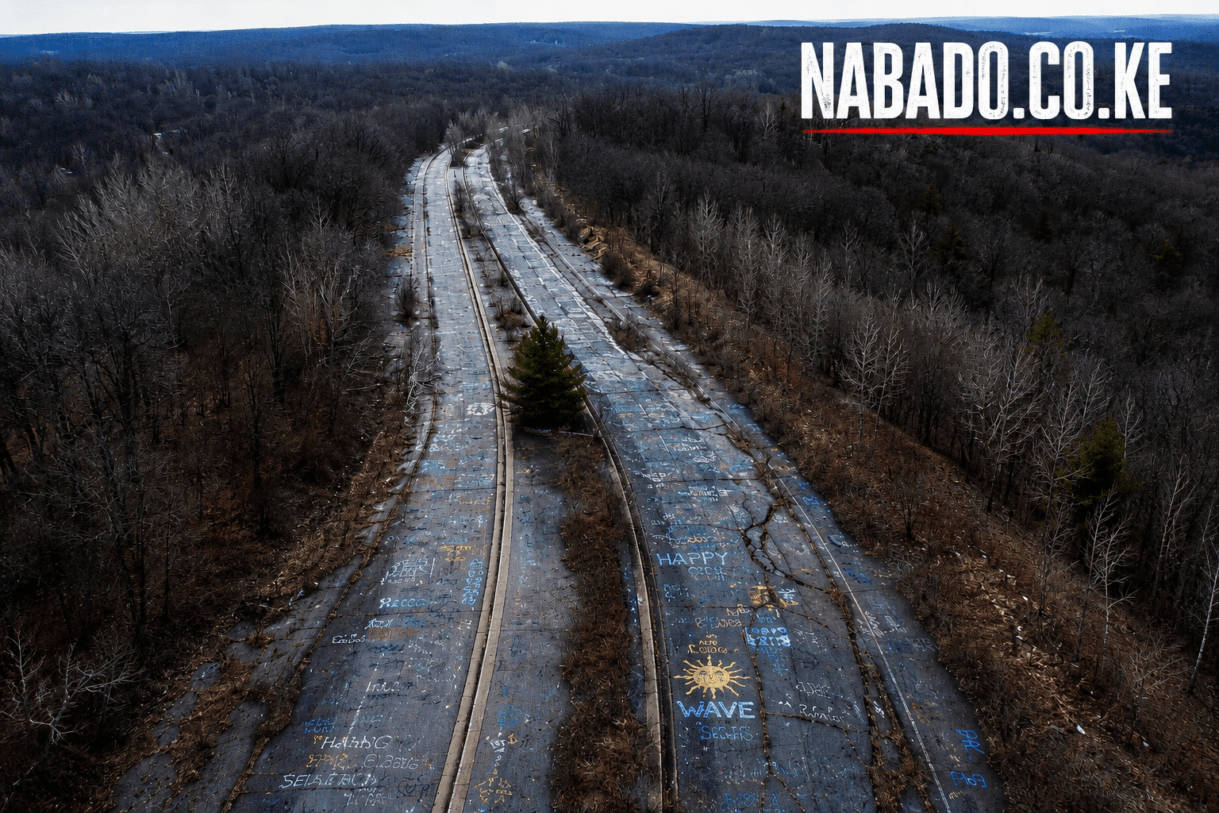
Driving through Centralia today feels surreal.
Many of the streets still exist, but the houses that once lined them are gone.
Empty lots mark where homes once stood.
Nature has reclaimed large portions of the community.
Trees grow where families once gathered.
Wild grass covers former neighbourhoods.
The silence is perhaps the most unsettling feature.
There are no crowded sidewalks.
No busy stores.
No sounds of children playing.
Only reminders of what once existed.
Visitors often describe the experience as eerie, almost as if time stopped decades ago.
The Fire Still Burns
Perhaps the most astonishing fact about Centralia is that the fire has never been extinguished.
Experts believe it could continue burning for many decades, and some estimates suggest it may remain active for centuries.
Deep underground, coal continues to fuel the blaze.
The exact location and spread of the fire shift over time, making containment extraordinarily difficult.
While the visible signs are less dramatic than they once were, the danger remains real.
The earth beneath Centralia is still alive with heat.
The disaster that began in 1962 never truly ended.
A Place That Inspired Horror Stories
Centralia’s eerie atmosphere has inspired books, documentaries, and horror films.
Many people believe the abandoned town helped inspire the setting of the famous horror franchise Silent Hill.
The comparison is understandable.
Fog.
Desolation.
Empty streets.
A hidden danger beneath the ground.
The similarities are impossible to ignore.
Yet what makes Centralia more frightening than any fictional story is one simple fact:
It is real.
No screenwriter invented it.
No novelist imagined it.
An actual town was slowly driven from existence by a fire burning beneath the earth.
Lessons from Centralia
Centralia stands as a powerful reminder of humanity’s complicated relationship with the environment.
For generations, coal brought jobs and prosperity.
But the same resource that built the town ultimately contributed to its destruction.
The story also highlights how seemingly small decisions can have enormous consequences.
A routine landfill fire in 1962 triggered an environmental disaster that continues more than six decades later.
Few people involved at the time could have imagined the outcome.
Yet the consequences remain visible today.
The Ghost Town That Refuses to Die
Most disasters eventually end.
Floodwaters recede.
Wildfires burn out.
Storms pass.
Centralia is different.
Its disaster continues day after day, year after year.
While most of its residents have moved on, the fire remains.
Beneath abandoned streets and empty fields, flames still consume ancient coal seams hidden deep underground.
The town may have lost its people, but its story continues to captivate the world.
Centralia is more than a ghost town.
It is a warning, a mystery, and one of the strangest real-life disasters in modern history—a place where the earth itself has been burning for generations and may continue burning long after all traces of the town have disappeared.
SUGGESTED READS
- The Ghost That Helped Solve a Murder: The Chilling Story of the Greenbrier Ghost
- The Russian Sleep Experiment Was Fake—But the Real Experiments Were Far More Terrifying
- The Corpse That Wouldn’t Decompose: The Haunting Mystery of Rosalia Lombardo
- Meet the Meru Man With 18+ Wives: Inside Kenya’s Most Extraordinary Family Empire
- The Green Children of Woolpit: The Medieval Mystery That Still Defies Explanation
- The Dancing Plague of 1518: The Terrifying Mystery of the People Who Couldn’t Stop Dancing
- The Chilling Mystery of Dyatlov Pass
- The Man Who Received Calls From the Dead

Support Our Website!
We appreciate your visit and hope you find our content valuable. If you’d like to support us further, please consider contributing through the TILL NUMBER: 9549825. Your support helps us keep delivering great content!
If you’d like to support Nabado from outside Kenya, we invite you to send your contributions through trusted third-party services such as Remitly, western union, SendWave, or WorldRemit. These platforms are reliable and convenient for international money transfers.
Please use the following details when sending your support:
Phone Number: +254701838999
Recipient Name: Peterson Getuma Okemwa
We sincerely appreciate your generosity and support. Thank you for being part of this journey!