

simply amazing, always for you.
The African wilderness has always been a place of beauty, mystery, and danger. But in 1898, along the banks of Kenya’s Tsavo River, a nightmare unfolded that would leave an unforgettable mark on history.
It began as a grand engineering project.
The British Empire was pushing forward with the construction of the Uganda Railway, a massive undertaking designed to connect the East African coast to the interior. Hundreds of workers labored under the scorching sun, laying tracks and building bridges through rugged terrain. For many, it was a chance to earn a living. For others, it was an adventure into an unknown land.
No one imagined they would soon become prey.
As darkness settled over the workers’ camps, strange stories began to circulate. Men were disappearing during the night. At first, some believed the victims had wandered off or fallen prey to the harsh wilderness. But then came the screams.
Workers awoke in terror as cries pierced the silence. Tents were torn open. Men were dragged into the darkness before anyone could react. By morning, all that remained were bloodstains and tracks leading into the bush.
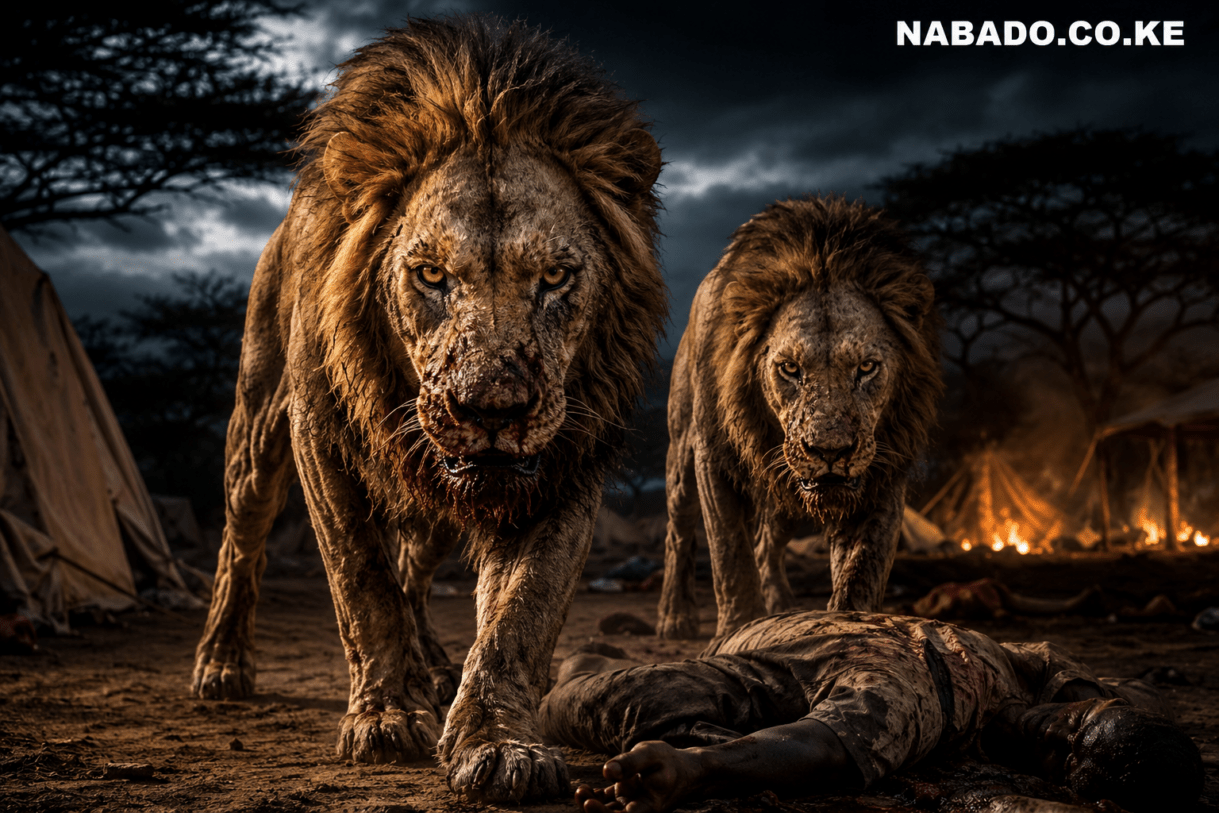
The killers were not human.
They were two enormous male lions.
The beasts seemed unlike any lions the workers had ever heard of. They showed little fear of humans and appeared determined to hunt people rather than their natural prey. Night after night, they returned, stalking the camps with chilling confidence.
Fear spread quickly.
Men who had traveled thousands of miles to work on the railway suddenly found themselves trapped in a living nightmare. Sleep became impossible. Workers built thorn fences around their camps, lit fires, and posted guards, hoping to keep the predators away.
Nothing worked.
The lions leaped over barriers, slipped through defenses, and continued their attacks. Every sunset brought fresh anxiety. Every rustle in the darkness sent hearts racing.
Soon, panic overwhelmed the railway project.
Many laborers abandoned their posts and fled. Construction slowed dramatically as rumors spread across East Africa. Some workers became convinced the lions were supernatural creatures sent to punish them. Others believed the animals were possessed by evil spirits.
Whatever the explanation, the fear was real.
The man tasked with ending the terror was British army officer and railway engineer John Henry Patterson.
Determined to stop the attacks, Patterson launched an intense hunt. He spent countless nights perched on platforms above bait, rifle in hand, waiting for the lions to appear. The predators, however, proved remarkably intelligent.
Again and again, they evaded traps.
Again and again, they struck when least expected.
Months passed as the deadly game continued. The lions had become legends before they were even caught. Stories about them spread far beyond Tsavo, capturing the imagination of people across the British Empire.
Then, at last, Patterson got his chance.
In December 1898, after a tense encounter, he shot one of the lions. Even wounded, the animal fought fiercely before finally collapsing. The second lion survived for several more weeks, continuing to haunt the region until Patterson eventually tracked it down and killed it as well.
The nightmare was over.
Relief swept through the railway camps. Workers returned, and construction resumed. Yet the story of the Tsavo man-eaters was only beginning.
As news of the lions spread, so did questions.
How many people had they actually killed?
Patterson later claimed the pair had taken 135 lives. Other reports offered lower figures. Modern scientific examinations of the lions’ remains suggest the true number may have been considerably less, though still horrifying.
Whatever the exact death toll, there is no doubt that dozens of people lived in fear and many never returned home.
The mystery deepened because the lions themselves were unusual. Unlike many male lions, they had little or no mane. They were exceptionally large, powerful, and bold. Researchers have spent decades studying why they targeted humans.
Some theories suggest disease had reduced the availability of their natural prey. Others propose that previous encounters with human remains may have conditioned the lions to view people as food. No single explanation has fully solved the puzzle.
Today, more than a century later, the Tsavo man-eaters remain among the most infamous predators in history.
Their preserved bodies still attract curious visitors, while books, documentaries, and films continue to retell their story. Yet beyond the legends lies a very real human tragedy—a period when ordinary workers faced a terror few could imagine.
As the sun disappeared behind the African horizon each evening, those men knew they might not survive the night.
They listened to distant roars echoing across the plains.
They watched shadows move beyond the campfires.
And they waited, wondering whether the man-eaters of Tsavo were coming for them next.
The story endures because it touches something primal: humanity’s ancient fear of becoming the hunted instead of the hunter. In the wild heart of Kenya, for a few terrifying months in 1898, that fear became reality.
SUGGESTED READS
- The Bear Who Went to War: The Unbelievable Story of Wojtek
- The Woman Who Fell 33,000 Feet and Lived: The Astonishing Story of Vesna Vulović
- The Great Emu War: When Australia Lost a Battle Against Birds
- The Teenager Who Fooled the World: The Unbelievable Story of Frank Abagnale
- How a Harvard Teenager Accidentally Built One of the World’s Biggest Companies
- The Bird That Lived Without a Head for 18 Months
- The Man Who Survived Two Atomic Bombs: The Unbelievable Story of Tsutomu Yamaguchi
- The 3-Meter Mistake That Almost Cost Her Life
- Captain Irene Koki Mutungi: The Girl Who Touched the Sky

Support Our Website!
We appreciate your visit and hope you find our content valuable. If you’d like to support us further, please consider contributing through the TILL NUMBER: 9549825. Your support helps us keep delivering great content!
If you’d like to support Nabado from outside Kenya, we invite you to send your contributions through trusted third-party services such as Remitly, western union, SendWave, or WorldRemit. These platforms are reliable and convenient for international money transfers.
Please use the following details when sending your support:
Phone Number: +254701838999
Recipient Name: Peterson Getuma Okemwa
We sincerely appreciate your generosity and support. Thank you for being part of this journey!