

simply amazing, always for you.
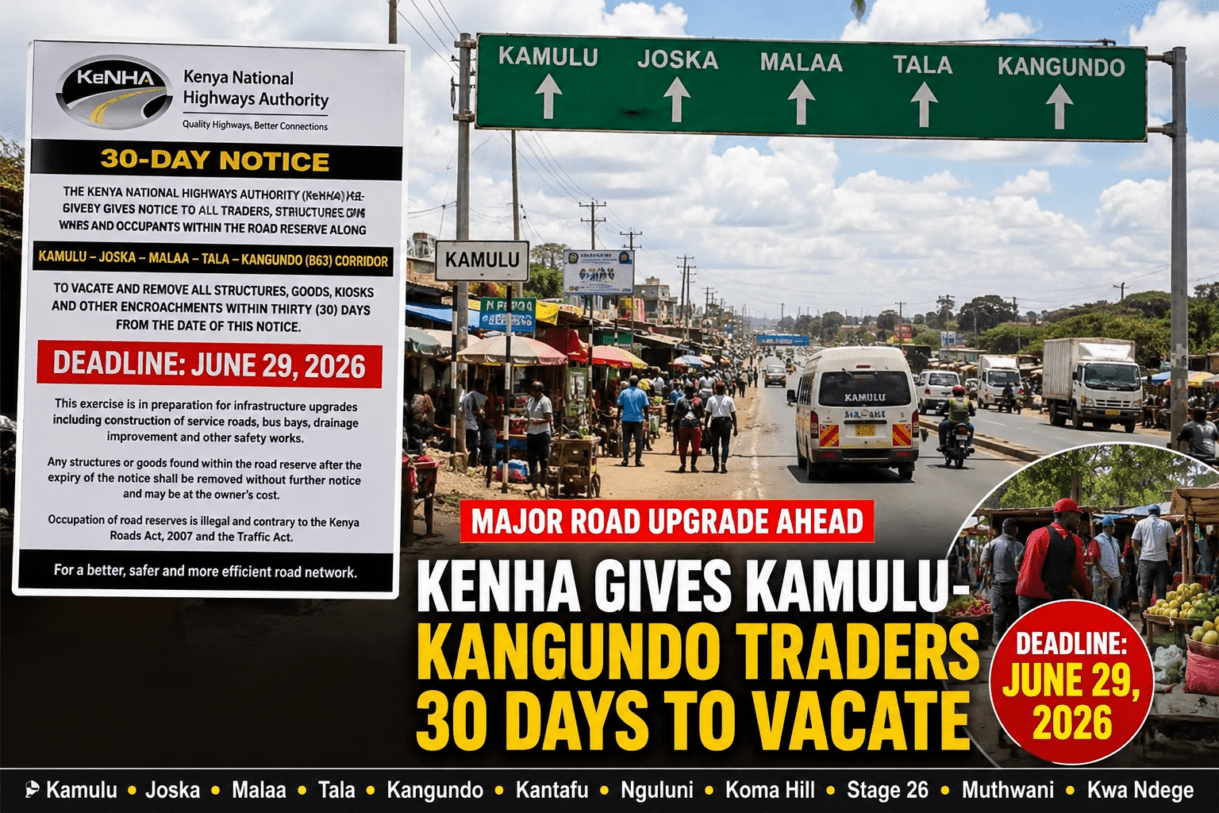
Hundreds of traders operating along the busy Kamulu-Kangundo road corridor have been given a 30-day ultimatum to vacate road reserves as the Kenya National Highways Authority (KeNHA) moves forward with plans to upgrade the crucial transport route.
The notice, which affects businesses and structures located within the designated road reserve, marks the beginning of a major infrastructure improvement project expected to transform transport and traffic flow across the rapidly growing region.
According to KeNHA, the exercise is intended to reclaim public land reserved for road expansion and safety improvements. The authority says the planned works will include the construction of service lanes, drainage systems, bus bays, pedestrian facilities, and other road safety features designed to improve mobility and reduce congestion.
Growing Corridor Faces Increasing Pressure
The Kamulu-Joska-Malaa-Tala-Kangundo corridor has experienced explosive growth over the past decade. What was once a relatively quiet route serving a handful of settlements has evolved into one of the fastest-growing residential and commercial zones on the outskirts of Nairobi.
As new housing developments, shopping centers, schools, and businesses continue to emerge, traffic volumes along the road have increased dramatically. Residents have repeatedly raised concerns about congestion, inadequate pedestrian facilities, poor drainage, and road safety challenges.
The planned improvements are expected to address many of these concerns while preparing the corridor for future growth.
However, the announcement has created uncertainty among traders who depend on roadside business activities for their daily income.
Areas Affected by the Notice
The eviction notice affects several key trading centers and settlements along the corridor, including Kamulu, Joska, Malaa, Kantafu, Nguluni, Tala, Kangundo Town, Koma Hill, Stage 26, Muthwani, and Kwa Ndege.
Many of these areas have witnessed a surge in informal and semi-permanent commercial structures over the years. Small shops, food kiosks, hardware stores, fruit vendors, and other businesses have established themselves close to the roadway to attract passing customers.
KeNHA argues that many of these structures have encroached on land legally reserved for road infrastructure and public safety purposes.
The authority has warned that any structures remaining after the expiry of the 30-day notice may be removed without further notice.
Why Road Reserves Matter
Road reserves are designated public spaces set aside for current and future road infrastructure development. They provide room for road expansion, utility installations, drainage systems, pedestrian walkways, and other transportation-related facilities.
When businesses or private developments occupy these areas, road authorities often face significant challenges when attempting to implement upgrades.
Experts note that encroachment on road reserves can contribute to numerous problems, including:
- Traffic congestion
- Increased accident risks
- Poor drainage and flooding
- Restricted visibility for motorists
- Delayed infrastructure projects
- Increased construction costs
By reclaiming these spaces, authorities hope to create safer and more efficient transport networks.
Traders Face Difficult Decisions
For many traders, the notice presents a difficult reality.
A significant number of businesses operating along the corridor depend heavily on roadside visibility and accessibility. Relocating could mean losing customers, incurring additional expenses, and rebuilding operations from scratch.
Some business owners have expressed concerns about the short timeline and the potential economic impact on families that rely on daily sales for survival.
Others have called on government agencies to provide alternative trading spaces or support mechanisms to ease the transition.
The coming weeks are expected to see increased discussions between affected traders, local leaders, and government officials as stakeholders seek practical solutions.
Road Upgrade Expected to Boost Economic Growth
Despite concerns surrounding the eviction notice, many residents have welcomed the planned road improvements.
The Kamulu-Kangundo corridor serves thousands of commuters traveling between Nairobi and eastern parts of Machakos County. Traffic congestion during peak hours has become a major challenge, with some motorists spending extended periods navigating bottlenecks.
Improved road infrastructure could significantly reduce travel times, improve safety, and enhance access to businesses and residential developments.
Property experts also predict that upgraded infrastructure may increase land values and attract new investment opportunities to the region.
Better roads often encourage commercial growth, improve access to services, and stimulate economic activity in surrounding communities.
Government Intensifies Crackdown on Encroachments
The Kamulu-Kangundo operation is part of a broader national effort by road authorities to reclaim public road reserves across Kenya.
In recent years, agencies have intensified enforcement measures targeting illegal structures erected on public infrastructure corridors. Similar notices have been issued in various parts of the country as authorities seek to create room for ongoing and future development projects.
Officials argue that protecting road reserves is critical for long-term urban planning and sustainable infrastructure development.
As Kenya’s urban population continues to grow, demand for improved transport networks is expected to increase significantly. Authorities say safeguarding public land today will help avoid costly disputes and project delays in the future.
What Happens Next?
Affected traders now have 30 days to remove structures, goods, and any other developments located within the designated road reserve.
During this period, authorities are expected to conduct inspections and sensitization efforts to ensure compliance.
Once the notice expires, enforcement teams may begin removing structures that remain within the affected areas.
For residents, motorists, and businesses along the corridor, the coming months could mark the beginning of a major transformation. While the transition may be challenging for some, many hope the planned upgrades will ultimately deliver safer roads, smoother traffic flow, and stronger economic growth throughout the region.
As the deadline approaches, all eyes will be on how traders, local leaders, and government agencies navigate the delicate balance between development and livelihoods.
SUGGESTED READS
- When Love Turns to Obsession: Understanding Paranoia in Relationships
- The Psychology of Guilt and Silent Burdens in Marriage
- The Spiritual Meaning of Repeating the Same Clothes — Especially Innerwear
- The Deep Spiritual Meaning of Someone Kissing Your Hand
- The Teenager Who Fooled the World: The Unbelievable Story of Frank Abagnale
- How a Harvard Teenager Accidentally Built One of the World’s Biggest Companies
- The Bird That Lived Without a Head for 18 Months

Support Our Website!
We appreciate your visit and hope you find our content valuable. If you’d like to support us further, please consider contributing through the TILL NUMBER: 9549825. Your support helps us keep delivering great content!
If you’d like to support Nabado from outside Kenya, we invite you to send your contributions through trusted third-party services such as Remitly, western union, SendWave, or WorldRemit. These platforms are reliable and convenient for international money transfers.
Please use the following details when sending your support:
Phone Number: +254701838999
Recipient Name: Peterson Getuma Okemwa
We sincerely appreciate your generosity and support. Thank you for being part of this journey!